Key Takeaway
Overhead conductor selection guide: ACSR vs AAC vs AAAC compared by strength, sag, corrosion resistance, and cost. Match conductor type to your span, voltage, and climate.
Conductor Selection Guide for Power Lines: How to Choose the Right Conductor
Choosing the right conductor for a power line project is one of the most consequential engineering decisions you will make. The conductor you select directly impacts line capacity, mechanical reliability, energy losses, and total lifecycle cost. Yet many buyers and project engineers find the selection process overwhelming — dozens of conductor types, competing standards, and trade-offs that shift depending on geography, voltage class, and local regulations.
This conductor selection guide breaks down the decision into a clear framework. Whether you are specifying conductors for a rural 11 kV distribution feeder or a 500 kV transmission backbone, you will find practical guidance on power line conductor types, sizing methodology, and the comparative strengths of each option.
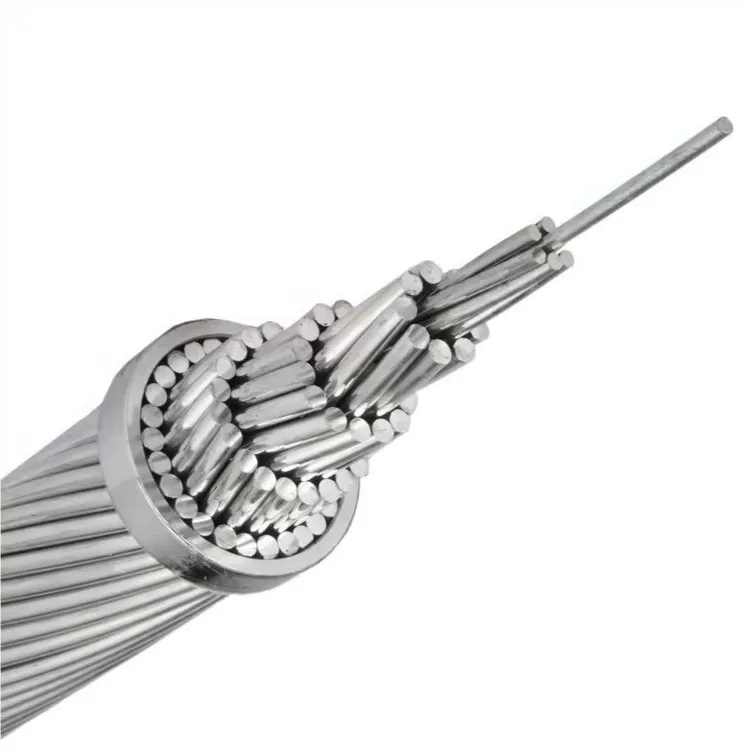
Why Conductor Selection Matters
The conductor typically represents 30–45% of the total cost of an overhead power line. Beyond the purchase price, a poor selection decision creates compounding costs:
- Higher resistive losses over the 40+ year service life of the line
- Premature sag that violates ground clearance requirements
- Corrosion failures in coastal or industrial atmospheres
- Overloading limitations that force expensive reconductoring years ahead of schedule
Getting conductor selection right the first time saves utilities and developers millions of dollars per project.
Understanding Power Line Conductor Types
Before applying a selection framework, you need to understand what is available. The four dominant conductor families for overhead power lines are:
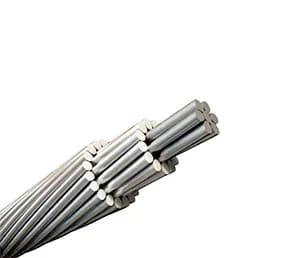
AAC — All Aluminium Conductor
AAC consists entirely of aluminium (typically EC-grade 1350-H19) wires stranded concentrically. It offers the highest conductivity per unit weight of any standard conductor but has relatively low tensile strength.
Best suited for:
- Short-span distribution lines (under 150 m spans)
- Urban areas with minimal wind and ice loading
- Coastal environments where steel cores would corrode
- Bus bars and substation connections
Limitations:
- Low strength-to-weight ratio limits span length
- Higher sag at elevated temperatures
- Not suitable for long river or valley crossings
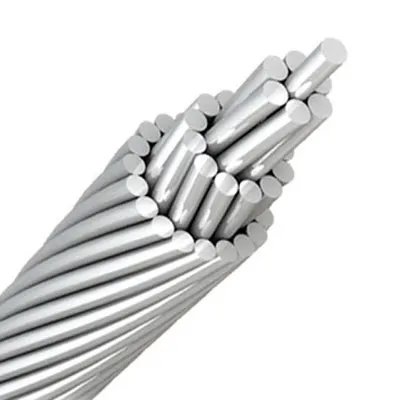
AAAC — All Aluminium Alloy Conductor
AAAC uses aluminium alloy (typically 6201-T81) wires instead of pure aluminium. The alloying process increases tensile strength by approximately 50% over AAC while maintaining good conductivity (about 52.5% IACS vs 61% for EC-grade aluminium).
Best suited for:
- Medium-span distribution and sub-transmission (150–400 m)
- Coastal and polluted environments
- Lines where corrosion of a steel core is a concern
- Replacement of ACSR where higher corrosion resistance is needed
Limitations:
- Lower conductivity than AAC for the same cross-section
- Higher cost per kilometer than AAC
- Still cannot match ACSR strength for very long spans
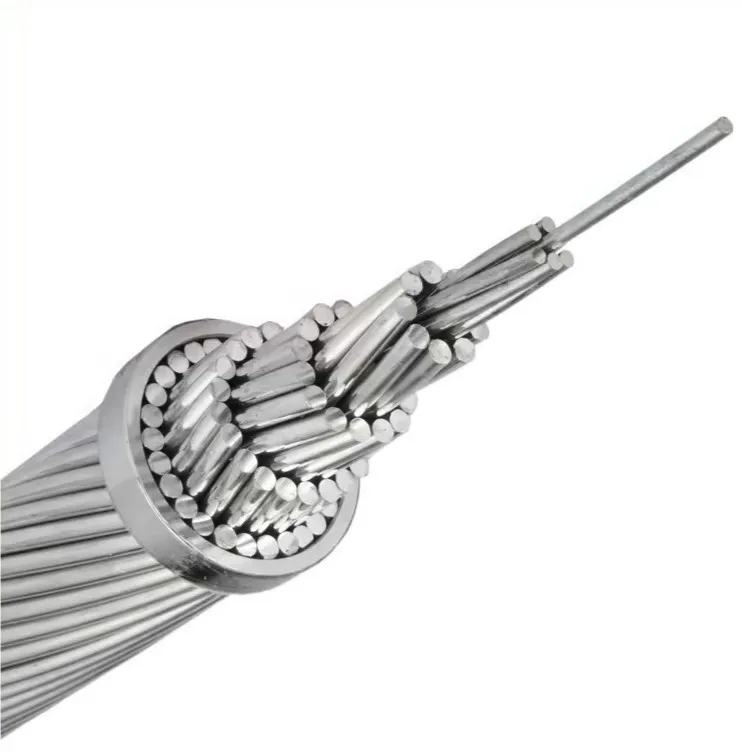
ACSR — Aluminium Conductor Steel Reinforced
ACSR combines an outer layer of aluminium wires (for current carrying) with a core of galvanized steel wires (for mechanical strength). This hybrid design has been the global workhorse for transmission lines since the early 20th century.
Best suited for:
- Long-span transmission lines (400 m+)
- High wind and ice loading zones
- River, valley, and mountain crossings
- EHV and UHV transmission (220 kV – 1000 kV)
Limitations:
- Steel core adds weight without carrying current
- Susceptible to corrosion in coastal/industrial environments (mitigated by greasing or aluminium-clad steel)
- Higher sag under thermal loading due to steel's thermal expansion
ACAR — Aluminium Conductor Alloy Reinforced
ACAR replaces the steel core of ACSR with aluminium alloy (6201) wires. This provides a middle ground — better corrosion resistance than ACSR, lighter weight, and both core and outer wires carry current.
Best suited for:
- Lines requiring higher ampacity than ACSR of the same diameter
- Moderate-span applications in corrosive environments
- Situations where all-aluminium construction is preferred but AAC lacks strength
Conductor Selection Framework: 7 Key Factors
How to choose a conductor systematically? Apply this seven-factor decision framework:
Factor 1: Voltage Class and Current Requirement
The voltage class of the line determines the minimum conductor diameter (for corona avoidance) and the current requirement determines the minimum cross-sectional area.
For voltages above 132 kV, corona discharge becomes the dominant sizing constraint. Bundled conductors (2, 3, 4, or 6 sub-conductors per phase) reduce the electric field gradient at the conductor surface.
Factor 2: Span Length and Terrain
Span length is the primary mechanical design driver. Longer spans require higher tensile strength to maintain acceptable sag.
For hilly or mountainous terrain with unequal span lengths, ACSR's high strength margin provides a safety buffer. In flat agricultural terrain with uniform spans, AAAC often delivers better whole-life economics.
Factor 3: Climate and Environmental Loading
Wind loading: Higher wind zones require higher breaking strength or reduced conductor diameter. Wind pressure increases with the square of wind speed.
Ice loading: In regions with ice accretion, the conductor must support its own weight plus ice load plus wind-on-ice. ACSR excels here due to its high ultimate tensile strength.
Temperature extremes: Conductors operating at high temperatures (above 75°C continuously) will sag more. If thermal uprating is anticipated, consider conductors with lower thermal expansion (e.g., ACSS, HTLS types).
Corrosion: Coastal zones, industrial pollutants (SO₂, H₂S), and desert salt flats attack exposed steel. In such environments, choose:
- AAAC (no steel to corrode)
- ACSR with aluminium-clad steel core (ACS/Alumoweld)
- Greased ACSR (grease-filled core gaps)
Factor 4: Electrical Losses and Efficiency
Resistive losses (I²R) over the lifetime of a conductor can exceed its purchase cost several times over. Selecting a conductor with lower resistance reduces losses and pays for itself.
For heavily loaded lines (capacity factor > 50%), invest in larger conductor cross-sections. The loss reduction typically pays back within 5–8 years.
Factor 5: Sag and Clearance Requirements
Every conductor sags under its own weight and additional loading. Sag increases with:
- Higher operating temperature
- Longer span
- Lower conductor tension
- Greater conductor weight per unit length
National electrical safety codes specify minimum ground clearances. Your conductor selection must ensure clearances are maintained at the maximum operating temperature (usually 75°C or 100°C for emergency rating).
Sag comparison (400 m span, 75°C):
As this table shows, AAC's higher sag often requires taller (more expensive) towers. ACSR's superior strength-to-weight ratio keeps sag manageable.
Factor 6: Corrosion and Service Life
Target service life for most overhead lines is 40–60 years. Conductor selection must account for cumulative environmental degradation.
Factor 7: Total Lifecycle Cost
The true cost of a conductor includes:
- Purchase cost — material price per km
- Installation cost — heavier conductors need stronger towers and larger stringing equipment
- Loss cost — I²R losses over 40 years at prevailing energy cost
- Maintenance cost — inspections, re-tensioning, corrosion monitoring
- Replacement cost — probability-weighted cost of premature failure
For most projects, loss cost dominates when the capacity factor exceeds 40%. This frequently justifies spending more on a larger or more conductive conductor upfront.
Decision Matrix: Choosing by Application
How to Size a Conductor: Step-by-Step Process
Once you have identified the conductor type, follow these steps to select the specific size:
Step 1: Determine Maximum Current
Calculate the maximum continuous current the line must carry, including future load growth (typically 2–3% per year for 10–15 years).
I_design = I_present × (1 + growth_rate)^planning_horizon
Step 2: Check Thermal Rating
Verify that the chosen conductor's thermal rating (ampacity) at the specified ambient temperature and wind conditions exceeds I_design.
Ampacity depends on:
- Ambient temperature
- Wind speed and direction
- Solar radiation
- Conductor emissivity and absorptivity
- Maximum allowable temperature
Step 3: Verify Voltage Drop
For distribution lines, voltage drop may be the limiting constraint rather than thermal capacity. Check that the voltage drop at maximum current does not exceed the permissible limit (typically 5% for LV, 3% for MV).
Step 4: Check Corona Performance
For lines above 66 kV, calculate the corona onset voltage and ensure it exceeds the maximum operating voltage under fair weather conditions. Increase conductor diameter or use bundled conductors if corona is a concern.
Step 5: Mechanical Design Check
Perform sag-tension calculations for:
- Maximum temperature (determines clearance)
- Maximum ice + wind (determines maximum tension)
- Everyday condition (determines vibration susceptibility)
Ensure the everyday tension does not exceed 20–25% of the conductor's rated breaking strength to avoid aeolian vibration damage.
Step 6: Economic Optimization
Compare 2–3 candidate sizes on a total lifecycle cost basis. Use the Kelvin economic conductor size formula as a starting point:
A_economic = I × √(ρ × cost_energy × hours × loss_factor / (cost_conductor × rate_of_return))
This often shows that one size larger than the minimum thermal size is the economic optimum.
Interested in this product?
Need help selecting the right conductor for your project? Our engineering team provides free technical consultation and can recommend the optimal conductor based on your specific line parameters.Conductor Comparison: ACSR vs AAAC vs AAC
This is the most common comparison buyers face. Here is a detailed head-to-head:
Key takeaways:
- Choose AAC when spans are short, corrosion is a concern, and maximum conductivity is needed.
- Choose AAAC when you need better strength than AAC without the corrosion vulnerability of steel.
- Choose ACSR when span length, wind loading, or ice loading dominate the design, and corrosion is manageable.
Special Conductor Types for Advanced Applications
High-Temperature Low-Sag (HTLS) Conductors
For reconductoring existing lines to increase capacity without rebuilding towers, HTLS conductors operate at 150–250°C with minimal additional sag:
- ACSS — Aluminium Conductor Steel Supported (annealed aluminium, can operate to 200°C+)
- ACCR — Aluminium Conductor Composite Reinforced (aluminium-matrix composite core)
- ACCC — Aluminium Conductor Composite Core (carbon fiber core)
These cost 2–5× more than standard ACSR but avoid the enormous expense of tower replacement.
Aerial Bundled Cable (ABC)
For urban and suburban distribution, aerial bundled cable eliminates the need for cross-arms and insulators while dramatically improving safety. ABC consists of insulated phase conductors bundled around a bare or insulated messenger wire.
ABC is the preferred choice for:
- Areas with dense tree cover
- Urban streets with limited right-of-way
- Regions with high theft/tampering rates
- Safety-critical zones (schools, markets)
Common Conductor Selection Mistakes
Mistake 1: Optimizing only for purchase price. The cheapest conductor per km often has the highest lifecycle cost due to losses.
Mistake 2: Ignoring future load growth. A conductor sized for today's load becomes a bottleneck in 5–10 years. Always design for projected demand.
Mistake 3: Using ACSR in coastal environments without protection. Standard galvanized steel corrodes rapidly in salt air. Specify aluminium-clad steel or switch to AAAC.
Mistake 4: Exceeding recommended everyday tension. High-strung conductors suffer aeolian vibration damage. Keep everyday tension below 20–25% of UTS.
Mistake 5: Neglecting thermal derating for high ambient temperatures. Ampacity tables assume 25–35°C ambient. In tropical regions (40–50°C ambient), ampacity drops 15–25%.
International Standards for Conductor Selection
When specifying conductors internationally, always reference the applicable standard and confirm that the manufacturer holds relevant test certifications.
Frequently Asked Questions
Q: What is the most commonly used conductor for transmission lines?
ACSR remains the most widely used conductor for transmission lines globally, accounting for over 60% of installed overhead line conductor. Its combination of high strength, proven reliability, and competitive cost makes it the default choice for spans above 200 m.
Q: How do I choose between ACSR and AAAC?
Choose ACSR when you need maximum mechanical strength — long spans, heavy ice loading, mountainous terrain, or EHV/UHV voltages requiring bundled conductors. Choose AAAC when corrosion resistance is critical, spans are moderate (under 400 m), and you want a lighter conductor that reduces tower loading.
Q: What conductor is best for coastal areas?
AAAC is the safest choice for coastal installations because it contains no steel that can corrode. If ACSR must be used (for very long spans), specify aluminium-clad steel (ACS) core wires and grease-filled construction.
Q: Can I increase line capacity without replacing towers?
Yes. HTLS conductors (ACSS, ACCC, ACCR) can carry 1.5–2× the current of standard ACSR at the same sag. They are designed specifically for reconductoring projects where tower modifications must be minimized.
Q: What size conductor do I need for a 33 kV line carrying 20 MVA?
At 33 kV three-phase, 20 MVA corresponds to approximately 350 A. A conductor with at least 400 A thermal rating is appropriate (allowing margin). This corresponds to approximately 150–185 mm² ACSR or AAAC, depending on ambient conditions.
Q: How does conductor selection affect power cable versus overhead line decisions?
Conductor selection applies specifically to overhead lines. When comparing overhead versus underground, the conductor type influences the overhead option's cost and performance. Underground power cables use different insulation systems (XLPE, EPR) and have separate selection criteria including thermal resistivity of surrounding soil.
Q: What is the difference between conductor size in mm² and AWG/MCM?
Most international projects use metric sizing (mm² of aluminium cross-section). North American practice uses MCM (thousands of circular mils) or AWG for smaller sizes. For example, ACSR "Drake" is 795 MCM, equivalent to approximately 468 mm² aluminium area.
Conclusion
Conductor selection for power lines requires balancing electrical, mechanical, environmental, and economic factors. No single conductor type is optimal for all situations. Use the seven-factor framework in this guide to systematically evaluate your project requirements, then apply the decision matrix to narrow your choice.
For most projects:
- Distribution in clean environments: AAAC offers the best all-around performance
- Distribution in corrosive environments: AAAC or ABC
- Transmission with long spans: ACSR remains the proven standard
- Capacity upgrades on existing lines: HTLS conductors avoid tower replacement
The conductor you select today will serve for 40+ years. Invest the time to get it right.
Interested in this product?
Request a quotation for AAC, AAAC, ACSR, or ABC conductors. Our factory supplies to IEC 61089 and GB/T 1179 standards with full test reports and competitive pricing for project quantities.Related Products & Resources
Product Categories
- Aerial Cable Products — Full range of overhead conductors: AAC, AAAC, ACSR, ACAR, and ABC
- Power Cable Products — Underground XLPE power cables for when overhead is not feasible
- Control Cable Products — PVC and armoured control cables for substations and switchgear
Related Articles
- ACSR Conductor: Complete Specifications & Factory Price Guide — The most widely used overhead conductor
- AAC vs AAAC Conductor Specifications — Compare all-aluminium conductor options
- ABC Cable: Aerial Bundled Conductor Guide — Insulated overhead distribution cable
- Overhead Transmission Line Cable Types — All conductor types for transmission lines
- XLPE Insulated Overhead Cable Guide — Covered conductors for MV distribution
- 4 Core Armoured Cable: SWA/STA Specifications — Underground armoured power cable sizing guide
- XLPE Power Cable Manufacturer Guide — Underground power cable alternative
- Cable Insulation Types Comparison — PVC vs XLPE vs EPR insulation
- How to Import Cable from China — Complete sourcing and logistics guide
- 3 Phase Power Cable: Complete Sizing Guide — underground 3 phase cable specifications and motor sizing