Key Takeaway
4 core armoured cable size chart from 1.5mm² to 800mm² with current ratings for SWA & STA types. Includes SWA vs STA selection guide, voltage drop calculator, and IEC/BS standard references. Get factory-direct pricing from a 45-year Chinese manufacturer.
Looking for 4 core armoured cable with verified specifications and competitive factory pricing? This guide covers everything procurement engineers and project managers need: full size charts from 1.5mm2 to 800mm2, current carrying capacities for every installation method, the key differences between SWA and STA armouring, and what to look for when sourcing from a Chinese manufacturer.
We produce 4 core armoured cables at our Henan factory — ranked among the top 10 XLPE cable manufacturers in China — certified to IEC 60502-1, BS 5467, and GB/T 12706. Our annual output exceeds 15,000 km of armoured cable across all voltage classes. Below is what we know from manufacturing and exporting to projects across Africa, the Middle East, and Southeast Asia.
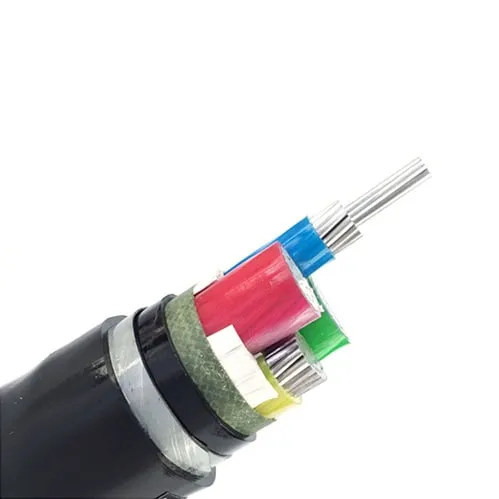
What Is 4 Core Armoured Cable?
A 4 core armoured cable is a power cable containing four insulated copper or aluminium conductors, protected by a metallic armour layer (steel wire or steel tape) beneath an outer PVC or LSZH sheath. The "4 core" configuration is specifically designed for three-phase power distribution with a neutral conductor.
Construction layers (outside to inside):
- Outer sheath - PVC (standard) or LSZH (low smoke environments) - provides UV, moisture, and chemical protection
- Steel armour - galvanised steel wires (SWA) or steel tape (STA) - delivers mechanical protection against impact, compression, and rodent damage
- Bedding - PVC layer between armour and insulation cores - prevents armour from damaging insulation
- Insulation - XLPE (cross-linked polyethylene) - rated for 90°C continuous conductor temperature
- Conductors - 4× stranded copper (Class 2 per BS EN 60228) or solid aluminium (Class 1)
Why 4 cores?
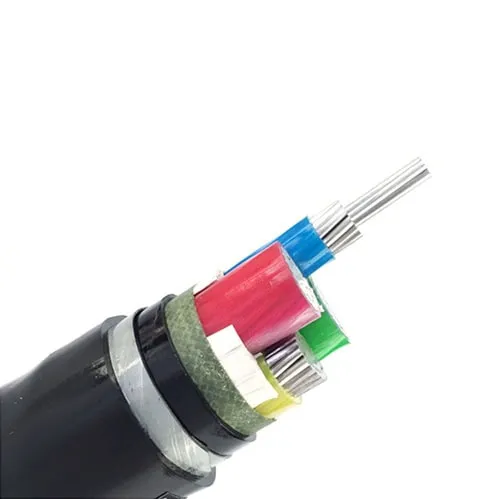
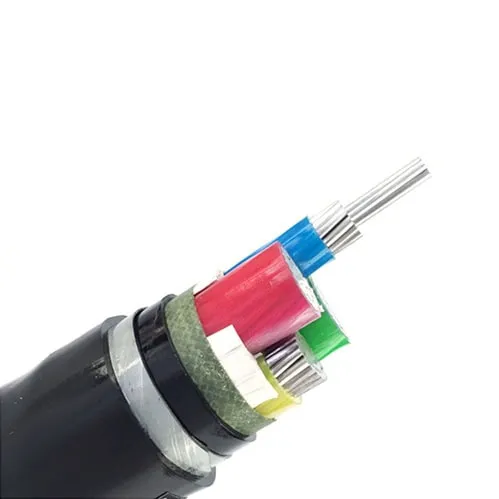
In a three-phase electrical system, you need three phase conductors (L1, L2, L3) plus a neutral (N). A 4 core cable carries all four in one run - eliminating the need for separate neutral cables and reducing installation labour and cost. For installations requiring an earth conductor, a 5 core cable (3 phases + neutral + earth) or the steel armour itself (used as CPC in BS 7671 installations) provides the earth path.
Core identification colours (per BS 7671 / IEC 60446):
- Brown (L1), Black (L2), Grey (L3), Blue (Neutral)
4 Core Armoured Cable Specifications & Size Chart
The following table provides complete specifications for 4 core copper conductor XLPE/SWA/PVC armoured cables manufactured to IEC 60502-1. All values are based on standard production parameters.
Physical Dimensions & Weight
| Conductor Size (mm2) | Insulation Thickness (mm) | Armour Wire Ø (mm) | Overall Cable Ø (mm) | Weight (kg/km) |
|---|---|---|---|---|
| 1.5 | 0.7 | 0.9 | 15.0 | 415 |
| 2.5 | 0.7 | 0.9 | 16.0 | 490 |
| 4 | 0.7 | 0.9 | 17.0 | 600 |
| 6 | 0.7 | 0.9 | 19.0 | 815 |
| 10 | 0.7 | 1.25 | 22.0 | 1,070 |
| 16 | 0.7 | 1.6 | 25.0 | 1,540 |
| 25 | 0.9 | 1.6 | 26.5 | 1,985 |
| 35 | 0.9 | 1.6 | 29.0 | 2,475 |
| 50 | 1.0 | 1.6 | 32.5 | 3,100 |
| 70 | 1.1 | 2.0 | 38.0 | 4,480 |
| 95 | 1.1 | 2.0 | 42.5 | 5,750 |
| 120 | 1.2 | 2.5 | 48.0 | 7,460 |
| 150 | 1.4 | 2.5 | 52.5 | 8,810 |
| 185 | 1.6 | 2.5 | 58.5 | 10,780 |
| 240 | 1.7 | 2.5 | 67.0 | 13,930 |
| 300 | 1.8 | 2.5 | 72.0 | 16,850 |
| 400 | 2.0 | 3.15 | 83.0 | 22,230 |
| 500 | 2.2 | 3.15 | 91.0 | 27,500 |
| 630 | 2.4 | 3.15 | 101.0 | 34,100 |
| 800 | 2.6 | 3.15 | 113.0 | 43,200 |
Data per IEC 60502-1 Design 1, copper conductor, XLPE insulated, PVC sheathed. Actual values may vary ±5% depending on conductor class and manufacturing tolerances.
Current Carrying Capacity (Ampacity)
Current ratings below are for 4 core cables operating at three-phase AC, with a maximum conductor temperature of 90°C (XLPE insulation).
| Conductor Size (mm2) | Clipped Direct (A) | In Free Air (A) | Direct Buried (A) |
|---|---|---|---|
| 1.5 | 23 | 25 | 21 |
| 2.5 | 31 | 33 | 28 |
| 4 | 42 | 44 | 36 |
| 6 | 53 | 56 | 44 |
| 10 | 73 | 78 | 58 |
| 16 | 94 | 99 | 75 |
| 25 | 124 | 131 | 96 |
| 35 | 154 | 162 | 115 |
| 50 | 187 | 197 | 135 |
| 70 | 238 | 251 | 167 |
| 95 | 289 | 304 | 197 |
| 120 | 335 | 353 | 223 |
| 150 | 386 | 406 | 251 |
| 185 | 441 | 463 | 281 |
| 240 | 520 | 546 | 324 |
| 300 | 599 | 628 | 365 |
| 400 | 673 | 728 | - |
| 500 | 770 | 833 | - |
| 630 | 878 | 950 | - |
| 800 | 990 | 1070 | - |
Reference conditions:
- Ambient air temperature: 30°C
- Ground temperature: 20°C
- Burial depth: 0.5m
- Soil thermal resistivity: 1.2 K·m/W
- Single circuit, no grouping
If installing multiple cables in the same trench or ambient temperatures differ, apply derating factors per IEC 60364-5-52 or BS 7671 Appendix 4.
Voltage Drop (mV/A/m) - Three-Phase
| Conductor Size (mm2) | Voltage Drop (mV/A/m) |
|---|---|
| 1.5 | 27 |
| 2.5 | 16 |
| 4 | 10 |
| 6 | 6.8 |
| 10 | 4.0 |
| 16 | 2.5 |
| 25 | 1.65 |
| 35 | 1.15 |
| 50 | 0.87 |
| 70 | 0.60 |
| 95 | 0.45 |
| 120 | 0.37 |
| 150 | 0.30 |
| 185 | 0.26 |
| 240 | 0.21 |
| 300 | 0.185 |
| 400 | 0.170 |
| 500 | 0.140 |
| 630 | 0.115 |
| 800 | 0.095 |
Data based on BS 7671 Table 4E4B / IEC 60364 reference method D (direct buried) and C (clipped direct). For exact project calculations, request our technical data sheets with conductor resistance and reactance values.
Conductor Resistance at 20°C
| Conductor Size (mm2) | Max. DC Resistance (Ω/km) - Copper | Max. DC Resistance (Ω/km) - Aluminium |
|---|---|---|
| 1.5 | 12.1 | - |
| 2.5 | 7.41 | - |
| 4 | 4.61 | - |
| 6 | 3.08 | - |
| 10 | 1.83 | 3.08 |
| 16 | 1.15 | 1.91 |
| 25 | 0.727 | 1.20 |
| 35 | 0.524 | 0.868 |
| 50 | 0.387 | 0.641 |
| 70 | 0.268 | 0.443 |
| 95 | 0.193 | 0.320 |
| 120 | 0.153 | 0.253 |
| 150 | 0.124 | 0.206 |
| 185 | 0.0991 | 0.164 |
| 240 | 0.0754 | 0.125 |
| 300 | 0.0601 | 0.100 |
| 400 | 0.0470 | 0.0778 |
| 500 | 0.0366 | 0.0605 |
| 630 | 0.0283 | 0.0469 |
| 800 | 0.0221 | 0.0367 |
Values per BS EN 60228, Class 2 stranded copper conductors and Class 1 solid/Class 2 stranded aluminium conductors.
Types of 4 Core Armoured Cable
4 core armoured cables are classified by armour type, insulation material, voltage rating, and conductor material. Here is how they break down:
By Armour Type
| Type | Full Name | Construction | Best For |
|---|---|---|---|
| SWA | Steel Wire Armoured | Helically applied galvanised steel round wires | Underground burial, areas with high mechanical risk |
| STA | Steel Tape Armoured | Two layers of galvanised steel tape, helically wound | Indoor/duct installations, lighter mechanical protection |
| AWA | Aluminium Wire Armoured | Aluminium round wires | Single-core cables (non-magnetic requirement) |
By Insulation
| Insulation | Max. Conductor Temp. | Short Circuit Temp. | Standard |
|---|---|---|---|
| XLPE | 90°C | 250°C | IEC 60502-1, BS 5467 |
| PVC | 70°C | 160°C | IEC 60502-1, BS 6346 |
| LSZH | 90°C | 250°C | BS 6724, IEC 60332 |
XLPE is the industry standard for new installations. It offers higher current capacity (90°C vs 70°C), better short-circuit performance, and lower dielectric losses compared to PVC. For a full comparison of all insulation materials, see our cable insulation types comparison. We manufacture PVC-insulated cables for replacement/maintenance projects but recommend XLPE for all new builds.
By Voltage Rating
| Voltage Class | Designation | Typical Application |
|---|---|---|
| 0.6/1kV | Low voltage | Building services, distribution boards, industrial |
| 1.9/3.3kV | Medium voltage | Industrial plant feeders, motor connections |
| 3.8/6.6kV | Medium voltage | Primary distribution, substation interconnects |
| 6.35/11kV | Medium voltage | Utility distribution networks |
This article focuses on 0.6/1kV cables - the most commonly procured type for construction and industrial projects. For medium voltage 4 core cables, see our XLPE power cable guide.
By Conductor Material
| Material | Conductivity | Weight | Cost | Best For |
|---|---|---|---|---|
| Copper (Cu) | 100% IACS | Heavier | Higher | Most applications, especially where space is limited |
| Aluminium (Al) | 61% IACS | ~50% lighter | ~40% less | Long runs where weight/cost matters, utility distribution |
Practical guidance: For conductor sizes ≤16mm2, copper is standard. For ≥25mm2, aluminium becomes economically viable - but you need one size larger to match copper's current capacity (e.g., 95mm2 Al ≈ 70mm2 Cu in ampacity).
Applications of 4 Core Armoured Cable
4 core SWA cable is the default choice for three-phase power distribution in construction and infrastructure. Here are the primary applications:
Underground Power Distribution
Direct burial in trenches at 500mm depth (domestic) or 600mm+ (commercial). The steel armour provides protection against spade strikes, ground movement, and rodent attack. No additional conduit is required for most installations.
Industrial Plant Wiring
Feeding motors, panels, and machinery in factories, warehouses, and processing plants. The armour protects against forklift impact, vibration, and accidental damage in high-traffic areas.
Building Services
Main incoming supply from transformer to distribution board. Sub-main distribution from main board to floor/zone distribution boards in commercial buildings, hospitals, and data centres.
Infrastructure Projects
- Road lighting circuits
- Water pumping stations
- Sewage treatment plants
- Telecommunications tower power feeds
- Solar farm DC collection (with appropriate voltage rating)
- Mining and quarry installations
External Above-Ground Installations
Clipped to cable trays, ladders, or structures in outdoor environments. The PVC sheath provides UV resistance and the armour prevents mechanical damage from wind-borne debris or accidental impact.
Real Project Installation Scenarios
These are based on cables we have supplied and the specifications our customers confirmed:
Scenario 1: Shopping Mall Main Incoming Supply (Nigeria)
- Cable: 4×300mm2 Cu/XLPE/SWA/PVC
- Standard: BS 5467
- Run length: 85m from utility transformer to main switchboard
- Installation: Direct buried at 600mm depth in sand-bedded trench
- Load: 500A three-phase supply, 0.6/1kV
- Why this size: 300mm2 gives 599A clipped direct - adequate headroom above 500A design current after 0.9 grouping factor (single circuit, no derating needed)
Scenario 2: Water Treatment Plant (Saudi Arabia)
- Cable: 4×70mm2 Cu/XLPE/SWA/PVC
- Standard: BS 5467
- Application: Feeding 55kW pump motors from MCC
- Installation: On cable trays inside plant, then transition to direct burial for 40m outdoor run to pump house
- Why this size: Motor FLC 98A at 415V, 70mm2 rated 238A clipped - ample margin for motor starting current
Scenario 3: Residential Compound Distribution (UAE)
- Cable: 4×16mm2 Cu/XLPE/SWA/PVC
- Standard: BS 5467
- Application: Sub-main from compound distribution board to individual villa DBs
- Run length: 45m average per villa
- Load: 63A per villa connection
- Voltage drop check: 2.5 mV/A/m × 63A × 45m / 1000 = 7.1V (1.7% of 415V) - well within 5% limit
Scenario 4: Solar Farm Collection Circuit (Kenya)
- Cable: 4×35mm2 Al/XLPE/SWA/PVC
- Standard: IEC 60502-1
- Application: Connecting string inverter outputs to central collection switchboard
- Run length: 200m
- Why aluminium: Long runs, cost-sensitive project, cable tray installation with minimal mechanical risk
Size selection guide by application:
| Application | Typical Size Range | Notes |
|---|---|---|
| Domestic sub-main | 16-25mm2 | Short runs, less than 100A demand |
| Small commercial incoming | 35-70mm2 | 100-250A TPN supply |
| Industrial motor feed | 10-95mm2 | Match motor FLC + starting current |
| Large commercial/industrial main | 120-300mm2 | High-demand buildings, multiple floors |
| Utility distribution | 185-800mm2 | Primary substations, bulk supply |
How to Choose the Right 4 Core Armoured Cable
Selecting the correct cable involves five key decisions:
1. Determine Required Current Capacity
Calculate the maximum design current (Ib) for the circuit. Include diversity factors where applicable. Then select a cable whose current rating (Iz) exceeds Ib after applying all derating factors:
Iz ≥ Ib / (Ca × Cg × Ci × Cc)
Where:
- Ca = ambient temperature correction factor
- Cg = grouping factor (multiple cables in same trench)
- Ci = thermal insulation factor
- Cc = burial depth correction factor
2. Check Voltage Drop
Verify the voltage drop does not exceed permitted limits:
- BS 7671: 5% from origin to final circuit (3% for lighting)
- IEC 60364: typically 4% distribution + 4% final circuit
Formula: Vd = (mV/A/m) × Ib × L / 1000
If voltage drop exceeds limits, go up one cable size.
3. Verify Short-Circuit Rating
The cable must withstand fault current for the duration of protective device clearance time. Use the adiabatic equation:
S ≥ √(I2t) / k
Where k = 143 for copper/XLPE, and I2t is the let-through energy of the protective device.
4. Select Armour Type (SWA vs STA)
- Choose SWA for underground burial, outdoor, or any location with significant mechanical risk. See our SWA armoured cable product page for full specifications.
- Choose STA for indoor ducts, cable trays, or where lighter weight is preferred
(See detailed comparison below)
5. Choose Conductor Material
- Copper - default for sizes ≤16mm2, premium performance, smaller diameter
- Aluminium - cost-effective for ≥50mm2, lighter, larger diameter requires bigger glands
SWA vs STA: Detailed Comparison
This is one of the most common questions we receive from procurement teams. For a deeper dive into SWA cable construction, installation, and gland sizing, see our dedicated SWA cable buying guide. Here is the definitive comparison:
| Parameter | SWA (Steel Wire Armoured) | STA (Steel Tape Armoured) |
|---|---|---|
| Armour construction | Round galvanised steel wires, helically applied | Two layers of steel tape, helically wound with gap |
| Mechanical strength | Superior - withstands direct impact, crushing | Moderate - protects against light mechanical damage |
| Tensile strength | High - can support cable's own weight in vertical runs | Lower - not suitable for vertical suspension |
| Flexibility | Less flexible, larger bend radius | More flexible, smaller bend radius |
| Weight | Heavier | ~10-15% lighter |
| Diameter | Larger (due to round wire profile) | Slightly smaller |
| Earth fault capacity | Higher - wire armour has greater cross-section | Lower - tape has limited earth fault current capacity |
| Best applications | Underground, outdoor, industrial, high-risk | Indoor, ducts, cable trays, risers |
| Cost | Slightly higher | Slightly lower |
| Cable designation | e.g., XLPE/PVC/SWA/PVC | e.g., XLPE/PVC/STA/PVC |
When to Use SWA
- Direct burial underground (no conduit)
- Outdoor installation exposed to mechanical risk
- Industrial environments (factories, mines, quarries)
- Where armour is used as circuit protective conductor (CPC)
- Vertical cable runs (cable must support own weight)
For the complete product range and datasheets, visit our SWA cable product page.
When to Use STA
- Cable ducts and enclosed trenches
- Indoor cable tray/ladder installations
- Where lower weight and tighter bending radius matter
- Applications requiring only basic mechanical protection
- Multi-core cables (3+ cores) where SWA would be excessively stiff
Our recommendation: If you are unsure, specify SWA. It costs marginally more but covers virtually all installation scenarios. STA is appropriate only when you are certain the cable will not face significant mechanical stress.
Standards & Certifications
Our 4 core armoured cables are manufactured and tested to the following international standards:
| Standard | Scope | Market |
|---|---|---|
| IEC 60502-1 | Power cables 1kV-3kV, construction and testing | International |
| BS 5467 | XLPE insulated armoured cables 0.6/1kV and 1.9/3.3kV | UK, Commonwealth, Middle East |
| BS 6346 | PVC insulated armoured cables 0.6/1kV | UK (legacy installations) |
| GB/T 12706 | XLPE insulated power cables 1kV-35kV | China |
| NFC 33-226 | Power cables for underground installation | France, North/West Africa |
| SANS 1507 | Low voltage power cables | South Africa |
| AS/NZS 5000.1 | Power cables for underground use | Australia, New Zealand |
Our factory certifications:
- ISO 9001:2015 Quality Management
- ISO 14001:2015 Environmental Management
- CCC (China Compulsory Certification)
- CE Marking
- SGS and BV third-party test reports available
All cables are subjected to routine testing including:
- Conductor resistance measurement
- High voltage withstand test (3.5kV for 5 minutes)
- Insulation resistance test (≥100 MΩ·km)
- Spark test on insulation and sheath
- Dimensional verification
Type test reports to IEC 60502-1 Clause 18 are available upon request.
Which Standard to Specify by Region
Choosing the right cable standard depends on where your project is located. Here is a practical guide for procurement teams:
Middle East & GCC (Saudi Arabia, UAE, Qatar, Oman, Kuwait, Bahrain)
Primary standard: BS 5467 (XLPE/SWA/PVC)
Most GCC countries follow British electrical standards due to historical influence. Specify BS 5467 for low-voltage armoured cables. Saudi Electricity Company (SEC) and DEWA (Dubai) both accept BS 5467 cables. Some projects also accept IEC 60502-1 - confirm with the consulting engineer.
Africa (Nigeria, Kenya, Tanzania, Ghana, Uganda, South Africa)
Primary standard: BS 5467 (East/West Africa) or SANS 1507 (South Africa)
Former British colonies predominantly use BS standards. South Africa uses SANS 1507 (aligned with IEC but with local modifications). Nigerian projects typically specify BS 5467 with SONCAP certification. For our complete Africa supply experience, see our armoured cable manufacturer page.
Southeast Asia (Philippines, Vietnam, Indonesia, Myanmar, Cambodia)
Primary standard: IEC 60502-1
Most Southeast Asian countries have adopted IEC standards directly. The Philippines uses PEC (Philippine Electrical Code) which references IEC. Vietnam uses TCVN standards aligned with IEC. We supply IEC 60502-1 certified cables with test reports accepted across the region.
Australia & New Zealand
Primary standard: AS/NZS 5000.1
Australian standards have specific requirements for conductor stranding, sheath marking, and fire performance that differ from IEC/BS. Cables must carry the AS/NZS mark. We manufacture to AS/NZS 5000.1 for the Australian market with appropriate certification.
UK & Europe
Primary standard: BS 5467 (UK) / IEC 60502-1 with national annexes (EU)
The UK maintains BS 5467 as the primary specification. Continental Europe generally follows IEC 60502-1 with country-specific amendments. France uses NFC 33-226 for underground cables. Germany references VDE 0276-603.
Latin America (Mexico, Colombia, Peru, Chile, Brazil)
Primary standard: IEC 60502-1 or local equivalent (NOM in Mexico, NBR in Brazil)
Most Latin American countries have adopted IEC standards with local certification requirements. Mexico requires NOM marking. Brazil uses NBR standards (heavily IEC-aligned). We provide cables with appropriate documentation for customs clearance in each market.
Not sure which standard your project needs? Send us the project location and end-client name - our technical team will confirm the correct specification within 24 hours.
Factory Direct Pricing
You buy directly from our manufacturing facility - no trading companies, no middlemen. This typically means 20-35% lower cost compared to sourcing through distributors or trading houses, as detailed in our comparison of Nexans vs Chinese cable manufacturers. We control every step from copper rod drawing to final cable packaging.
Production Capacity
Our factory operates 12 production lines dedicated to low-voltage armoured cables. Monthly output capacity for 4 core armoured cable alone exceeds 2,000 km. This means:
- Standard sizes (4mm2-95mm2) ship from stock
- Non-standard configurations manufactured within 15-20 working days
- Large project orders (100+ km) handled without capacity constraints
Quality Control
Every production drum undergoes:
- 100% spark testing during insulation and sheath extrusion
- Conductor resistance verification per drum
- Sample high-voltage testing per production batch
- Third-party inspection welcome (SGS, BV, TÜV)
Export Experience
We have shipped armoured cables to 45+ countries. We understand:
- Documentation requirements (commercial invoice, packing list, certificate of origin, test reports)
- Shipping logistics (standard wooden drums, container loading plans, weight distribution)
- Local standard compliance (BS, IEC, NFC, SANS - we produce to whatever standard your project requires)
Technical Support
Our engineering team assists with:
- Cable sizing calculations for your specific project
- Custom cable designs (non-standard conductor sizes, special sheath colours, LSZH requirements)
- Installation guidance and bending radius calculations
- Test report interpretation and compliance documentation
Frequently Asked Questions
What is the difference between 4 core and 3+1 core armoured cable?
A true 4 core cable has four conductors of equal cross-sectional area. A 3+1 core cable (also called 3.5 core) has three full-size phase conductors plus a reduced neutral conductor (typically 50% of phase conductor area). The 3+1 configuration is used when neutral current is expected to be low - for example, balanced three-phase motor loads. For general distribution where neutral current may be significant (single-phase loads connected between phases and neutral), use full 4 core. See our 3 phase power cable sizes and specifications guide for complete sizing tables across all core configurations.
Can I use the SWA armour as an earth conductor?
Yes, in many jurisdictions (including under BS 7671 in the UK), the steel wire armour can serve as the circuit protective conductor (CPC) provided its cross-sectional area is adequate for the expected earth fault current. The armour must be properly terminated using brass cable glands at both ends to maintain earth continuity. For STA cables, the tape armour generally has insufficient cross-section to serve as sole CPC - a separate earth conductor is recommended.
What is the minimum bending radius for 4 core SWA cable?
Per IEC 60502-1 and BS 5467, the minimum bending radius for multicore armoured cables is 6× the overall cable diameter during installation (8× for single-core armoured). For example, a 4×95mm2 cable with 42.5mm overall diameter has a minimum bend radius of 255mm (approximately 510mm diameter). During fixed installation (no further movement), 4× diameter is acceptable.
How deep should 4 core armoured cable be buried?
Standard burial depths per BS 7671 and IEC 60364:
- Under roads/driveways: 600mm minimum
- In gardens/fields: 500mm minimum
- Under building foundations: Not recommended without ducting
- Lay cable on 50mm of fine sand, cover with 50mm sand, then place cable marker tape 150mm above
The cable's steel armour provides mechanical protection, but depth provides additional safety margin against spade/excavator damage. For complete underground installation methods including ducted, direct burial, and HDD techniques, see our underground power cable installation guide.
What size 4 core armoured cable do I need for 100A three-phase supply?
For a 100A three-phase supply, you need a cable with current rating ≥100A after applying derating factors. Looking at the current rating table:
- Direct buried: 35mm2 (115A) is marginal - go to 50mm2 (135A) for adequate margin
- Clipped in air: 25mm2 (124A) works but has minimal headroom - 35mm2 (154A) is safer
- Always apply grouping and ambient temperature factors to confirm
What is the maximum operating temperature?
- XLPE insulated (standard): 90°C continuous, 250°C short-circuit (5 seconds)
- PVC insulated: 70°C continuous, 160°C short-circuit
XLPE allows approximately 20% higher current rating than PVC for the same conductor size due to the higher operating temperature limit.
How do I calculate cable weight for shipping?
Use our weight table above and multiply by the length in km. Add approximately 8-12% for the wooden cable drum weight. For example:
- 1,000m of 4×95mm2 SWA = 5,750 kg cable + ~600 kg drum ≈ 6,350 kg total
- Standard 20ft container capacity: approximately 20-22 tonnes
- Standard 40ft container capacity: approximately 25-27 tonnes (volume limited for smaller sizes)
Contact us with your quantity and we will provide an optimised container loading plan.
Do you supply aluminium conductor 4 core armoured cable?
Yes. We manufacture aluminium conductor armoured cables from 10mm2 upward. Aluminium 4 core cables are popular for utility distribution and long-run industrial feeders where weight and cost savings are priorities. Available in both SWA and STA configurations, manufactured to the same IEC 60502-1 / BS 5467 standards as our copper range.
What is the MOQ for 4 core armoured cable orders?
For standard sizes (4mm2 to 240mm2 copper SWA), we keep stock and can supply from 1 drum (1000m standard length). For non-standard specifications or aluminium conductors, the minimum production run is generally 3-5km. Contact our sales team for current stock availability and lead times for your specific requirement.
What documentation do you provide with each shipment?
Every shipment includes: factory routine test report per IEC 60502-1 (conductor resistance, HV withstand, insulation resistance, spark test), Mill Test Certificate with material traceability, packing list with drum numbers and lengths, and commercial invoice. Third-party inspection reports (SGS, Bureau Veritas, Intertek) arranged on request at buyer's cost. We also provide cable data sheets and installation guides in PDF format.
How do you pack 4 core armoured cable for export?
Cables are wound on heavy-duty wooden or steel cable drums depending on cable weight and size. Steel drums are used for armoured export cable; wooden drums for lighter specifications. Container loading follows an optimised plan to maximise payload while maintaining safe weight distribution. Standard drum length: 1000m (shorter lengths available for sizes above 240mm² due to weight limits).
Request a Quote
Need pricing for your project? Provide the following details and our team will respond within 24 hours with a competitive FOB quotation:
- Conductor size(s) and material (copper/aluminium)
- Number of cores
- Voltage rating
- Required standard (IEC/BS/NFC/other)
- Quantity (metres or km)
- Delivery destination
We supply 4 core armoured cable in all standard sizes from 1.5mm2 to 800mm2, in both SWA and STA configurations, with copper or aluminium conductors. Custom requirements - including special sheath colours, LSZH variants, and non-standard conductor sizes - are available on request.
Contact us for factory direct pricing →
Related Products
- XLPE Power Cable - Our full range of low and medium voltage power cables
- Control Cable - Multi-core cables for instrumentation and control circuits
- Fire Resistant Cable - IEC 60331 fire-rated cables for critical circuits
Related Articles
- SWA Cable Applications: Underground, Industrial & Commercial Use Cases - Where and why to use steel wire armoured cable across 9 industry sectors
- XLPE Power Cable Manufacturer Guide: Factory Specifications & Pricing - Deep dive into XLPE insulation technology and medium voltage cable selection
- Cable Insulation Types Comparison: XLPE vs PVC vs EPR - Understand the differences between insulation materials for power cables
- How to Import Cable from China: Complete Buyer's Guide - Logistics, inspection, and procurement process for importing cables
- 3 Phase Power Cable Sizing Guide - 3-core, 3+1, and 3+2 cable specifications from 1.5 to 800mm2
- Underground Power Cable Types & Installation Guide - Burial depth, methods, and cable protection for underground applications
- Cable Size Chart: mm², AWG & Ampacity - Cross-reference sizing between metric and AWG systems
- 11kV Cable Specifications & Size Chart - Medium voltage armoured cable sizing for 11kV networks
- Top 10 XLPE Cable Manufacturers in China - Leading Chinese armoured cable factories compared