Key Takeaway
Armoured cable from certified China factory: 4 core SWA 16–300mm², 3 core STA, XLPE/PVC insulation. IEC 60502 & BS 5467. Competitive FOB pricing.
Armoured Cable: Complete Buying Guide from China's Leading Cable Factory
When sourcing armoured cable for infrastructure, industrial, or commercial projects, procurement professionals need a supplier that delivers certified quality, competitive pricing, and reliable lead times. At chinacablefactory.com, we manufacture and supply the full range of armoured cables — from single-core underground power cables to multi-core steel wire armoured cable for heavy industrial applications — direct from our production facilities in China.
This guide covers everything a buyer needs to know: construction, specifications, standards compliance, sizing, applications, and how to select the right armoured cable for your project.
What Is Armoured Cable?
Armoured cable is a power or control cable with an additional layer of mechanical protection — typically steel tape armour (STA) or steel wire armour (SWA) — designed to resist physical damage, crushing, and rodent attack. This makes armoured cable suitable for direct burial, outdoor installation, and harsh industrial environments where standard PVC-sheathed cables would be vulnerable.
The armour layer sits between the inner sheath (bedding) and the outer sheath (serving), providing a robust barrier without compromising electrical performance.
Key Characteristics of Armoured Cable
- Mechanical protection against impact, crushing, and penetration
- Suitable for direct burial without additional conduit
- Resistance to moisture ingress when properly terminated
- Available in low voltage (0.6/1kV) and medium voltage (up to 33kV) ratings
- Multi-core and single-core configurations
- Compliant with international standards (IEC, BS, GB)
Armoured Cable Construction: Layer-by-Layer Breakdown
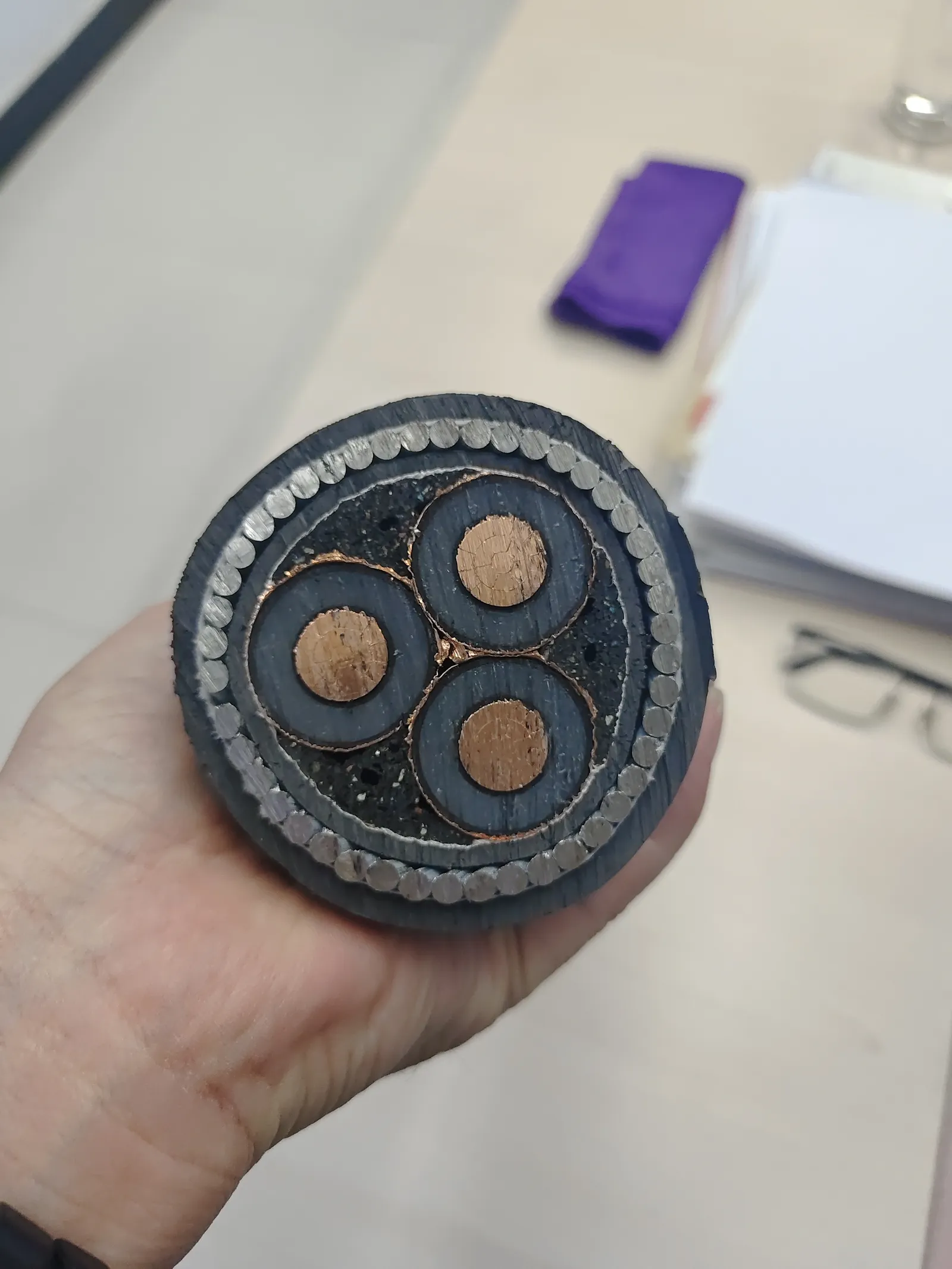
Understanding the construction of armoured cable helps buyers specify the right product for their application. Each layer serves a distinct purpose.
1. Conductor
The current-carrying core. Available in:
- Copper (Cu): Higher conductivity (56 m/Ω·mm²), preferred for most applications
- Aluminium (Al): Lighter weight, lower cost, suitable for larger cross-sections
Conductor class options per IEC 60228:
- Class 1: Solid conductor (up to 10mm²)
- Class 2: Stranded conductor (standard for most sizes)
- Class 5: Flexible stranded (for flexible armoured cables)
2. Conductor Insulation
Electrically isolates each conductor. Common materials:
- PVC (Polyvinyl Chloride): Rated to 70°C continuous. Cost-effective for standard applications.
- XLPE (Cross-Linked Polyethylene): Rated to 90°C continuous. Higher current carrying capacity, better moisture resistance, preferred for underground and high-load applications.
3. Inner Sheath (Bedding)
A layer of PVC or similar material applied over the laid-up cores. It provides:
- A smooth, round surface for armour application
- Separation between insulation and metal armour
- Additional moisture protection
4. Armour Layer
The defining feature. Two main types:
Steel Tape Armour (STA)
- Two layers of galvanized steel tape, wound helically in opposite directions
- Provides protection against crushing and rodent attack
- Used on multi-core cables (3-core, 4-core, 5-core)
- Lighter than wire armour
- Designated as "STA" in cable codes
Steel Wire Armour (SWA)
- Single layer of galvanized steel wires applied helically
- Superior tensile strength — resists pulling forces during installation
- Used on both single-core and multi-core cables
- Required for single-core AC cables (to avoid eddy current heating in steel tape)
- Designated as "SWA" in cable codes
Important note for single-core cables: Steel wire armour for single-core AC cables must use non-magnetic materials (aluminium wire armour, AWA) or be designed to avoid circulating currents. Standard galvanized steel wire armour is used for single-core DC cables or multi-core AC cables.
5. Outer Sheath (Serving)
The final external layer, typically black PVC, providing:
- Protection of armour against corrosion
- Additional mechanical protection
- Chemical resistance
- UV resistance for outdoor installations
Armoured Cable Specification: Standards & Compliance
Our armoured cables are manufactured to international standards. Buyers should specify the applicable standard based on their project location and regulatory requirements.
IEC Standards (International)
| Standard | Scope |
|---|---|
| IEC 60502-1 | Power cables with extruded insulation, rated voltages 1kV to 3kV |
| IEC 60502-2 | Power cables with extruded insulation, rated voltages 6kV to 30kV |
| IEC 60228 | Conductor specifications (class, resistance) |
| IEC 60332 | Fire performance tests (flame propagation) |
| IEC 60811 | Non-metallic material tests |
BS Standards (British / widely used in Africa, Middle East, Asia)
| Standard | Scope |
|---|---|
| BS 5467 | PVC insulated, armoured cables for voltages up to 1000V |
| BS 6724 | XLPE insulated, LSZH sheathed, armoured cables up to 1000V |
| BS 6622 | XLPE insulated cables for rated voltages 6.35/11kV to 19/33kV |
| BS 7846 | XLPE insulated, armoured, LSZH sheathed, 600/1000V |
GB Standards (Chinese National Standards)
| Standard | Scope |
|---|---|
| GB/T 12706.1 | XLPE insulated power cables, rated voltage 1kV to 3kV |
| GB/T 12706.2 | XLPE insulated power cables, rated voltage 6kV to 35kV |
GB standards are technically harmonized with IEC 60502 and are accepted in many markets alongside IEC certification.
Certification & Testing
All cables from chinacablefactory.com undergo:
- Routine testing per applicable standard (conductor resistance, voltage withstand, insulation resistance)
- Type testing as required
- Third-party certification available (SGS, BV, TUV, KEMA)
- Factory audit reports available upon request
Armoured Cable Sizes: Complete Range
We manufacture armoured cable across the full range of conductor cross-sections and core counts demanded by the market.
Available Conductor Cross-Sections
1.5mm², 2.5mm², 4mm², 6mm², 10mm², 16mm², 25mm², 35mm², 50mm², 70mm², 95mm², 120mm², 150mm², 185mm², 240mm², 300mm², 400mm², 500mm², 630mm²
Available Core Counts
- 1-core (single core) — for medium voltage and specific LV applications
- 2-core — for single-phase circuits
- 3-core — for three-phase circuits without neutral
- 3+1 core — three-phase with reduced neutral
- 3+2 core — three-phase with reduced neutral and earth
- 4-core — three-phase with full neutral (most popular for LV distribution)
- 4+1 core — three-phase with full neutral and earth
- 5-core — three-phase with neutral and earth
- Multi-core control cables — 7, 12, 19, 27, 37 cores (for instrumentation and control)
Popular Armoured Cable Sizes for LV Distribution
| Cable Designation | Cores × Cross-Section | Typical Application |
|---|---|---|
| 4×16mm² SWA | 4 core × 16mm² | Sub-main distribution, small commercial |
| 4×25mm² SWA | 4 core × 25mm² | Commercial building supply |
| 4×35mm² SWA | 4 core × 35mm² | Industrial feeder |
| 4×50mm² SWA | 4 core × 50mm² | Medium industrial loads |
| 4×70mm² SWA | 4 core × 70mm² | Large commercial/industrial |
| 4×95mm² SWA | 4 core × 95mm² | Heavy industrial distribution |
| 4×120mm² SWA | 4 core × 120mm² | Main incoming supply |
| 4×150mm² SWA | 4 core × 150mm² | High-capacity feeder |
| 4×185mm² SWA | 4 core × 185mm² | Substation interconnection |
| 4×240mm² SWA | 4 core × 240mm² | Primary distribution |
| 4×300mm² SWA | 4 core × 300mm² | High-capacity main supply |
4 Core Armoured Cable: The Industry Workhorse
The 4 core armoured cable is the most widely specified configuration for low-voltage three-phase power distribution. It carries three phase conductors plus one neutral conductor, all protected by steel wire armour.
Why 4 Core Armoured Cable Is the Default Choice
- Supports three-phase + neutral in a single cable run
- Earth continuity provided by the armour itself (when properly bonded)
- Eliminates need for separate earth conductor in most installations
- Available in both copper and aluminium conductors
- Cost-effective compared to running separate single-core cables
4 Core Armoured Cable Specification Table (Cu/XLPE/SWA/PVC, 0.6/1kV)
| Size (mm²) | Conductor Resistance (Ω/km, max, 20°C) | Current Rating (A, buried direct) | Overall Diameter (approx. mm) | Weight (approx. kg/km) |
|---|---|---|---|---|
| 4×4mm² | 4.61 | 37 | 19.5 | 590 |
| 4×6mm² | 3.08 | 47 | 20.8 | 700 |
| 4×10mm² | 1.83 | 64 | 23.0 | 920 |
| 4×16mm² | 1.15 | 84 | 25.8 | 1180 |
| 4×25mm² | 0.727 | 110 | 29.8 | 1580 |
| 4×35mm² | 0.524 | 134 | 32.8 | 1970 |
| 4×50mm² | 0.387 | 163 | 36.5 | 2530 |
| 4×70mm² | 0.268 | 201 | 41.0 | 3320 |
| 4×95mm² | 0.193 | 244 | 45.8 | 4350 |
| 4×120mm² | 0.153 | 280 | 50.0 | 5280 |
| 4×150mm² | 0.124 | 316 | 54.0 | 6250 |
| 4×185mm² | 0.0991 | 355 | 58.8 | 7500 |
| 4×240mm² | 0.0754 | 415 | 65.5 | 9500 |
| 4×300mm² | 0.0601 | 470 | 71.0 | 11400 |
Note: Current ratings are indicative for direct burial at 20°C soil temperature, 1.0m depth, soil thermal resistivity 1.0 K·m/W. Actual ratings depend on installation conditions. Refer to IEC 60502-1 and IEC 60287 for derating factors.
4 Core vs 3+1 Core: What's the Difference?
| Feature | 4 Core (Equal) | 3+1 Core (Reduced Neutral) |
|---|---|---|
| Neutral size | Same as phase conductors | Reduced (typically 50-70% of phase) |
| Application | Balanced and unbalanced loads | Predominantly balanced three-phase loads |
| Cost | Higher (more copper/aluminium) | Lower |
| Weight | Heavier | Lighter |
| When to choose | Single-phase loads present, LED lighting, harmonic-rich loads | Motor loads, balanced distribution |
Steel Wire Armoured Cable: Construction & Advantages
Steel wire armoured cable (SWA cable) uses individual galvanized steel wires as the armour layer, providing superior mechanical protection compared to steel tape armour.
SWA vs STA: Selection Guide
| Property | Steel Wire Armour (SWA) | Steel Tape Armour (STA) |
|---|---|---|
| Mechanical strength | High tensile and impact resistance | Good crush resistance, lower tensile |
| Flexibility | Moderate | Good |
| Weight | Heavier | Lighter |
| Single-core AC cables | Not recommended (galvanized steel) | Not suitable |
| Multi-core cables | Preferred for larger sizes and burial | Common for smaller sizes |
| Installation | Direct burial, ducts, cable trays | Indoor, trays, moderate environments |
| Pulling tension | Higher tolerance | Lower tolerance |
| Cost | Slightly higher | Slightly lower |
When to Specify Steel Wire Armoured Cable
- Direct burial installations without additional mechanical protection
- Long cable runs where pulling tension is a factor
- Areas subject to ground movement or settlement
- Industrial environments with heavy traffic or machinery vibration
- Subsea or waterway crossings (with appropriate outer sheath)
Applications of Armoured Cable
Armoured cable serves a wide range of industries and installation scenarios. Below are the primary applications by sector.
Power Distribution & Utilities
- Underground mains distribution (11kV and 33kV XLPE armoured)
- Low-voltage feeder cables from substations to buildings
- Street lighting circuits
- Rural electrification schemes
Construction & Buildings
- Main incoming supply to commercial and residential buildings
- Sub-main distribution between distribution boards
- External lighting and power to outbuildings
- Car park and basement power distribution
Industrial & Manufacturing
- Power supply to motors, pumps, and heavy machinery
- Process plant wiring
- Mining operations (underground and surface)
- Petrochemical installations (with appropriate ratings)
Infrastructure & Transport
- Airport runway lighting
- Railway signalling and power
- Port and dock installations
- Tunnel lighting and ventilation systems
Renewable Energy
- Solar farm collector cables
- Wind farm inter-array cables
- Battery energy storage system (BESS) connections
Oil, Gas & Petrochemical
- Refineries and processing plants
- Pipeline cathodic protection
- Offshore platform power distribution (with appropriate certification)
How to Select the Right Armoured Cable: Procurement Checklist
Selecting the correct armoured cable requires balancing technical requirements with commercial considerations. Use this checklist when preparing your specification.
Step 1: Determine Voltage Rating
- 0.6/1kV: Standard low-voltage distribution
- 3.8/6.6kV: Medium voltage distribution
- 6.35/11kV: Primary distribution (most common MV)
- 12.7/22kV: Sub-transmission
- 19/33kV: Transmission-level distribution
Step 2: Select Conductor Material
- Copper: Higher conductivity, smaller diameter for same rating, easier to terminate, required where space is limited
- Aluminium: 60% lighter, significantly lower material cost, preferred for larger cross-sections (≥50mm²) where weight and cost savings are substantial
Step 3: Choose Insulation Type
- PVC (70°C): Lower cost, suitable for general indoor/outdoor use, limited to 70°C
- XLPE (90°C): Higher current rating for same cross-section, better moisture resistance, preferred for direct burial, mandatory for medium voltage
Step 4: Determine Core Configuration
- Single-core: MV applications, large LV feeders where parallel runs are needed
- 2-core: Single-phase circuits
- 3-core: Three-phase without neutral (motors)
- 3+1: Three-phase with reduced neutral (balanced loads)
- 4-core: Three-phase with full neutral (general distribution)
- 5-core: Three-phase with neutral and earth
Step 5: Select Cross-Section
Based on:
- Load current (ampacity requirement)
- Voltage drop limits (typically 3-5% maximum)
- Short-circuit rating
- Future load growth allowance
Step 6: Specify Armour Type
- SWA: Default for direct burial, long runs, heavy mechanical stress
- STA: Acceptable for indoor, tray, or lighter-duty applications
- AWA (Aluminium Wire Armour): Required for single-core AC cables
Step 7: Confirm Standards & Certification
- Which standard applies to your market? (IEC, BS, or local)
- Do you need third-party test reports?
- Are there specific fire performance requirements? (LSZH, IEC 60332-3)
Armoured Cable Comparison: PVC vs XLPE Insulated
| Parameter | PVC Insulated Armoured | XLPE Insulated Armoured |
|---|---|---|
| Max conductor temperature | 70°C | 90°C |
| Short-circuit temperature | 160°C | 250°C |
| Current carrying capacity | Baseline | 15-25% higher than PVC (same size) |
| Moisture resistance | Good | Excellent |
| Dielectric loss | Higher | Lower |
| Voltage range | Up to 1kV | Up to 33kV |
| Flexibility | More flexible | Slightly stiffer |
| Cost | Lower | Higher (offset by smaller size for same load) |
| Recommended for | Indoor, general LV | Direct burial, MV, high-load LV |
For most armoured cable applications in Africa, Middle East, and Southeast Asia where ambient temperatures are high, XLPE insulation is strongly recommended as it provides better thermal performance and longer service life in hot climates.
Installation Considerations for Armoured Cable
Direct Burial
- Minimum depth: 500mm under driveways, 600mm under roads (check local regulations)
- Cable should be bedded in fine sand or sieved soil (no sharp stones)
- Warning tape placed 300mm above cable
- Minimum bending radius: 12× cable diameter for multi-core SWA
Cable Tray & Ladder
- Armoured cables can be run on open cable tray without additional conduit
- Ensure tray is rated for cable weight
- Maintain spacing for thermal derating if multiple cables run together
Termination & Glands
- Cable glands must match armour type (SWA gland for wire armour, STA gland for tape armour)
- Indoor glands: CW type (4-part)
- Outdoor/weatherproof glands: CXT type or equivalent
- Gland size matches cable outer diameter — refer to gland selection charts
Earthing
- Steel wire armour provides an effective earth path when properly bonded at both ends
- Armour earth continuity must be tested at commissioning
- For single-core cables: armour bonded at one end only (to avoid circulating currents) or cross-bonded on long routes
Armoured Cable for Specific Markets
Africa
African markets commonly specify cables to BS 5467 (PVC) or BS 6724 (XLPE/LSZH). Key requirements:
- Nigeria: SON certification preferred, BS standards widely referenced
- Kenya/Tanzania/Uganda: BS standards, KEBS certification for Kenya
- Ghana: Ghana Standards Authority marking
- South Africa: SANS 10142 installation standard, SABS certification
We supply to all major African markets with documentation packages tailored to local authority requirements.
Middle East
Middle Eastern projects often require:
- BS or IEC standards compliance
- XLPE insulation mandatory for buried cables (high ambient temperatures). Refer to our underground cable installation guide for Middle East burial depth requirements.
- Fire-rated options (LSZH) for buildings and tunnels
- Specific utility approvals (DEWA, ADDC, SEC, KAHRAMAA)
Southeast Asia
Southeast Asian markets typically reference:
- IEC standards (primary)
- Local standards (TCVN for Vietnam, TIS for Thailand, SNI for Indonesia, MS for Malaysia)
- High humidity and flood resistance considerations
- Tropical rating considerations for current capacity
Medium Voltage Armoured Cable (6kV to 33kV)
For medium voltage applications, armoured cable construction includes additional layers:
MV Cable Construction
- Conductor — stranded copper or aluminium
- Conductor screen — semi-conducting layer for electric field uniformity
- XLPE insulation — primary dielectric
- Insulation screen — semi-conducting layer
- Metallic screen — copper tape or wire screen for fault current path
- Bedding — PVC or PE inner sheath
- Armour — SWA or STA
- Outer sheath — PVC or PE
Common MV Armoured Cable Specifications
| Voltage Rating | Standard | Conductor Range | Typical Application |
|---|---|---|---|
| 3.8/6.6kV | IEC 60502-2 / BS 6622 | 35–400mm² | Industrial plant distribution |
| 6.35/11kV | IEC 60502-2 / BS 6622 | 50–630mm² | Primary distribution network |
| 12.7/22kV | IEC 60502-2 | 50–630mm² | Utility sub-transmission |
| 19/33kV | IEC 60502-2 / BS 6622 | 95–630mm² | Transmission-level distribution |
Why Source Armoured Cable from China?
China is the world's largest cable manufacturing market, producing over 30% of global cable output. Benefits of sourcing from chinacablefactory.com:
Manufacturing Capability
- Production capacity: Multiple production lines covering 1.5mm² to 630mm² conductor sizes
- Voltage range: 0.6/1kV through 33kV
- Annual output: Capacity to fulfill large-volume orders for infrastructure projects
- Equipment: Advanced extrusion lines (CCV/VCV for XLPE), stranding machines, armouring lines, testing equipment
Quality Assurance
- ISO 9001:2015 certified quality management system
- ISO 14001 environmental management
- In-house testing laboratory with:
- High voltage test sets (AC and DC)
- Partial discharge measurement
- Conductor resistance measurement
- Insulation resistance testing
- Hot set testing for XLPE
- Ageing ovens
- Tensile testing machines
- Third-party inspection welcomed (SGS, BV, Intertek)
Supply Chain Advantages
- Direct access to raw material suppliers (copper rod, aluminium rod, PVC compound, XLPE compound)
- Vertically integrated production reduces lead time
- Flexible order quantities for project-based purchasing
- Consolidation of multiple cable types in one shipment
Export Experience
- Exported to 50+ countries across Africa, Middle East, Southeast Asia, South America
- Familiar with destination port requirements and documentation
- Packaging options: wooden drums, steel drums, or coils per customer requirement
- Cable marking and print legends customized per buyer specification
Packaging & Shipping
Drum Packaging
- Standard wooden drums (non-returnable) for export
- Steel drums available for larger cables or repeat shipments
- Drum sizes matched to cable length and container optimization
- Each drum labeled with: cable type, length, drum number, gross/net weight, production date
Container Loading
- 20ft container: typically 18-22 tonnes, depending on drum dimensions
- 40ft container: typically 24-26 tonnes
- Flat rack or open-top containers for oversized drums
- Loading plan provided before shipment for buyer approval
Documentation Package
- Commercial invoice and packing list
- Certificate of origin
- Bill of lading
- Test reports (routine test certificates per drum/length)
- Certificate of compliance to specified standard
- Material certificates (conductor, insulation) on request
- Third-party inspection certificate (if ordered)
Frequently Asked Questions
What is the difference between SWA and STA armoured cable?
SWA (Steel Wire Armoured) uses individual steel wires wound helically, providing superior tensile strength. STA (Steel Tape Armoured) uses flat steel tapes. SWA is preferred for direct burial and applications requiring high pulling tension. STA is lighter and suitable for less demanding environments.
Can armoured cable be installed without conduit?
Yes. The armour layer provides mechanical protection, allowing direct burial or surface mounting without additional conduit. This is one of the primary advantages of armoured cable.
What is the minimum bending radius for armoured cable?
For multi-core armoured cables, the minimum bending radius is typically 12 times the overall cable diameter during installation. For single-core armoured cables, it is typically 15 times the diameter. Always check the manufacturer's datasheet for specific cable types.
Do I need a separate earth conductor with armoured cable?
In most LV installations, the steel wire armour serves as the circuit protective conductor (earth) when properly terminated with cable glands and bonded to the earthing system. However, local regulations may require additional earth conductors in certain applications.
What temperature rating should I specify for hot climates?
XLPE insulation (90°C rated) is strongly recommended for hot climates. Current carrying capacity must be derated for ambient temperatures above 30°C. For ground temperatures above 20°C (common in Africa and Middle East), derating factors per IEC 60287 should be applied.
Can you supply cables to multiple standards in one order?
Yes. We regularly fulfill project orders containing cables manufactured to different standards (e.g., BS 5467 for LV and BS 6622 for MV) within a single shipment.
How do I get pricing for armoured cable?
Contact our sales team via chinacablefactory.com with your cable schedule (type, size, length, standard, quantity). We provide quotations within 24-48 hours for standard specifications.
Request a Quote
View full product specifications: SWA Armoured Cable — All Sizes & Standards →
Ready to source armoured cable for your next project? Whether you need 4 core armoured cable for a commercial development, steel wire armoured cable for underground distribution, or a full cable schedule covering multiple armoured cable sizes and specifications — our team is ready to provide competitive factory-direct pricing.
To request a quote, provide:
- Cable type and standard (e.g., 4×95mm² Cu/XLPE/SWA/PVC to BS 5467)
- Total length required (metres or kilometres)
- Destination port
- Project timeline
- Any specific certification requirements
Contact us at chinacablefactory.com for pricing, technical datasheets, and sample test reports.
chinacablefactory.com — Your direct source for quality armoured cable from China. Serving contractors, distributors, and project buyers across Africa, Middle East, and Southeast Asia.
Related Reading
- SWA Cable Applications: Where & Why to Use Steel Wire Armoured Cable — 9 industry sectors where SWA cable is required
- 3 Phase Power Cable Sizes & Specifications — Complete 3-core and 3+1 armoured cable sizing guide
- 4 Core Armoured Cable: SWA & STA Specifications — Full size chart with current ratings 1.5–800mm²
- Underground Power Cable Types & Installation — Direct burial methods and depth requirements
- Cable Insulation Types Comparison — XLPE vs PVC vs EPR for armoured cables
- Prysmian vs Chinese Manufacturers: 30%+ Cost Saving — Same IEC standard, lower price
- Southwire vs Chinese Manufacturers — Specifications & import pricing compared
- Cable Size Chart: mm² to AWG & Ampacity — Universal conductor sizing reference