Key Takeaway
Complete medium voltage cable guide: 11kV, 33kV & 35kV XLPE insulated MV cable. Single-core & 3-core, copper screen, IEC 60502-2. DNO distribution network supply. Factory-direct pricing from China manufacturer.
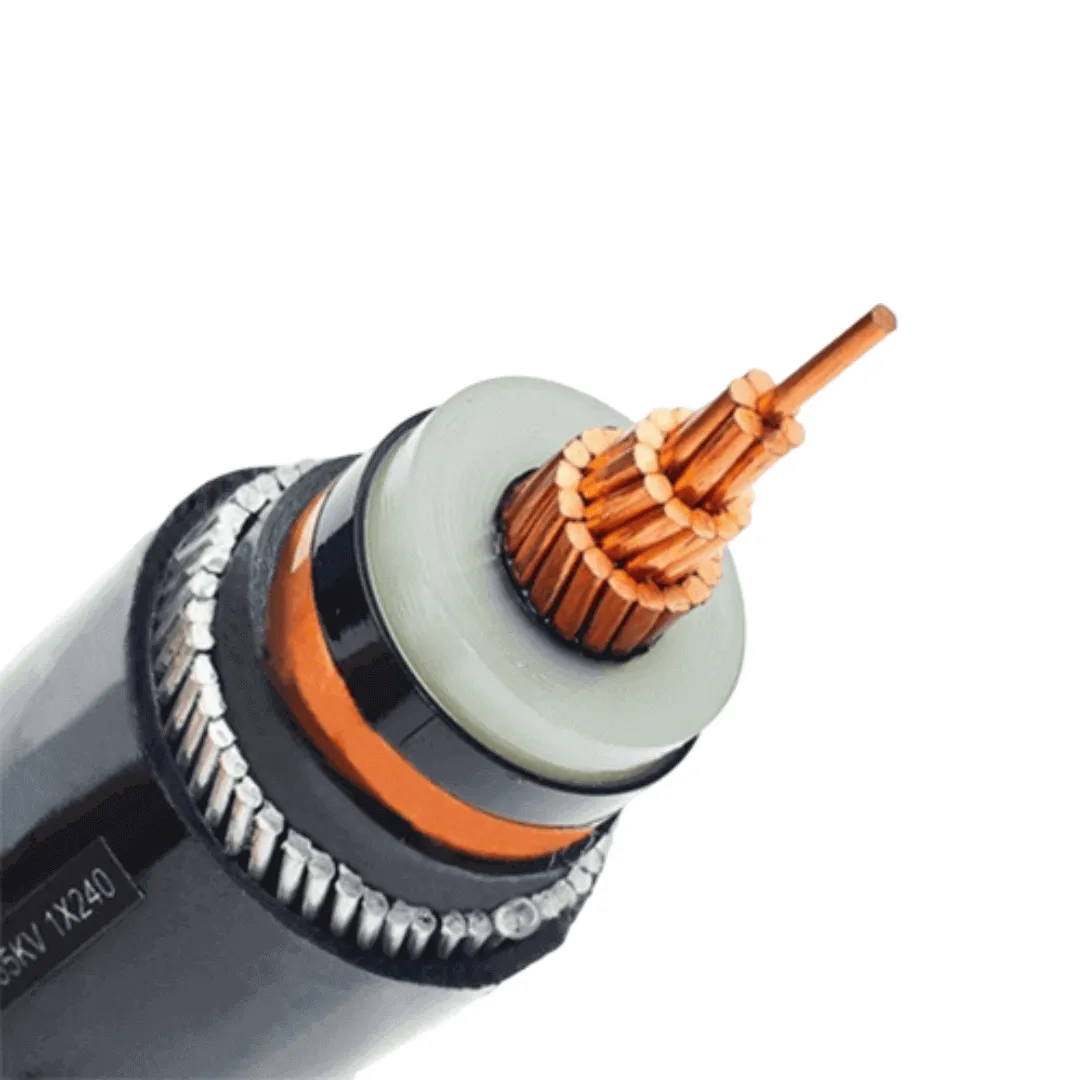
Medium voltage cable connects the high-voltage transmission grid to the low-voltage networks that serve buildings, factories, and infrastructure. Operating at voltage levels from 6kV to 35kV, MV cable is the workhorse of underground power distribution — carrying electricity from primary substations to secondary substations, from ring main units to transformers, and from switchgear to large industrial loads.
Whether you are specifying 11kV cable for a utility distribution network, 33kV cable for a wind farm collection system, or 20kV cable for an industrial plant incoming supply, the construction, materials, and testing requirements are fundamentally different from low-voltage cable. Semi-conductive screens, controlled insulation geometry, partial discharge testing, and metallic shielding all become mandatory at medium voltage.
This guide provides procurement engineers, utility planners, and EPC contractors with the technical knowledge to correctly specify medium voltage cable: construction details per IEC 60502-2, complete specification tables, screen type selection, installation guidance, and testing requirements. We manufacture XLPE medium voltage cable at our factory in Henan, China — rated from 3.6/6kV to 26/35kV, certified to IEC 60502-2 and GB/T 12706.2/12706.3.
What Is Medium Voltage Cable?
Medium voltage (MV) cable refers to power cables designed for operation at rated voltages between 1kV and 36kV. The IEC standard IEC 60502-2 covers cables from 6kV (U₀/U = 3.6/6kV) up to 30kV (U₀/U = 18/30kV), while national standards in some countries extend the medium voltage classification to 36kV or even 45kV.
The voltage rating notation U₀/U means:
- U₀ = rated voltage between conductor and earth (metallic screen)
- U = rated voltage between any two phase conductors
Common MV Voltage Classes
| Voltage Rating (U₀/U) | System Voltage | Typical Application |
|---|---|---|
| 3.6/6kV | 6kV | Industrial plant distribution, older networks |
| 6/10kV | 10kV | Urban distribution (China, Europe, parts of Asia) |
| 8.7/15kV | 15kV | North American distribution, some Asian utilities |
| 12/20kV | 20kV | European utility distribution (France, Nordic) |
| 12.7/22kV | 22kV | Southeast Asian utility distribution |
| 18/30kV | 33kV | Sub-transmission, wind farm collection, large industrial |
| 19/33kV | 33kV | UK and Commonwealth utility networks |
| 26/35kV | 35kV | Heavy industrial, mining, high-capacity sub-transmission |
The most commonly ordered voltage classes globally are 8.7/15kV (for 11kV system networks in UK, Middle East, and Africa), 12/20kV (European 20kV systems), and 18/30kV or 19/33kV (for 33kV sub-transmission).
Why MV Cable Is Different from LV Cable
The jump from 0.6/1kV to 6/10kV and above introduces critical design requirements that do not exist in low-voltage cable:
- Semi-conductive screens — Required over the conductor and over the insulation to eliminate air gaps and ensure uniform electric field distribution
- Controlled insulation thickness — Precisely calculated per voltage class, with eccentricity tolerances specified in the standard
- Metallic screen — Carries fault current and provides the earth return path; must be designed for the system fault level
- Water blocking — Required for direct burial to prevent water treeing in XLPE insulation
- Higher testing voltages — Routine tests at 3.5 × U₀ for AC withstand; partial discharge testing mandatory
Medium Voltage Cable Construction
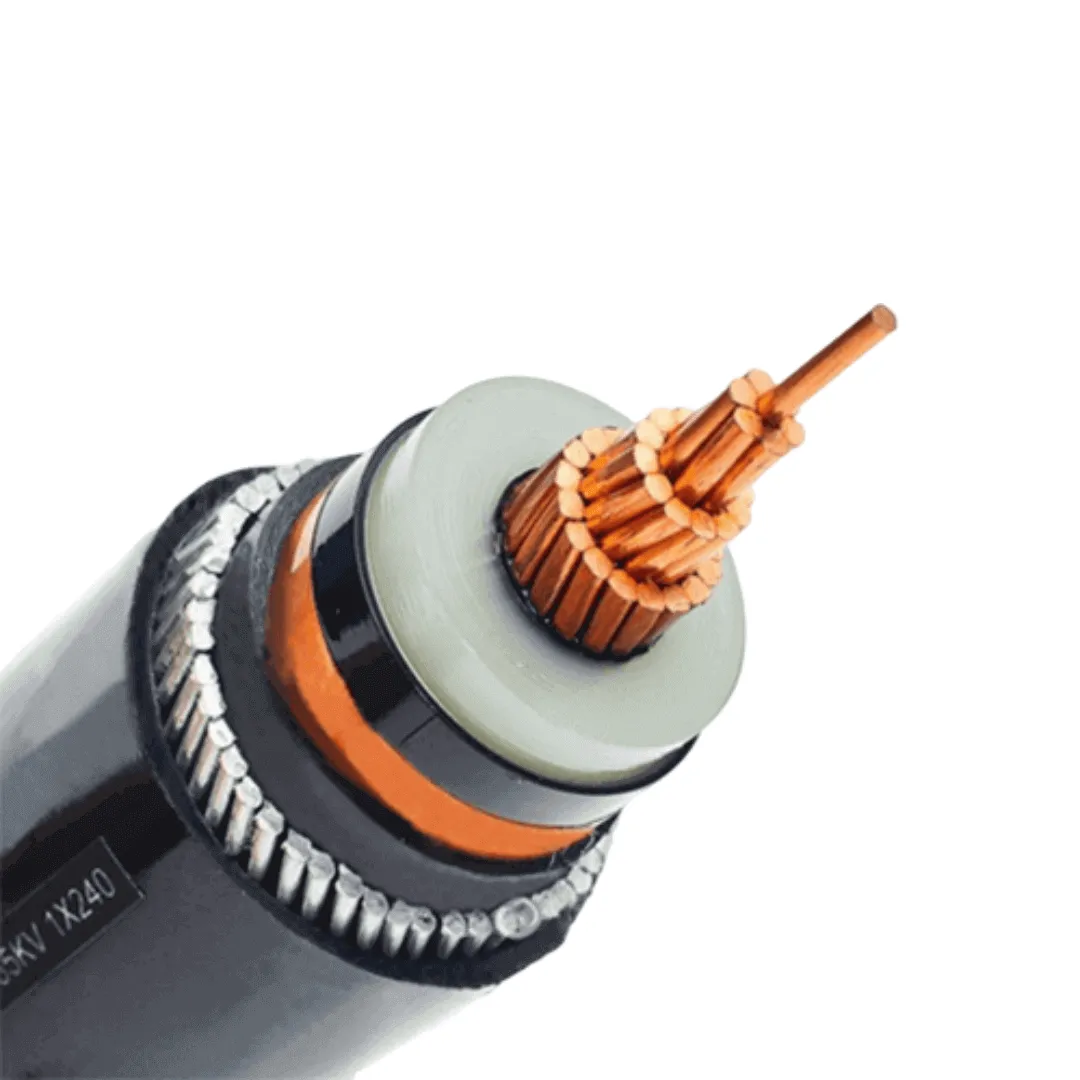
Layer-by-Layer Construction (Inside to Outside)
1. Conductor
- Material: Copper (Cu) Class 2 stranded, or Aluminium (Al) Class 2 stranded per IEC 60228
- Cross-sections: 35mm² to 800mm² (copper and aluminium)
- Shape: Circular compacted stranded is standard; milliken conductor for sizes ≥800mm² to reduce skin effect
- Water blocking: Water-swellable powder or tapes applied between strands for longitudinal water tightness
2. Conductor Screen (Semi-Conductive Layer)
- Material: Extruded semi-conductive compound (carbon-black filled polyethylene or XLPE)
- Purpose: Eliminates air voids between the conductor surface and insulation; creates a smooth, uniform equipotential surface
- Application: Triple-extrusion (conductor screen + insulation + insulation screen applied simultaneously in a single extrusion head)
- Thickness: Typically 0.5–1.0mm depending on conductor size
3. Insulation
- XLPE (Cross-Linked Polyethylene): The dominant MV insulation material worldwide. Maximum conductor temperature 90°C continuous, 250°C short-circuit. Excellent dielectric properties (tan δ < 0.001), low permittivity (εr = 2.3), high impulse strength.
- EPR (Ethylene Propylene Rubber): Alternative for applications requiring higher flexibility or frequent thermal cycling. Same 90°C rating but with better flexibility and moisture resistance. Higher permittivity (εr = 2.8–3.5) and higher cost.
- TR-XLPE (Tree-Retardant XLPE): Enhanced XLPE with additives to resist water-tree growth. Used where long service life (40+ years) in wet conditions is required.
Insulation thickness is specified by IEC 60502-2:
| Voltage Rating (U₀/U) | Nominal Insulation Thickness |
|---|---|
| 3.6/6kV | 3.4mm |
| 6/10kV | 3.4mm |
| 8.7/15kV | 4.5mm |
| 12/20kV | 5.5mm |
| 18/30kV | 8.0mm |
| 26/35kV | 9.0mm |
4. Insulation Screen (Semi-Conductive Layer)
- Material: Extruded semi-conductive compound, strippable or bonded
- Purpose: Provides a smooth equipotential surface at the outer boundary of the insulation; prevents partial discharge at irregularities
- Strippable type: Required for jointing and termination — the screen must peel cleanly from the insulation surface without damage
- Bonded type: Used where joints are rare (e.g., submarine applications)
- Thickness: Typically 0.5–1.0mm
5. Metallic Screen (Shield)
- Functions: Carries earth fault current, confines the electric field within the cable, provides touch safety, enables relay protection operation
- Types (detailed below): Copper wire screen, copper tape screen
- Must be designed for the system fault level and fault duration
6. Separation/Bedding Layer
- Semi-conductive or non-conductive tape wound over the metallic screen
- Prevents the outer sheath from adhering to the screen
- Water-swellable tapes used here for radial water blocking
7. Outer Sheath
- HDPE (High-Density Polyethylene): Standard for direct burial. Excellent moisture barrier, abrasion resistance, and chemical resistance. Typically black with embedded identification.
- PVC: Used where fire performance is required (LSZH variants) or for indoor installations
- LSZH (Low Smoke Zero Halogen): Required for tunnels, metro systems, and enclosed spaces
Metallic Screen Types for MV Cable
The metallic screen is one of the most critical components in medium voltage cable design. It must be specified for the system's earth fault current level and protection clearing time.
Copper Wire Screen
- Construction: Helically applied copper wires (typically 0.8mm to 1.4mm diameter) with counter-wound copper tape
- Cross-sections: 16mm² to 95mm² equivalent (determined by number and diameter of wires)
- Advantages: High fault current capacity, flexibility, easy jointing
- Standard sizes: 16mm², 25mm², 35mm², 50mm², 70mm², 95mm²
- Application: The most common choice for utility distribution; suitable for fault currents up to 31.5kA for 1 second (95mm² screen)
Copper Tape Screen
- Construction: One or two overlapping helically wound copper tapes (typically 0.1mm to 0.2mm thick)
- Equivalent cross-section: Typically 6–16mm²
- Advantages: Lower cost, lighter weight, smaller overall diameter
- Limitations: Lower fault current capacity; suitable only for low fault-level systems
- Application: Industrial installations with fault currents below 6kA; cost-sensitive projects
MV Cable Specifications: Complete Tables
For dedicated 11kV cable sizing with full current rating tables for all installation methods (air, buried, ducts), derating factors, and worked examples, see our 11kV cable specifications & size chart.
Single-Core 8.7/15kV (11kV System) — Copper Conductor, XLPE Insulation, Copper Wire Screen, HDPE Sheath
| Conductor Size (mm²) | Conductor Diameter (mm) | Insulation Thickness (mm) | Screen (mm²) | Overall Diameter (mm) | Weight (kg/km) | Current Rating — Direct Buried (A) | Current Rating — In Air (A) |
|---|---|---|---|---|---|---|---|
| 35 | 7.1 | 4.5 | 16 | 28.8 | 1080 | 170 | 140 |
| 50 | 8.3 | 4.5 | 16 | 30.2 | 1250 | 200 | 165 |
| 70 | 9.8 | 4.5 | 16 | 32.0 | 1500 | 245 | 205 |
| 95 | 11.4 | 4.5 | 16 | 34.0 | 1800 | 290 | 245 |
| 120 | 12.9 | 4.5 | 16 | 35.8 | 2100 | 330 | 280 |
| 150 | 14.4 | 4.5 | 16 | 37.6 | 2400 | 370 | 315 |
| 185 | 16.0 | 4.5 | 16 | 39.5 | 2800 | 415 | 355 |
| 240 | 18.2 | 4.5 | 25 | 42.5 | 3400 | 480 | 415 |
| 300 | 20.4 | 4.5 | 25 | 45.0 | 4000 | 540 | 470 |
| 400 | 23.2 | 4.5 | 35 | 48.5 | 5000 | 620 | 545 |
| 500 | 26.0 | 4.5 | 35 | 52.0 | 6100 | 710 | 625 |
| 630 | 29.3 | 4.5 | 50 | 56.5 | 7600 | 810 | 715 |
| 800 | 33.1 | 4.5 | 50 | 61.0 | 9300 | 910 | 810 |
Current ratings based on: soil temperature 20°C, soil thermal resistivity 1.0 K·m/W, depth 1.0m, single circuit. Air rating at 30°C ambient, single cable in free air.
Single-Core 18/30kV (33kV System) — Copper Conductor, XLPE Insulation, Copper Wire Screen, HDPE Sheath
| Conductor Size (mm²) | Conductor Diameter (mm) | Insulation Thickness (mm) | Screen (mm²) | Overall Diameter (mm) | Weight (kg/km) | Current Rating — Direct Buried (A) | Current Rating — In Air (A) |
|---|---|---|---|---|---|---|---|
| 35 | 7.1 | 8.0 | 16 | 36.0 | 1350 | 160 | 130 |
| 50 | 8.3 | 8.0 | 16 | 37.5 | 1520 | 190 | 155 |
| 70 | 9.8 | 8.0 | 16 | 39.5 | 1780 | 230 | 190 |
| 95 | 11.4 | 8.0 | 16 | 41.5 | 2100 | 275 | 230 |
| 120 | 12.9 | 8.0 | 25 | 43.5 | 2450 | 315 | 265 |
| 150 | 14.4 | 8.0 | 25 | 45.5 | 2800 | 350 | 300 |
| 185 | 16.0 | 8.0 | 25 | 47.5 | 3200 | 395 | 340 |
| 240 | 18.2 | 8.0 | 35 | 50.5 | 3900 | 455 | 395 |
| 300 | 20.4 | 8.0 | 35 | 53.5 | 4600 | 515 | 450 |
| 400 | 23.2 | 8.0 | 50 | 57.5 | 5700 | 595 | 520 |
| 500 | 26.0 | 8.0 | 50 | 61.0 | 6900 | 680 | 600 |
| 630 | 29.3 | 8.0 | 70 | 66.0 | 8700 | 780 | 690 |
| 800 | 33.1 | 8.0 | 70 | 71.0 | 10700 | 875 | 780 |
Single-Core 26/35kV (35kV System) — Copper Conductor, XLPE Insulation, Copper Wire Screen, HDPE Sheath
| Conductor Size (mm²) | Conductor Diameter (mm) | Insulation Thickness (mm) | Screen (mm²) | Overall Diameter (mm) | Weight (kg/km) | Current Rating — Direct Buried (A) | Current Rating — In Air (A) |
|---|---|---|---|---|---|---|---|
| 35 | 7.1 | 9.0 | 16 | 38.5 | 1450 | 155 | 125 |
| 50 | 8.3 | 9.0 | 16 | 40.0 | 1630 | 185 | 150 |
| 70 | 9.8 | 9.0 | 16 | 42.0 | 1900 | 220 | 185 |
| 95 | 11.4 | 9.0 | 16 | 44.0 | 2250 | 265 | 225 |
| 120 | 12.9 | 9.0 | 25 | 46.0 | 2600 | 300 | 255 |
| 150 | 14.4 | 9.0 | 25 | 48.0 | 2950 | 340 | 290 |
| 185 | 16.0 | 9.0 | 25 | 50.5 | 3400 | 380 | 325 |
| 240 | 18.2 | 9.0 | 35 | 53.5 | 4100 | 440 | 380 |
| 300 | 20.4 | 9.0 | 35 | 56.5 | 4900 | 500 | 435 |
| 400 | 23.2 | 9.0 | 50 | 60.5 | 6100 | 575 | 505 |
| 500 | 26.0 | 9.0 | 50 | 64.0 | 7400 | 660 | 580 |
| 630 | 29.3 | 9.0 | 70 | 69.5 | 9300 | 755 | 670 |
| 800 | 33.1 | 9.0 | 70 | 74.5 | 11400 | 850 | 755 |
Three-Core 8.7/15kV (11kV System) — Copper Conductor, XLPE Insulation, Copper Tape Screen, SWA, PVC Sheath
| Conductor Size (mm²) | Insulation Thickness (mm) | Overall Diameter (mm) | Weight (kg/km) | Current Rating — Direct Buried (A) |
|---|---|---|---|---|
| 35 | 4.5 | 55 | 4100 | 135 |
| 50 | 4.5 | 58 | 4700 | 160 |
| 70 | 4.5 | 62 | 5500 | 195 |
| 95 | 4.5 | 66 | 6500 | 230 |
| 120 | 4.5 | 70 | 7500 | 260 |
| 150 | 4.5 | 74 | 8600 | 290 |
| 185 | 4.5 | 78 | 9900 | 325 |
| 240 | 4.5 | 84 | 11800 | 375 |
| 300 | 4.5 | 90 | 13800 | 420 |
| 400 | 4.5 | 98 | 17000 | 480 |
Three-core ratings are lower than single-core due to mutual heating between cores.
Aluminium Conductor Options
Aluminium conductor MV cable is widely used where weight and cost are primary considerations. For the same current rating, aluminium requires approximately 1.6× the cross-section of copper (e.g., 240mm² Al ≈ 150mm² Cu in ampacity).
| Copper Equivalent | Aluminium Size | Approximate Weight Saving |
|---|---|---|
| 95mm² Cu | 150mm² Al | 40% |
| 150mm² Cu | 240mm² Al | 45% |
| 240mm² Cu | 400mm² Al | 45% |
| 300mm² Cu | 500mm² Al | 45% |
| 400mm² Cu | 630mm² Al | 50% |
Single-Core vs Three-Core MV Cable: Selection Guide
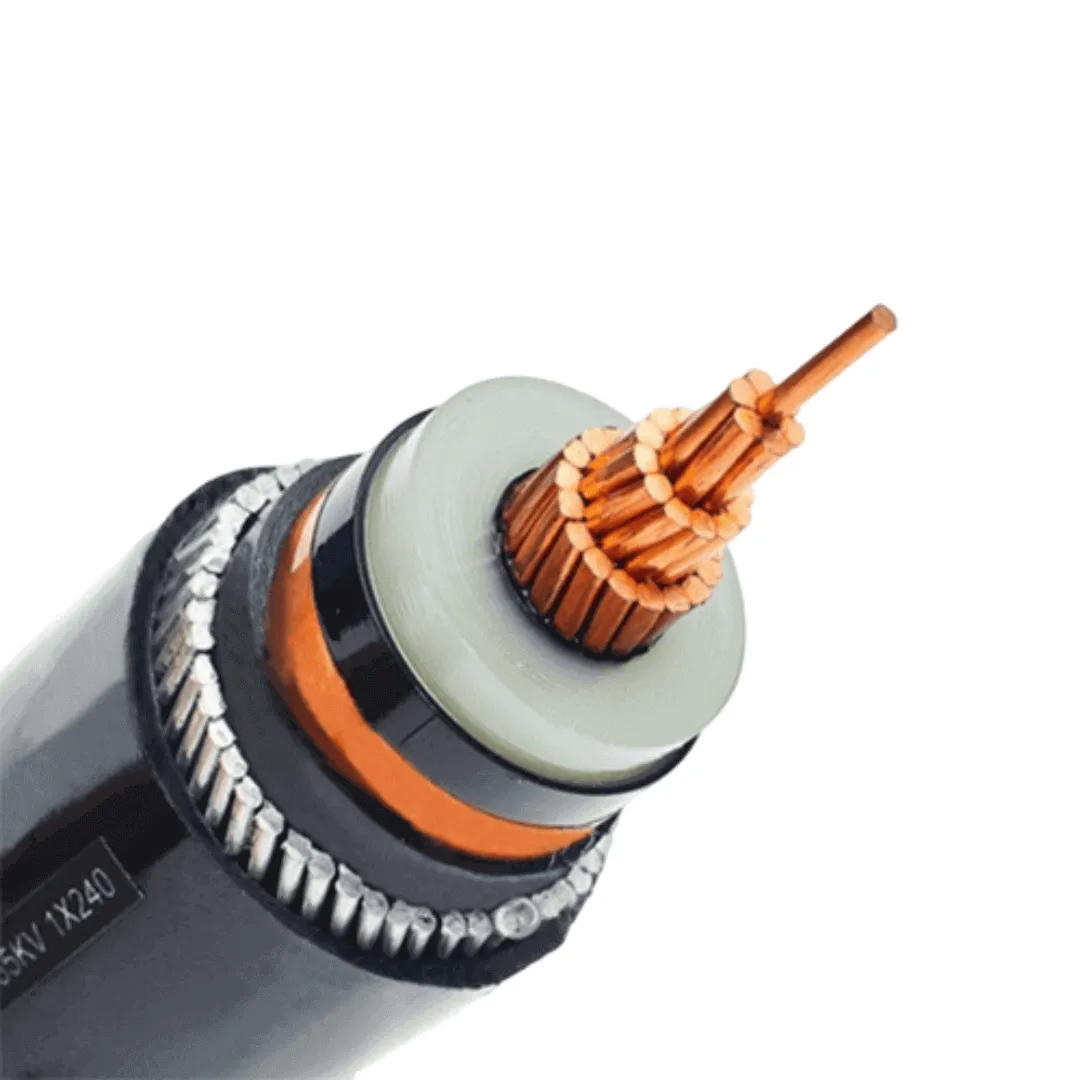
When to Use Single-Core Cable
- High current circuits (>400A): Single-core cables in trefoil or flat formation offer better heat dissipation
- Long cable runs (>2km): Easier to manufacture, transport, and install in long lengths
- Larger conductor sizes (≥400mm²): Three-core cable becomes impractically large and heavy above 300–400mm²
- 33kV and above: Single-core is the standard choice at 33kV for utility networks
- Cross-bonding applications: Single-core allows screen cross-bonding to reduce sheath losses on long runs
- Submarine cables: Almost exclusively single-core for MV submarine crossings
When to Use Three-Core Cable
- 11kV distribution (≤300mm²): Single cable is faster to install than three separate cables
- Space-constrained routes: One cable takes less duct/trench space than three
- No screen bonding required: Screens are connected at each end; no induced voltages between phases
- Shorter runs (under 1km): Installation labour savings outweigh the minor rating reduction
- Industrial plant reticulation: Simpler termination and installation
Comparison Summary
| Parameter | Single-Core (3×1C) | Three-Core |
|---|---|---|
| Current rating | Higher (better heat dissipation) | Lower (mutual heating) |
| Maximum practical size | 800mm² | 300–400mm² |
| Installation complexity | Trefoil clamping or flat formation | Single cable, simpler |
| Screen bonding | Required for long runs (cross-bonding) | Not required |
| Cost per metre | Lower cable cost, higher installation | Higher cable cost, lower installation |
| Typical voltage class | 11kV, 22kV, 33kV | 6.6kV, 11kV |
| Jointing complexity | Three joints per location | One joint per location |
XLPE vs EPR Insulation: MV Cable Comparison
Both XLPE and EPR are thermoset insulations rated for 90°C maximum conductor temperature. The choice between them affects cable flexibility, electrical characteristics, and cost.
| Property | XLPE | EPR |
|---|---|---|
| Maximum conductor temperature | 90°C | 90°C |
| Short-circuit temperature | 250°C | 250°C |
| Dielectric constant (εr) | 2.3 | 2.8–3.5 |
| Dielectric loss (tan δ) | < 0.001 | 0.003–0.005 |
| Flexibility | Relatively stiff | More flexible |
| Minimum bending radius | 15–20 × OD | 12–15 × OD |
| Moisture resistance | Good (with water blocking) | Excellent |
| Cost | Lower | 20–40% higher |
| Thermal cycling resistance | Good | Excellent |
| Typical lifespan | 30–40 years | 30–40 years |
| Market share (MV) | ~85% worldwide | ~15% worldwide |
When to choose XLPE: Standard utility distribution, cost-sensitive projects, long straight runs, any application where flexibility is not critical.
When to choose EPR: Installations requiring tight bending (tunnel curves, ship wiring), applications with frequent thermal cycling (wind turbines, intermittent loads), areas with high ambient moisture and no water-blocking option.
For the vast majority of 11kV and 33kV distribution cable applications, XLPE is the standard and most cost-effective choice.
Installation Methods for Underground MV Cable
Direct Burial
The most common method for utility distribution cables in urban and suburban areas.
Requirements:
- Minimum depth: 900mm (roads), 600mm (footpaths), 1200mm (agricultural land) per typical utility standards
- Cable bedding: 100mm fine sand or sifted soil above and below the cable
- Protective covering: Concrete tiles or marker tape above the cable
- Backfill: Selected material free of rocks and sharp objects
- Warning tape: Yellow or red with "HIGH VOLTAGE CABLE BELOW" printed at 300mm above cable
Burial derating factors (from reference rating at 1.0m depth):
| Depth of Burial | Derating Factor |
|---|---|
| 0.6m | 1.04 |
| 0.8m | 1.02 |
| 1.0m | 1.00 (reference) |
| 1.2m | 0.98 |
| 1.5m | 0.96 |
| 2.0m | 0.93 |
Installation in Ducts
Used where future cable replacement or additional circuits are anticipated.
Key considerations:
- Duct bore: Minimum 1.5× cable OD for single-core; typical 150mm or 200mm ID PVC or HDPE ducts
- Fill ratio: Maximum 40% duct cross-section occupied by cables
- Derating: Cables in ducts carry 10–20% less current than direct buried due to reduced heat dissipation. Our underground power cable guide covers all installation methods in detail.
- Pulling force: Maximum sidewall pressure and tension limits per cable manufacturer's data
- Pulling compound: Required to reduce friction coefficient
Trefoil vs Flat Formation (Single-Core)
Trefoil (touching):
- Three cables in triangular formation, usually bound with cable ties or in a trefoil duct
- Equal mutual heating on all phases — balanced current ratings
- Lower overall reactance
- Smaller trench width required
Flat formation (spaced):
- Three cables laid side by side with defined spacing (typically 1 cable diameter between edges)
- Higher individual cable ratings due to better heat dissipation
- Unequal mutual heating — centre phase carries less current
- Requires screen cross-bonding on long runs to balance induced voltages
Special Installation: Submarine / River Crossings
Medium voltage submarine cable for short crossings (harbours, rivers, island connections) uses single-core construction with:
- Double-layer wire armour (galvanized steel wires for fresh water, stainless steel or phosphor bronze for seawater)
- Lead sheath or aluminium-polyethylene laminate as a complete moisture barrier
- Polypropylene serving between armour layers
- Steel wire armour sized for the mechanical loads during laying
Testing Requirements for MV Cable
IEC 60502-2 specifies three categories of testing: routine tests (every drum), sample tests (statistical), and type tests (design validation). For a comprehensive guide to understanding these tests and reading the reports, see our cable quality testing guide.
Routine Tests (Per IEC 60502-2 Clause 18.1)
Every manufacturing length (drum) must pass these tests before shipment:
| Test | Requirement |
|---|---|
| Conductor resistance | Must comply with IEC 60228 at 20°C |
| Voltage test (AC) | 3.5 × U₀ for 5 minutes (e.g., 30.45kV for 8.7/15kV cable) |
| Partial discharge test | ≤ 10pC at 2 × U₀ (17.4kV for 8.7/15kV cable) |
| Insulation resistance | Measured at ambient temperature |
Sample Tests (Per IEC 60502-2 Clause 18.2)
Performed on samples from each production batch:
- Measurement of insulation thickness and dimensions
- Hot set test on XLPE insulation (elongation ≤175%, permanent set ≤15%)
- Tensile strength and elongation of insulation and sheath
- Shrinkage test on insulation
- Conductor examination
Type Tests (Per IEC 60502-2 Clause 18.3)
Performed once per cable design to validate the construction:
| Test | Description |
|---|---|
| Bending test | Cable wound on mandrel of specified diameter |
| Partial discharge (after bending) | ≤ 10pC at 2 × U₀ |
| Tan δ measurement | Dielectric loss angle at U₀ |
| Heating cycle voltage test | 20 heating cycles at rated temperature, then AC withstand |
| Impulse voltage test | Lightning impulse (BIL) followed by AC test |
| 4-hour voltage test | 4 hours at 4 × U₀ after heating cycles |
| Water penetration test | Longitudinal and radial watertightness |
| External fire test | Where fire-resistant properties are claimed |
Partial Discharge: The Critical Quality Indicator
Partial discharge (PD) testing is the single most important quality indicator for MV cable. PD activity indicates voids, contaminants, or defects in the insulation system that will eventually lead to premature failure.
- Factory acceptance: ≤ 10pC at 2 × U₀ (IEC 60502-2 requirement)
- Premium quality: ≤ 5pC (many utilities specify this tighter limit)
- After installation: On-site PD testing using VLF (Very Low Frequency) or damped AC methods
Our factory routinely achieves PD levels below 5pC through clean-room triple-extrusion, degassing chambers, and rigorous quality control of raw materials.
How to Specify MV Cable for Your Project
Information Required for Quotation
When requesting a quotation for medium voltage cable, provide these essential parameters:
- System voltage and voltage rating (e.g., 11kV system → 8.7/15kV cable for solidly earthed systems, 12/20kV for non-effectively earthed)
- Earthing system — Determines the voltage class selection:
- Category A (solidly earthed, fault cleared within 1 minute): Use U₀/U rating matching system voltage
- Category B (non-effectively earthed, fault duration 1 minute to 1 hour): Use next higher voltage rating
- Category C (un-earthed or resonant earthed, fault duration >1 hour): Use U₀/U = U/U
- Conductor material — Copper or aluminium
- Conductor cross-section — Based on current rating calculation
- Number of cores — Single-core or three-core
- Insulation type — XLPE (standard), EPR, or TR-XLPE
- Screen type and cross-section — Based on system fault level and clearing time
- Armour requirement — Unarmoured, SWA, or ATA (for three-core)
- Outer sheath material — HDPE, PVC, or LSZH
- Water blocking — Longitudinal (conductor), radial (laminate), or both
- Total length required — Including drum lengths (standard or maximum)
- Applicable standards — IEC 60502-2, BS 7835, NF C 33-226, AS/NZS 1429.1, or others
- Testing requirements — Routine, sample, type tests; any additional client specifications
- Fire performance — If LSZH, IEC 60332 flame retardance level
Choosing the Correct Screen Size
The metallic screen must carry the earth fault current without exceeding its adiabatic temperature limit. The calculation per IEC 60949:
I²t = K² × S²
Where:
- I = fault current (A)
- t = fault duration (seconds)
- K = material constant (226 for copper at XLPE temperature limits)
- S = screen cross-section (mm²)
Example: For a 12.5kA fault current with 1-second clearing time:
- Required screen area = I × √t / K = 12,500 × 1 / 226 = 55.3mm²
- Specify: 70mm² copper wire screen (next standard size up)
Voltage Class Selection Based on System Earthing
| System Type | Fault Clearing | Cable Rating for 11kV System | Cable Rating for 33kV System |
|---|---|---|---|
| Solidly earthed (Category A) | Under 1 minute | 6.35/11kV or 8.7/15kV | 19/33kV |
| Resistance earthed (Category B) | 1 min–1 hour | 8.7/15kV | 19/33kV or 18/30kV |
| Unearthed / Petersen coil (Category C) | >1 hour | 12/20kV | Not recommended |
Factory Capabilities
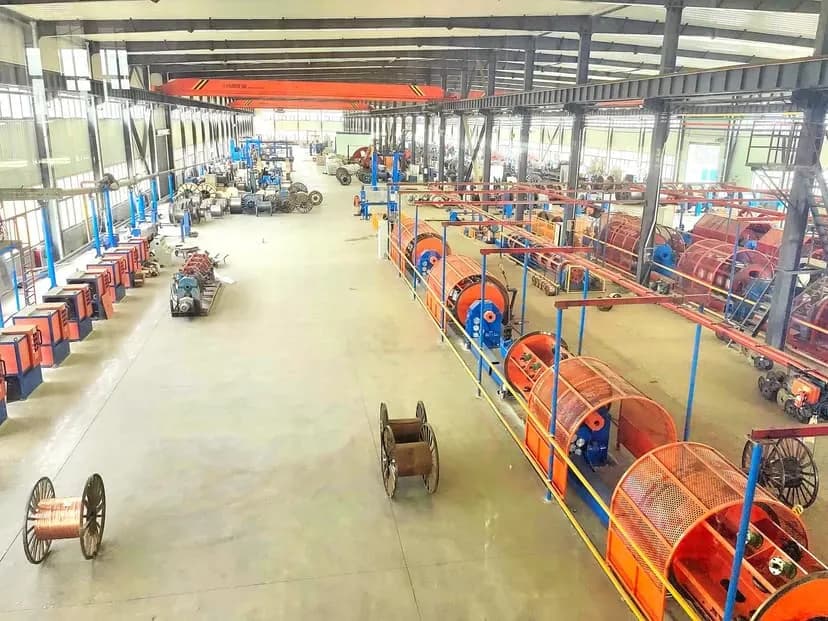
Our factory produces medium voltage cable across the full IEC 60502-2 range:
- Voltage range: 3.6/6kV to 26/45kV (medium voltage); 64/110kV to 127/220kV (high voltage)
- Conductor sizes: 35mm² to 800mm² (copper and aluminium)
- Configurations: Single-core and three-core
- Insulation: XLPE, TR-XLPE, EPR
- Screen types: Copper wire screen (16–95mm²), copper tape screen
- Sheath options: HDPE, PVC, LSZH, PE
Production Equipment
- VCV (Vertical Continuous Vulcanization) line — Triple-extrusion of conductor screen + XLPE insulation + insulation screen in a single pass. Vertical curing eliminates gravity-induced eccentricity in the insulation.
- CCV (Catenary Continuous Vulcanization) line — For three-core MV cable and LV cable production
- Dry-curing nitrogen system — Eliminates micro-voids caused by steam-curing; produces cleaner insulation with lower PD
- Degassing chambers — Remove cross-linking by-products (methane, acetophenone) from XLPE insulation before testing
- Computer-controlled screening line — Precise copper wire application with automated tension control
- Full high-voltage test facility — AC withstand up to 400kV, PD measurement to 1pC sensitivity, VLF testing, tan δ measurement
Quality Control
- ISO 9001:2015 certified quality management system
- In-house laboratory for routine, sample, and type testing per IEC 60502-2 — what do these tests cover?
- Raw material incoming inspection: PD screening of XLPE compound granules
- Production monitoring: continuous eccentricity measurement, spark testing on every layer
- Pre-shipment inspection and witnessing by third-party (SGS, BV, TUV) available
- Full traceability from raw material lot to finished cable drum
Certifications and Standards
| Standard | Scope |
|---|---|
| IEC 60502-2 | Power cables 6kV to 30kV |
| GB/T 12706.2 / 12706.3 | Chinese national standard (technically equivalent to IEC 60502-2) |
| BS 7835 | British standard for MV XLPE cables |
| NF C 33-226 | French utility standard |
| AS/NZS 1429.1 | Australian/New Zealand standard |
| IEC 60228 | Conductor specifications |
| IEC 60332-1 / 60332-3 | Flame retardance (single cable / bundled cables) |
| IEC 60754 | Halogen acid gas emission |
| IEC 61034 | Smoke density |
DNO Medium Voltage Cable Supply: 11kV & 33kV Distribution Networks
Distribution Network Operators (DNOs) require medium voltage cables that meet strict utility specifications for underground primary distribution. Whether you are a DNO directly, an ICP (Independent Connection Provider), or a contractor working on DNO-approved projects, the cable specification requirements are well-defined.
Typical DNO 11kV Cable Specification
For 11kV distribution networks, the standard specification across most UK DNOs (UKPN, SSEN, Northern Powergrid, SP Energy Networks) is:
- Construction: 3-core, 6.35/11kV (Um = 12kV)
- Conductor: Stranded aluminium, 95mm² to 300mm²
- Insulation: XLPE (cross-linked polyethylene)
- Screen: Copper wire screen, sized for earth fault rating
- Armour: Aluminium wire armour (AWA) — not steel, to avoid magnetic losses on 3-core
- Outer sheath: MDPE (medium-density polyethylene) — black, with extruded identification markings
- Standards: BS 7870-4 (UK DNO cables), IEC 60502-2
Typical DNO 33kV Cable Specification
For 33kV sub-transmission networks:
- Construction: Single-core, 18/30kV or 19/33kV (Um = 36kV)
- Conductor: Stranded copper or aluminium, 185mm² to 630mm²
- Insulation: XLPE, with semi-conductive screens (inner and outer)
- Screen: Copper wire screen (minimum 35mm² equivalent for earth fault)
- Sheath: MDPE or HDPE, with copper wire earthing provision
- Standards: BS 7870-4.20, IEC 60502-2, ENA TS 09-0012
Why DNOs Accept China-Manufactured MV Cable
Several factors have driven DNOs and their approved contractors to source MV cable from qualified Chinese manufacturers:
- Cost advantage: 30-45% below European manufacturers for equivalent BS 7870-4 cable
- Capacity: Chinese factories can deliver 50-200km orders within 4-6 weeks; European lead times often exceed 12-16 weeks
- Third-party verified: All cables supplied with KEMA/CESI type test reports and independent witness testing available
- BS 7870 compliance: Factories specifically tooled for UK-spec cables with MDPE sheath, AWA armour, and correct screen configurations
Our DNO Supply Experience
We supply MV cable to distribution network projects across:
- UK: UKPN, SSEN, and WPD network areas (via approved ICPs)
- Middle East: Saudi Electricity Company (SEC), DEWA Dubai, KAHRAMAA Qatar
- Africa: KPLC Kenya, ECG Ghana, PHCN Nigeria
- Southeast Asia: MEA Thailand, TNB Malaysia, NGCP Philippines
All MV cable is type-tested to IEC 60502-2 with partial discharge ≤5pC at 2U₀, and can be supplied with third-party inspection (SGS, BV, Intertek) at our factory.
Frequently Asked Questions
What is the difference between 11kV cable and 33kV cable?
The primary differences are insulation thickness and overall cable diameter. An 11kV cable (rated 8.7/15kV per IEC 60502-2) has 4.5mm insulation thickness, while a 33kV cable (rated 18/30kV) has 8.0mm insulation thickness. The 33kV cable also typically requires a larger copper wire screen (to handle higher fault currents in sub-transmission networks) and has a correspondingly larger overall diameter and weight. Construction principles are identical — both use XLPE insulation with semi-conductive screens.
Can medium voltage cable be installed without armour?
Yes. For installation in cable ducts, cable trays (indoor), or where the cable is protected by a concrete trough, unarmoured cable is standard. Direct burial without armour is permitted in some jurisdictions when the cable route is adequately marked and protected by cable tiles. However, many utility specifications require armoured cable for all underground installations regardless of protection level. Three-core MV cable commonly uses SWA (steel wire armour) or ATA (aluminium tape armour); single-core uses aluminium wire armour (non-magnetic) to avoid eddy current heating.
Why is single-core MV cable not armoured with steel wire?
Alternating current in a single-core cable induces voltage and eddy currents in any ferromagnetic material surrounding it. Steel wire armour on a single-core AC cable would generate significant heat losses (up to 50% of the conductor losses), reducing the cable rating dramatically. Single-core MV cables use either non-magnetic armour (aluminium wire) or no armour at all — relying on the duct or protective backfill for mechanical protection.
What does the partial discharge test tell you about cable quality?
Partial discharge (PD) is a localised electrical breakdown in a void or contamination site within the insulation. Even at levels below the detection threshold of routine tests, PD indicates that the insulation contains defects that will grow over time. The IEC limit of 10pC at 2×U₀ ensures that any delivered cable is free of significant defects. Lower PD levels (≤5pC or even ≤2pC) indicate cleaner manufacturing and predict longer cable life. Always request the PD test report with your cable delivery.
How long does medium voltage XLPE cable last?
XLPE medium voltage cable is designed for a minimum service life of 30 years under rated conditions per IEC 60502-2. In practice, correctly manufactured and installed MV XLPE cable routinely achieves 40+ years of service. The primary ageing mechanisms are water treeing (in wet conditions without water blocking), thermal ageing (from overloading), and electrical treeing (from manufacturing defects). Using TR-XLPE insulation and comprehensive water blocking can extend expected life to 50+ years.
What is the minimum bending radius for MV cable?
Per IEC 60502-2 and most manufacturer specifications:
- Single-core unarmoured: 15 × overall diameter (during installation); 10 × OD (final fixed position)
- Single-core armoured: 15 × OD
- Three-core armoured: 12 × OD
For a typical 240mm² single-core 33kV cable with ~50mm OD, the minimum bending radius during installation is 750mm (15 × 50). Exceeding these limits can damage the semi-conductive screens or create voids in the insulation.
What information do I need to provide to order MV cable?
At minimum: system voltage, earthing method, conductor material and size, number of cores, screen type and required fault current capacity, sheath material, installation method, total length, drum length preference, applicable standard, and any special requirements (fire rating, water blocking, etc.). See the "How to Specify" section above for the complete checklist.
Is medium voltage cable the same as high voltage cable?
No. In IEC terminology, medium voltage covers 1kV to 36kV (IEC 60502-2), while high voltage covers 36kV to 150kV (IEC 60840) and extra-high voltage is above 150kV (IEC 62067). Construction is similar in principle, but high voltage cable requires thicker insulation, more sophisticated screen designs, and more stringent manufacturing and testing conditions.
What is 33kV MDPE cable?
33kV MDPE cable refers to a 33kV medium voltage cable with a Medium-Density Polyethylene (MDPE) outer sheath instead of PVC. MDPE sheath is standard for UK DNO specifications (BS 7870-4) because it offers superior moisture resistance, better mechanical properties for direct burial, and longer service life (40+ years) compared to PVC. The cable construction is typically single-core XLPE insulated with copper wire screen and MDPE oversheath in black with identification markings.
What is the difference between 11kV and 33kV cable construction?
The primary differences are insulation thickness and screen design. An 11kV cable (6.35/11kV rated) has approximately 3.4mm XLPE insulation thickness, while a 33kV cable (18/30kV or 19/33kV rated) requires approximately 8.0mm insulation thickness. The 33kV cable also requires a larger copper wire screen (typically 35mm² minimum vs 16mm² for 11kV) to handle higher earth fault currents. Additionally, 33kV cables are almost always single-core construction for sizes above 185mm², while 11kV cables are commonly supplied as 3-core up to 300mm².
What is the burial depth for 11kV and 33kV underground cable?
Per ENA TS 09-0014 and typical DNO requirements: 11kV cables require minimum 600mm cover in footpaths and 900mm cover in roads. 33kV cables require minimum 750mm cover in footpaths and 1050mm cover in roads. Additional depth may be required at road crossings or where future excavation is likely. Warning tape or tiles must be placed 150mm above the cable in all cases.
Get a Factory-Direct Quotation
Tell us your project requirements and we will provide a detailed technical offer within 24 hours:
- Full technical datasheet with dimensions, weight, and electrical parameters
- Routine test protocol and sample test schedule
- Packaging, drum size options, and shipping proposal
- Type test reports for the specified cable design
Email: sales@chinacablefactory.com | WhatsApp: +86 134-6102-4180
Interested in this product?
Request Medium Voltage Cable QuoteRelated Products & Resources
- XLPE Power Cable — Complete Manufacturer Guide
- Cable Insulation Types: PVC vs XLPE vs EPR Comparison
- 3 Phase Power Cable: Sizes & Specifications
- 4 Core Armoured Cable — SWA/STA Specifications
- How to Import Cable from China — Buyer's Guide
- Conductor Selection Guide for Power Lines
- Power Cable Product Range