Key Takeaway
KVV control cable from a China factory: KVV unshielded, KVVP shielded and KVVR flexible types compared, to GB/T 9330. Selection guide for panel, instrumentation and drag-chain wiring in Africa, the Middle East & Southeast Asia.
Pick the wrong control cable type and the cable will still power up, still pass a continuity test, and still look correct on the drawing. The problem shows up months later: a 4–20mA reading that drifts whenever a nearby motor starts, a limit switch that chatters, a conductor that work-hardens and cracks inside a moving cable chain. These are not manufacturing defects. They are the predictable result of specifying an unshielded cable where a screen was needed, or a solid-conductor cable where the run had to flex.
KVV, KVVP and KVVR are the three core variants of PVC-insulated, PVC-sheathed control cable to the Chinese national standard GB/T 9330 — and the differences between them are exactly the differences that decide whether a control circuit behaves. This guide compares all three (plus the combined KVVRP), explains when each is the correct choice, and gives procurement teams in Africa, the Middle East and Southeast Asia a specification they can put straight into a purchase order.
The Three Types at a Glance
All three share the same DNA: copper conductors, PVC core insulation, cores laid up into a bundle, and a PVC outer sheath, all rated 450/750V and built to GB/T 9330 — the same basis as our full control cable range. What changes is two things — whether there is a copper screen, and whether the conductor is solid or fine-stranded. Those two choices generate the whole family.
- KVV — standard control cable. Solid or standard-stranded copper conductors (Class 1/Class 2 to IEC 60228), PVC insulation, PVC sheath, no screen. The default for fixed panel and equipment wiring where there is no significant electrical noise and the cable does not move.
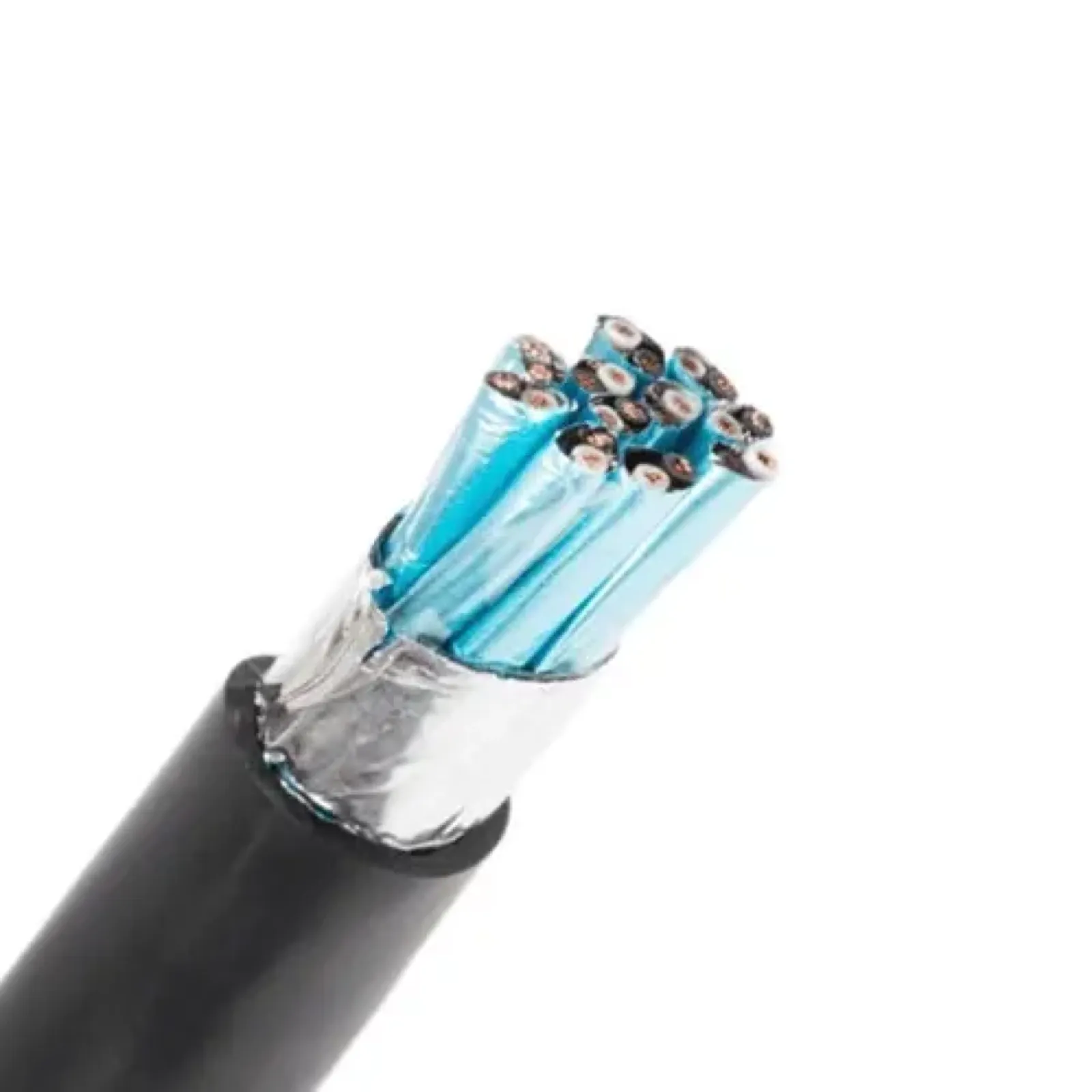
- KVVP — screened control cable. Same construction as KVV but with a copper screen (braid or copper/aluminium tape) applied over the laid-up cores, under the sheath. The "P" is for pingbi — shielding. This is the cable to specify when the circuit carries low-level signals near sources of electromagnetic interference.
- KVVR — flexible control cable. Same as KVV but with fine-stranded (Class 5 to IEC 60228) conductors. The "R" is for ruan — soft. The many fine wires let the cable bend repeatedly without the conductor work-hardening, which is essential in cable chains, on machine tools, and anywhere the cable flexes in service.
- KVVRP — screened and flexible. Class 5 fine-stranded conductors plus a copper screen. The correct choice when a signal cable both needs EMI protection and has to move — servo feedback in a drag chain, an encoder on a moving axis, a sensor on a robot arm.
The naming is systematic, which makes it easy to read a cable code once you know the parts. Add a "2" before the P for an instrumentation-style construction (KVVP2, copper-tape screen), or the armour suffixes covered in our armoured control cable guide (22 for steel tape, 32 for steel wire). A prefix of ZR- denotes flame-retardant grade to IEC 60332-1 — the grade most of our substation and power-plant customers specify by default.
KVV: The Unshielded Baseline
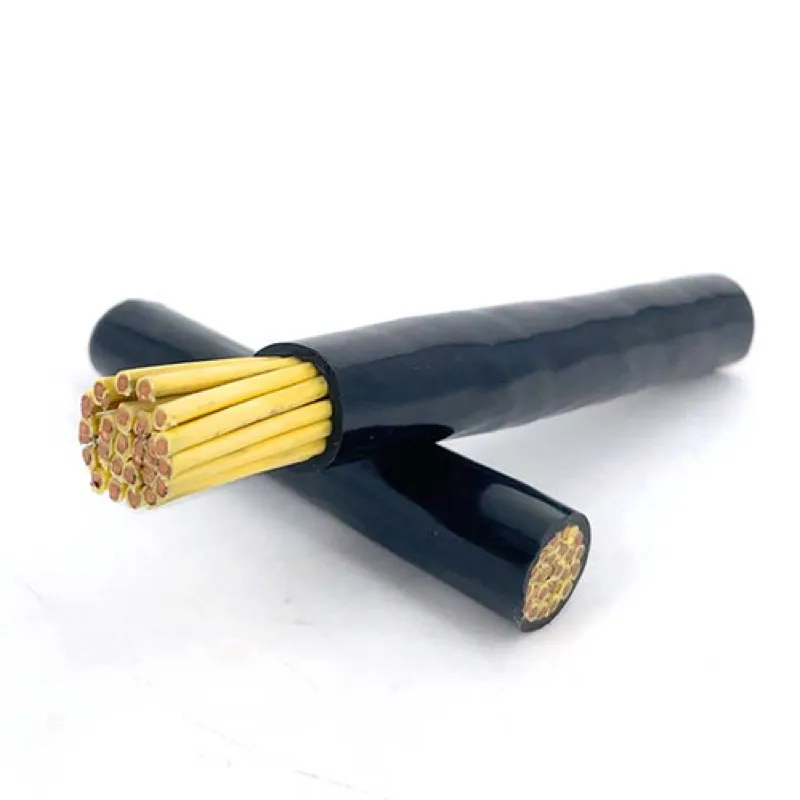
KVV is the workhorse. If a control circuit is fixed in place and does not run alongside heavy power cables or variable-frequency drives, KVV is not a compromise — it is the right answer, and paying for a screen you do not need is wasted money on a large project.
Construction. Solid (Class 1) or standard-stranded (Class 2) copper conductors, each core individually PVC-insulated and colour- or number-coded, laid up with fillers into a round bundle, wrapped, and sheathed in PVC. Core counts run from 2 up to 61; conductor sizes from 0.75mm² to 10mm², with 1.5mm² and 2.5mm² the most common for general control and interlock wiring. This is our standard KVV control cable construction.
Where it belongs. Switchgear and MCC internal wiring, interconnection between fixed panels, motor control circuits, lighting and small-power control, valve and actuator control where the signal is a simple on/off command rather than an analogue measurement. In a substation control room in Egypt or a pumping station in Bangladesh, most of the point-to-point control wiring between fixed cubicles is KVV.
Where it fails. The moment a KVV cable carries a low-level analogue signal — a 4–20mA transmitter loop, a thermocouple, an RTD — and runs parallel to a power cable or near a VFD, the unshielded cores act as an antenna. Induced noise rides on top of the measurement signal and the reading becomes unstable. KVV also should not be used where the cable flexes: the solid or coarse-stranded conductor work-hardens with repeated bending and eventually cracks. Those two failure modes are exactly what KVVP and KVVR are built to prevent.
KVVP: When You Need a Screen
KVVP is KVV with a copper screen added over the laid-up cores, under the outer sheath. That single layer is the difference between a noisy signal and a clean one, and specifying it correctly is one of the highest-value decisions in a control cable schedule.
What the screen does
Electromagnetic interference couples into a cable two ways: capacitively (electric field, from nearby high-voltage or fast-switching cables) and inductively (magnetic field, from high currents). A copper screen tackles the capacitive path — it intercepts the electric field and diverts the induced current to earth instead of letting it reach the signal conductors. This is why a screen is essential for low-level analogue signals near VFDs, soft starters, and power cables, and largely irrelevant for a robust 24V digital on/off circuit.
Screen types we produce
- Copper braid screen — woven tinned or bare copper wire, typically 85% coverage as standard, 95%+ available. Braid handles flexing better than tape and gives a low-resistance path, so it is preferred where the cable moves or where fault current may flow in the screen.
- Copper-tape / aluminium-polyester (Al-Mylar) tape screen — a wrapped tape giving 100% coverage against high-frequency interference. Foil tape is standard for instrumentation cable (the KVVP2 construction) and is usually run with a drain wire so the screen can be terminated cleanly.
- Combined individual + overall screen — each pair or triple individually screened, plus an overall screen. This is the construction for multi-signal instrumentation runs where crosstalk between pairs must also be controlled, common in DCS and PLC marshalling.
The rule that decides whether it works: earth one end only
A screen only works if it is earthed correctly. For low-level signal circuits, earth the screen at one end only — normally the control-panel/instrument end. Earthing both ends creates an earth loop: a difference in earth potential between the two ends drives a circulating current through the screen, and that current re-induces noise into the very signal you are trying to protect. This single wiring mistake defeats an otherwise perfectly specified KVVP cable, and it is the first thing to check when a "shielded" circuit is still noisy.
Where it belongs
Transmitter and sensor loops (4–20mA, 0–10V), thermocouple and RTD extension, encoder and tachometer feedback, communication and signalling circuits running near power, and any control wiring inside a VFD-heavy plant room. In a Gulf oil-and-gas facility or a Southeast Asian process plant, the instrumentation-to-marshalling runs are almost always screened.
KVVR: When the Cable Has to Move
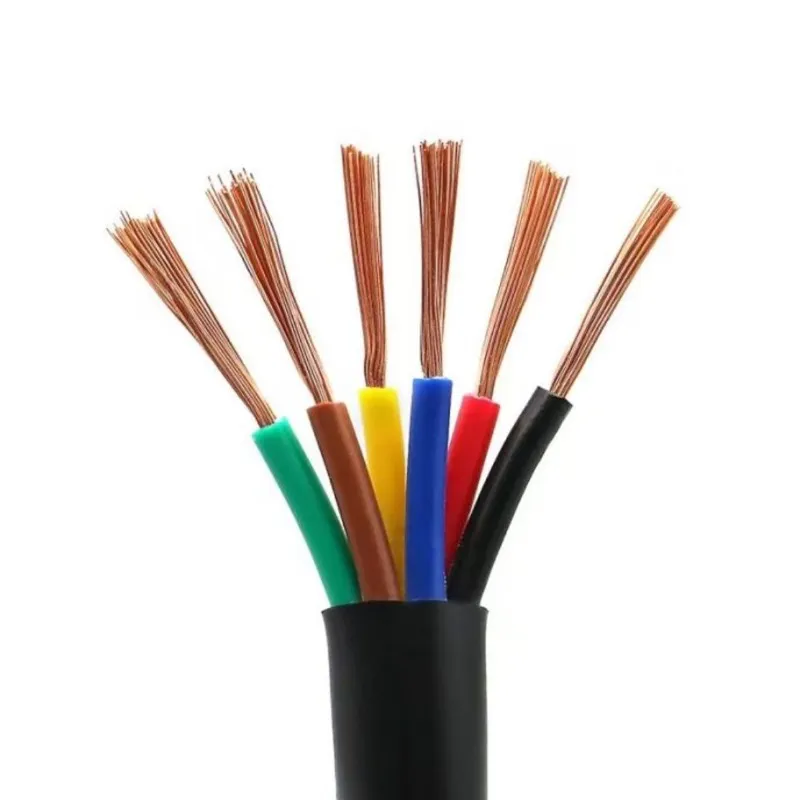
KVVR is KVV built with fine-stranded (Class 5 to IEC 60228) conductors — our KVVR flexible cable — instead of solid or standard-stranded ones. Everything else — PVC insulation, laid-up cores, PVC sheath, GB/T 9330 rating — is the same. The difference is entirely in the conductor, and it matters more than it looks.
Why fine stranding matters. When a solid conductor bends, the metal on the outside of the bend stretches and the inside compresses. Repeat that thousands of times and the copper work-hardens and cracks — the cable fails from the conductor outward, often invisibly. A Class 5 conductor replaces one thick wire with dozens of fine ones; each thin strand bends easily and the mechanical stress is shared and reduced. That is what lets KVVR survive continuous flexing where KVV would fatigue and break.
Where it belongs. Machine tools, drag chains and cable carriers, portable and semi-portable equipment, robot and gantry wiring, any control connection that moves with a moving part. On a Vietnamese textile line or a South African mining conveyor, the control wiring that follows a moving carriage is KVVR, not KVV.
Flexible is not the same as bendable-once. KVVR is built for repeated flexing in service. For a cable that is simply installed around tight corners and then left alone, standard KVV with an adequate bending radius is usually sufficient. Reserve KVVR for genuine dynamic applications — it costs more, and its value is entirely in the movement.
KVVRP: Screened and Flexible Together
When a circuit needs both — a signal that must be protected from EMI and a cable that has to move — the answer is KVVRP: Class 5 fine-stranded conductors plus a copper screen. This is the specification for servo feedback and encoder cables in a drag chain, sensor wiring on a moving robot arm, or any screened instrumentation run on dynamic machinery.
For flexing screened cable, a braid screen is strongly preferred over a foil tape screen. Foil cracks and tears under repeated bending, losing coverage exactly where you need it; a woven braid flexes with the cable and keeps its shielding integrity. This is a real specification detail — asking for "shielded flexible" without stating braid can get you a foil-screened cable that degrades in service.
Side-by-Side Comparison
| Feature | KVV | KVVP | KVVR | KVVRP |
|---|---|---|---|---|
| Conductor | Solid / std-stranded (Class 1/2) | Solid / std-stranded (Class 1/2) | Fine-stranded (Class 5) | Fine-stranded (Class 5) |
| Screen | None | Copper braid or tape | None | Copper braid (preferred) |
| Flexing in service | No | No | Yes, repeated | Yes, repeated |
| EMI protection | No | Yes | No | Yes |
| Voltage rating | 450/750V | 450/750V | 450/750V | 450/750V |
| Standard | GB/T 9330 | GB/T 9330 | GB/T 9330 | GB/T 9330 |
| Relative cost | Lowest | Medium | Medium | Highest |
| Typical use | Fixed panel / interlock wiring | Instrument & signal loops near power | Drag chains, machine tools | Servo/encoder in motion + EMI |
How to Choose in Two Questions
You can specify the right cable from this family by answering just two questions about the circuit:
- Does the cable move in service? If yes → you need an R type (KVVR or KVVRP). If no → a non-R type (KVV or KVVP).
- Does the circuit carry a low-level signal near an EMI source? If yes → you need a P type (KVVP or KVVRP). If no → a non-P type (KVV or KVVR).
Cross those two answers and the cable selects itself:
- Fixed + no noise → KVV
- Fixed + noise-sensitive signal → KVVP
- Moving + no noise → KVVR
- Moving + noise-sensitive signal → KVVRP
Add the grade and any armour on top: prefix ZR- for flame-retardant to IEC 60332-1 (standard for substations, power plants, and oil-and-gas), and the 22 / 32 armour suffix if the run needs mechanical protection or direct burial, as covered in our armoured control cable product page.
Application Notes for Africa, the Middle East & Southeast Asia
The correct type is only half the specification. The operating environment in these three markets drives the grade and the detail, and getting them wrong is a more common cause of field failure than choosing between KVV and KVVP.
High ambient temperature (Gulf, Sahara, tropical Southeast Asia). Standard PVC control cable is rated for a 70°C conductor temperature. In a Saudi or UAE plant room, or a Nigerian outdoor marshalling cabinet in direct sun, the ambient alone can erode the usable current-carrying and temperature margin. State the site ambient in your enquiry so the correct grade — standard PVC, or a heat-resistant variant where the ambient is severe — is quoted. Do not assume a nominal 70°C cable is comfortable at 55°C ambient without derating.
Humidity and water ingress (coastal West Africa, Southeast Asian monsoon — see the tropical derating notes on our Malaysia page). For screened cable in humid environments, the screen termination and gland detail matter as much as the screen itself. Moisture tracking across a poorly terminated screen can create the very earth path you were trying to avoid. Specify the sheath and, where the route is exposed, consider the armoured variants for mechanical and moisture protection.
Fire performance (substations, oil & gas, high-occupancy buildings). Across all three markets, project specifications increasingly call for flame-retardant cable in enclosed or high-risk areas. Our full KVV/KVVP/KVVR/KVVRP range is available in ZR- flame-retardant grade to IEC 60332-1, and fire-resistant grade can be produced to order where circuit integrity during a fire is required — for example, emergency shutdown and fire-and-gas signalling loops in an oil-and-gas facility.
EMI-dense installations (VFD-heavy plants everywhere). The single biggest driver of KVVP vs KVV demand across these markets is the spread of variable-frequency drives in pumping, HVAC, and process plants. Where a plant is VFD-heavy, treat every analogue signal run near a drive as a screened circuit by default — see our industrial plant notes on drive separation — retrofitting a screen after a plant is commissioned is far more expensive than specifying KVVP at procurement.
What to Specify in Your Enquiry
A control cable enquiry that a factory can quote accurately — and that arrives as the cable you actually need — states the following. The two-question logic above gives you the type; this list turns it into a purchase order.
- Cable type: KVV, KVVP, KVVR or KVVRP (the type answers "does it move" and "is it noise-sensitive")
- Grade: standard or ZR- flame-retardant (IEC 60332-1); note if fire-resistant is required
- Armour: none, 22 (steel tape) or 32 (steel wire) — see the armoured guide if the run is buried or exposed
- Core count and conductor size: e.g. 12 × 1.5mm² (2–61 cores, 0.75–10mm²)
- For screened types (KVVP/KVVRP): screen construction — braid vs tape, coverage %, individual + overall vs overall only, drain wire required
- Standard: GB/T 9330, or the IEC / BS equivalent your specification calls for
- Site conditions: ambient temperature, indoor/outdoor, buried/tray/conduit, humidity
- Quantity and drum requirements: total length per type, maximum drum length, marking requirements
Quality Checks That Matter
Whatever type you order, these are the checks that separate a specification-compliant cable from one that merely looks right:
- Conductor resistance to IEC 60228 — the definitive test. It confirms both the cross-sectional area and the copper purity; a measured value at or below the standard maximum proves you have the copper you paid for. Ask for measured values on the test report, not just a pass/fail — and check you are dealing with a factory-direct supplier rather than a reseller who cannot produce them.
- Conductor class — Class 1/2 for KVV/KVVP, Class 5 for KVVR/KVVRP. A "flexible" cable built with a coarser conductor than Class 5 will not survive the flexing it was bought for.
- Screen coverage (screened types) — verify the actual braid coverage % or confirm tape overlap. A thin, low-coverage screen shields poorly.
- Insulation resistance and voltage (spark) test — every length is tested to confirm insulation integrity.
- Flame-retardant verification (ZR- grades) — IEC 60332-1 test evidence for flame-retardant orders.
- Sheath print and marking — cable type, standard, core/size, meter marking and year, so the installed cable can be verified on site against the schedule.
Frequently Asked Questions
What is the difference between KVV and KVVP control cable?
KVV is unshielded; KVVP has a copper screen (braid or tape) over the laid-up cores, under the sheath. Both use solid or standard-stranded conductors to GB/T 9330. Specify KVVP when the circuit carries a low-level signal (4–20mA, thermocouple, RTD, communications) near power cables or variable-frequency drives, where an unshielded KVV would pick up electromagnetic interference. For robust digital or on/off control away from noise, KVV is the correct and more economical choice.
What does the R in KVVR mean?
The R stands for ruan (soft/flexible). KVVR uses fine-stranded Class 5 copper conductors instead of the solid or standard-stranded conductors in KVV. The many fine strands let the cable bend repeatedly without the conductor work-hardening and cracking, which is essential for cable chains, machine tools, and moving equipment. KVVR is not for higher voltage or current — only for flexibility.
When do I need KVVRP instead of KVVP or KVVR?
Use KVVRP when a circuit needs both EMI protection and repeated flexing — for example servo feedback, encoder, or sensor cables that run in a drag chain on moving machinery. KVVP is screened but not flexible; KVVR is flexible but not screened; KVVRP combines fine-stranded conductors with a copper screen. For flexing screened cable, specify a braid screen rather than foil tape, because foil cracks under repeated bending.
Should a control cable screen be earthed at one end or both ends?
For low-level signal circuits, earth the screen at one end only — normally the control-panel or instrument end. Earthing both ends creates an earth loop where a difference in earth potential drives a circulating current through the screen, which re-induces noise into the signal. Single-end earthing is the standard practice that makes a screened cable actually perform.
Are KVV, KVVP and KVVR available in flame-retardant grade?
Yes. The full range is available in ZR- flame-retardant grade to IEC 60332-1, and fire-resistant grade can be produced to order. Flame-retardant grade is standard for substations, power plants, oil-and-gas facilities, and high-occupancy buildings across Africa, the Middle East, and Southeast Asia.
What core counts and conductor sizes do you offer?
All four types are available from 2 to 61 cores, with conductor sizes from 0.75mm² to 10mm². The 1.5mm² and 2.5mm² sizes are the most common for general control and instrumentation duty. Custom configurations, including combined individual and overall screens for KVVP, are available on request.
Get a Project Quotation
We manufacture the complete control cable family — KVV unshielded, KVVP screened, KVVR flexible, and KVVRP screened-flexible — in standard and ZR- flame-retardant grade, plain and armoured, at our factory in Henan, China, certified to GB/T 9330 and IEC 60227.
Send your cable schedule with the details from the checklist above and we will return:
- A technical datasheet with construction, dimensions, and ratings for each type
- The applicable test reports (GB/T 9330, IEC 60228 conductor resistance, IEC 60332-1 for ZR- grades)
- A project-specific quotation based on current copper price and your quantities
- A delivery timeline to your specified port
Tell us the circuit — does it move, and is it noise-sensitive — and our engineering team will confirm the correct type, screen construction, and grade before you commit to an order.