Key Takeaway
Armoured control cable from a certified China factory: KVV22 steel-tape & KVV32 steel-wire armour, 2–61 core, 0.75–10mm², GB/T 9330 & IEC 60227. Direct-burial specs for Africa, Middle East & Southeast Asia projects.
Armoured control cable is what keeps a control circuit alive when the cable route runs through ground that offers no mercy. Buried across a substation yard in Nigeria, pulled through a cable trench at a Saudi desalination plant, or trenched between machine houses at a Vietnamese cement works, an unarmoured control cable would be one excavator bucket, one rockfall, or one rodent away from a dead signal. The steel armour layer is the difference between a cable you can bury directly and a cable that needs a protective conduit for every metre of its run.
This guide covers KVV22 (steel-tape armoured) and KVV32 (steel-wire armoured) control cables in full: construction, the complete core-count and conductor-size range, applicable standards, direct-burial installation practice, and how to specify the right armoured control cable for infrastructure and industrial projects across Africa, the Middle East, and Southeast Asia.
We manufacture armoured control cable at our factory in Henan, China — certified to GB/T 9330 and IEC 60227, with steel-tape and steel-wire armour lines in-house and production capacity exceeding 500 km per month.
What Is Armoured Control Cable?
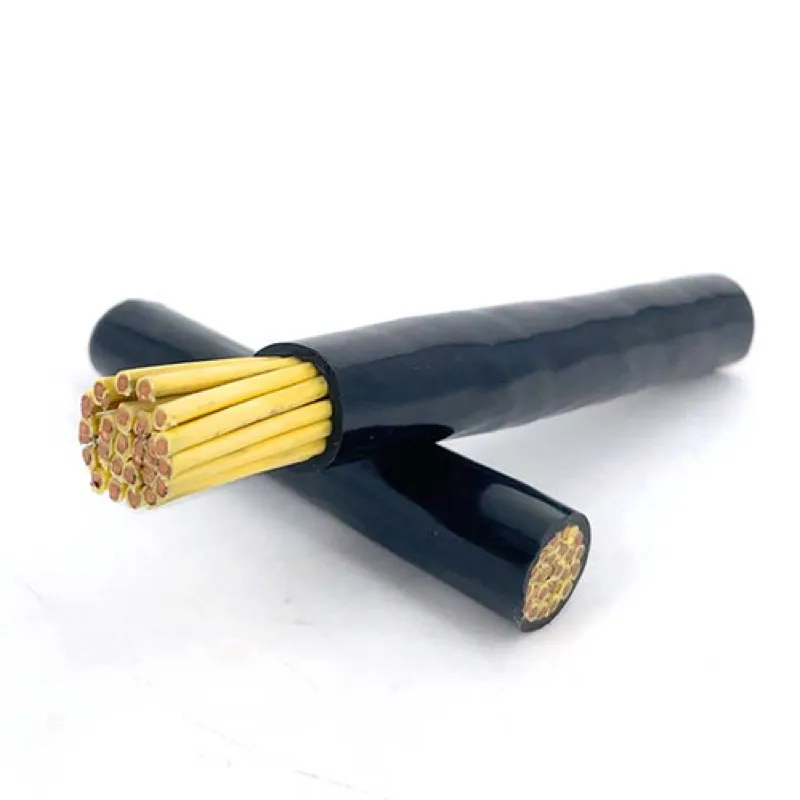
Armoured control cable is a multi-core control cable that carries low-voltage control, monitoring, and signal circuits — typically rated 450/750V — with an added metallic armour layer for mechanical protection. Unlike a power cable that moves load current, a control cable moves information: relay commands, interlock signals, sensor feedback, and instrument readings between switchgear, PLCs, motor starters, and field devices. The armour does not change that electrical function. What it changes is where you can put the cable.
A standard PVC control cable (KVV) needs to be protected from crushing, impact, and rodents. Run it in a cable tray indoors and that protection comes from the building. Bury it in the ground, run it through a trench shared with heavy plant, or route it across a yard where vehicles cross, and the cable itself has to carry that protection. That is exactly what the armour provides.
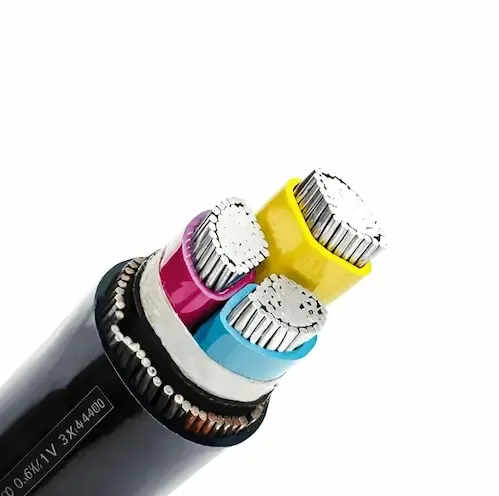
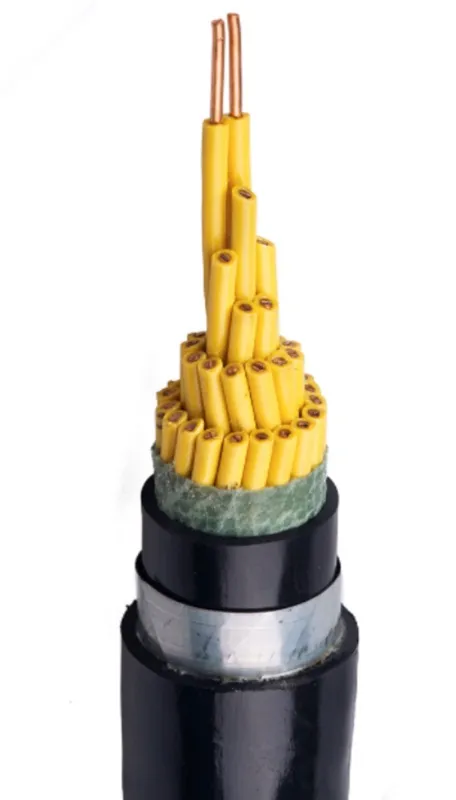
The armour sits between an inner PVC bedding sheath and an outer PVC serving sheath. It forms a continuous mechanical barrier around the laid-up cores without interfering with the signals inside. When the armour is bonded and earthed correctly at termination, it also gives the cable a degree of electromagnetic screening and a fault-current return path — useful in electrically noisy environments such as substations and VFD-driven plant.
Why Armour Matters in Africa, the Middle East & Southeast Asia
The three markets this guide is written for share installation conditions that punish unarmoured cable:
- Direct burial is common and often unavoidable. In many African grid-extension and mining projects, and across Middle East oil, gas, and water infrastructure, control cables are trenched directly into ground rather than run in a fully built-out conduit system. Direct burial demands armour.
- Mechanical risk is high. Construction traffic on active sites, shared trenches with power and process piping, shifting ground, and rocky backfill all threaten a bare-sheathed cable. Steel armour resists crushing and penetration.
- Rodent and termite damage is a real failure mode. In tropical Southeast Asia and much of sub-Saharan Africa, rodents and termites chew through PVC sheaths. Steel armour is an effective physical deterrent.
- Outdoor and buried runs see moisture and mechanical stress together. The armour reinforces the cable against pulling tension during installation and against ground movement afterwards.
For a procurement engineer specifying cable for these environments, the question is rarely "do we need armour?" — it is "steel tape or steel wire, and what core count and conductor size?" The rest of this guide answers that.
KVV22 vs KVV32: Steel Tape vs Steel Wire Armour
The two most widely specified armoured control cables are KVV22 and KVV32. They share the same electrical construction — copper conductors, PVC insulation per core, and a PVC outer sheath — and differ only in the armour type. That single difference drives where each is used.
KVV22 — Steel Tape Armour (STA)
KVV22 uses two steel tapes wound helically around the inner bedding, overlapping to form a continuous metal shield. Steel tape gives excellent protection against radial crushing forces — the kind of load a cable sees when buried under backfill, driven over, or compressed in a congested trench.
- Designation: KVV22 — the first "2" denotes steel-tape armour, the second "2" denotes a PVC outer sheath
- Armour: Double steel tape, helically applied
- Best against: Crushing, radial impact, pressure from backfill and traffic
- Typical use: Direct burial in stable ground, cable trenches, ducts, indoor runs needing mechanical protection
Steel tape armour is the default choice for the majority of buried control-cable runs. It is lighter and lower cost than steel wire for the same size, and its crush resistance covers the dominant risk in most trench and duct installations.
KVV32 — Steel Wire Armour (SWA)
KVV32 uses a layer of galvanised round steel wires laid helically around the bedding. Steel wire adds high longitudinal tensile strength on top of crush resistance — it resists the pulling and axial stress a cable experiences on long vertical runs, in unstable ground, or during heavy-tension pulls.
- Designation: KVV32 — the "3" denotes steel-wire armour, the "2" denotes a PVC outer sheath
- Armour: Round galvanised steel wire
- Best against: Tensile/pulling stress, ground movement, vertical drops, mechanical impact
- Typical use: Long direct-burial runs, unstable or subsiding ground, vertical shafts, high-tension pulls, mining and heavy-industry sites
For a control cable being pulled a long distance through rough terrain, dropped down a shaft, or laid in ground prone to movement, steel wire armour is the safer specification. The wire carries axial load that would otherwise stress the cores and terminations.
Choosing Between Them
| Factor | KVV22 (steel tape) | KVV32 (steel wire) |
|---|---|---|
| Primary protection | Crushing / radial impact | Tensile / axial + crushing |
| Relative weight | Lighter | Heavier |
| Relative cost | Lower | Higher |
| Direct burial, stable ground | Yes — standard choice | Yes — where extra strength needed |
| Long pulls / vertical runs | Adequate | Preferred |
| Unstable / subsiding ground | Limited | Preferred |
| Mining / heavy industry | Suitable | Preferred |
As a rule: specify KVV22 for standard buried and trenched control circuits where crushing is the main threat, and step up to KVV32 where the cable will see significant pulling tension, vertical drops, or ground movement. If in doubt on a specific route, send us the run length, elevation change, and ground conditions and our engineers will confirm the correct armour type.
Armoured Control Cable Construction — Layer by Layer
Understanding the construction helps a buyer read a datasheet, verify what is quoted, and check what is delivered. From the centre outward, an armoured control cable is built up as follows:
- Copper conductor. Plain annealed copper, solid (Class 1) or stranded (Class 2) per IEC 60228. The conductor carries the control signal. For armoured control cable used in fixed installations, Class 1 solid or Class 2 stranded is standard; fine-stranded flexible conductors are used only in the flexible KVVR family, not in armoured fixed cable.
- PVC insulation. Each conductor is individually insulated with PVC to GB/T 9330 / IEC 60227, colour-coded or number-printed for identification. Insulation is the electrical barrier between cores.
- Laid-up cores. The insulated cores are twisted together with a defined lay. Fillers occupy the gaps to give a round cross-section, and a binder tape holds the assembly.
- Inner sheath (bedding). A PVC bedding layer is extruded over the laid-up cores. It cushions the cores and provides a smooth, round bed for the armour.
- Armour. Double steel tape (KVV22) or galvanised round steel wire (KVV32) applied helically over the bedding. This is the mechanical protection layer.
- Outer sheath (serving). A PVC outer jacket over the armour. It protects the steel from corrosion, provides the final moisture barrier, and carries the printed cable marking.
Each layer is verifiable. On delivery, a buyer can confirm conductor size with a micrometer, count and identify cores, inspect the armour type and coverage, and check the printed marking against the purchase specification. The "Quality Verification" section below sets out exactly what to check.
Shielded + Armoured: KVVP22 and KVVP2-22
Where a circuit needs both electromagnetic screening and mechanical armour — for example, an instrumentation or signal cable buried near power cables or VFD feeders — the shielded-armoured variants combine both:
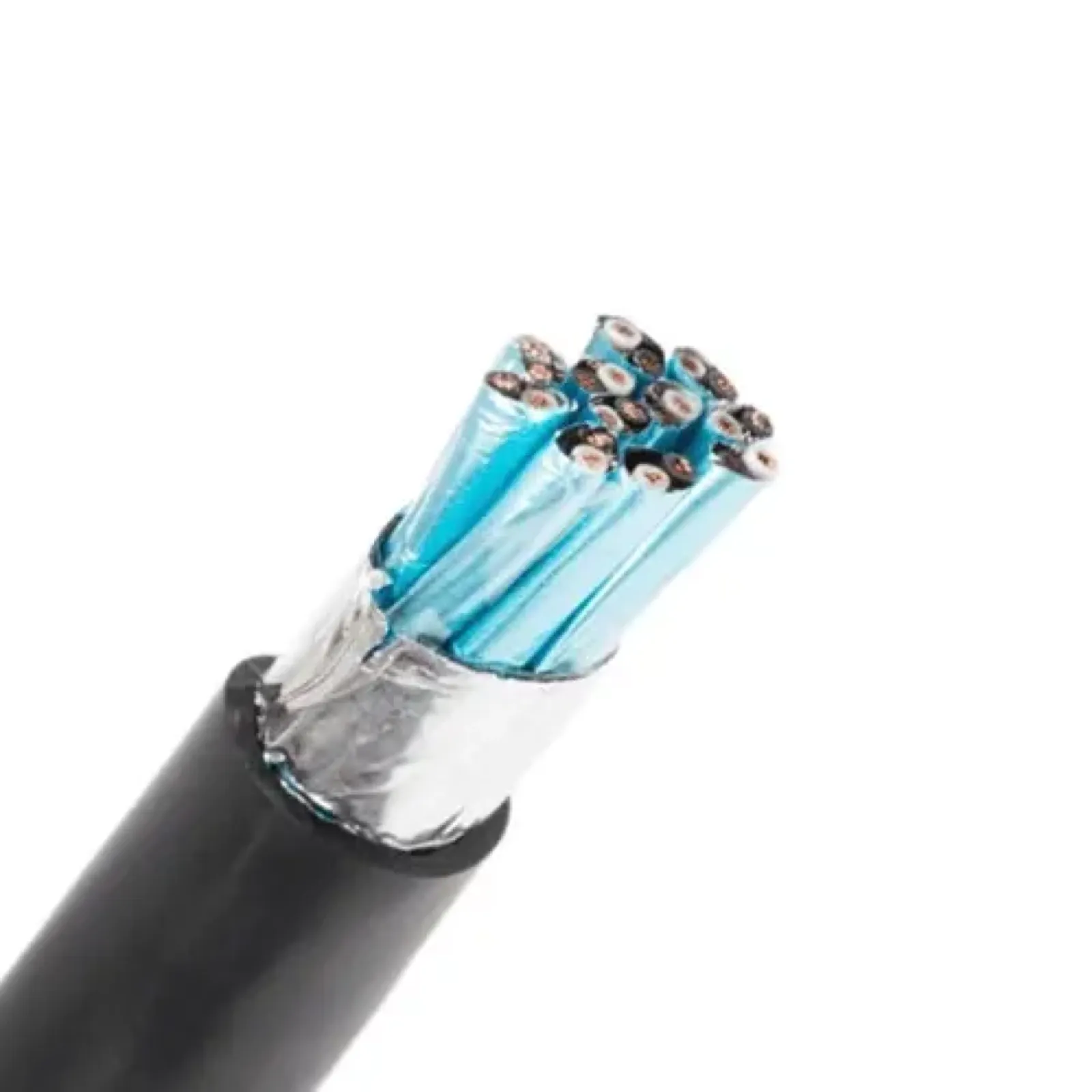
- KVVP22 — copper-braid or copper-tape overall screen plus steel-tape armour. The screen suppresses electromagnetic interference; the armour protects the buried run.
- KVVP2-22 — copper-tape screen plus steel-tape armour, commonly specified for instrumentation and process-signal circuits where a defined screen coverage is required.
These are the correct specification when a low-level analogue signal (for example a 4–20mA loop or a thermocouple/RTD reading) has to survive both EMI and a buried, mechanically exposed route. The screen must be earthed at one end only for signal circuits to avoid earth-loop currents — see the installation notes later in this guide.
Complete Specification: Core Counts & Conductor Sizes
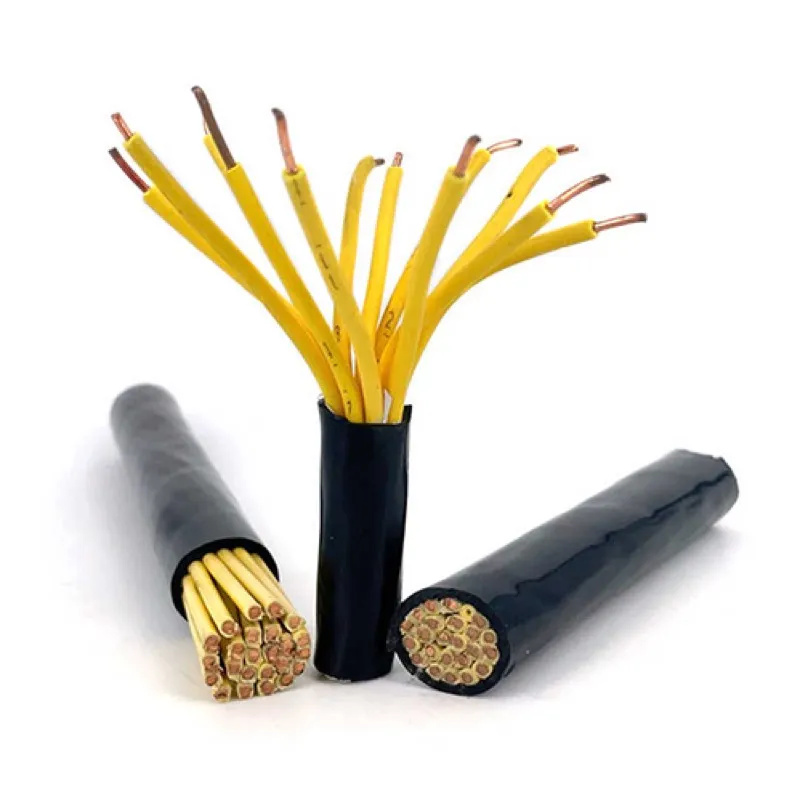
The following tables cover our standard armoured control cable production range per GB/T 9330 and IEC 60227. Both KVV22 and KVV32 are available across this range. Custom core counts and sizes outside this table are available on request.
Core Count and Available Conductor Sizes
| Core Count | Available Conductor Sizes (mm²) | Typical Application |
|---|---|---|
| 2 | 0.75, 1.0, 1.5, 2.5, 4.0, 6.0, 10.0 | Simple on/off control, single sensors, valve actuation |
| 3 | 0.75, 1.0, 1.5, 2.5, 4.0, 6.0, 10.0 | 3-phase control, motor control circuits |
| 4 | 0.75, 1.0, 1.5, 2.5, 4.0, 6.0, 10.0 | Instrumentation, 4–20mA loops, metering |
| 5 | 0.75, 1.0, 1.5, 2.5, 4.0 | Multi-signal control panels |
| 7 | 0.75, 1.0, 1.5, 2.5 | PLC I/O connections, field junction boxes |
| 8 | 0.75, 1.0, 1.5, 2.5 | Building and plant management systems |
| 10 | 0.75, 1.0, 1.5, 2.5 | Industrial automation |
| 12 | 0.75, 1.0, 1.5, 2.5 | Process control |
| 14 | 0.75, 1.0, 1.5, 2.5 | DCS field wiring |
| 16 | 0.75, 1.0, 1.5, 2.5 | Substation secondary wiring |
| 19 | 0.75, 1.0, 1.5, 2.5 | Complex control panels |
| 24 | 0.75, 1.0, 1.5 | Relay protection circuits |
| 30 | 0.75, 1.0, 1.5 | Large automation projects |
| 37 | 0.75, 1.0, 1.5 | Multi-zone process control |
| 44 | 0.75, 1.0, 1.5 | Refinery / petrochemical marshalling |
| 48 | 0.75, 1.0, 1.5 | Large-scale DCS trunk |
| 61 | 0.75, 1.0, 1.5 | Maximum-density trunk cables |
The 1.5mm² and 2.5mm² sizes are by far the most common for general control and instrumentation duty. Larger conductors (4.0–10mm²) appear where the control circuit also carries a small load — for example, feeding a solenoid, actuator, or contactor coil over a long run where voltage drop matters. Higher core counts (24–61) are used as marshalling and trunk cables in substations, refineries, and large process plants, where many signals are gathered into a single armoured run to a marshalling cabinet.
Electrical & Physical Ratings
| Parameter | Specification |
|---|---|
| Rated voltage (Uo/U) | 450/750V (standard) / 300/500V (light duty) |
| Power-frequency test voltage | 2500V AC for 5 minutes (450/750V rated) |
| Conductor | Plain annealed copper, Class 1 (solid) or Class 2 (stranded) per IEC 60228 |
| Insulation | PVC per GB/T 9330 / IEC 60227 |
| Inner sheath (bedding) | PVC |
| Armour | Double steel tape (KVV22) / galvanised round steel wire (KVV32) |
| Outer sheath | PVC |
| Insulation resistance | ≥ specified minimum per GB/T 9330 at 20°C |
| Standard operating temperature | −15°C to +70°C (standard PVC) |
| Minimum bending radius | See installation section below |
Standard PVC control cable is rated to a +70°C conductor temperature. Where an installation sees sustained high ambient — a common condition in Middle East outdoor plant and un-shaded desert routes — heat-resistant PVC compounds and derating factors should be applied. Specify the ambient temperature at enquiry and we will confirm the correct compound and any derating.
Direct-Burial Installation Guide
Armoured control cable earns its cost during installation and over the life of a buried route. Getting the installation right protects that investment. The following practice applies to KVV22 and KVV32 buried directly in ground — the dominant installation method across the target markets.
Trench Depth and Bedding
- Trench depth: Bury control cable deep enough to clear mechanical loads at the surface. A typical minimum is 0.5–0.7m for control cable in areas without vehicle traffic, and 0.8m or more where vehicles cross. Follow the project specification and local regulation where they are stricter.
- Sand bedding: Lay the cable on a bed of fine sand or sifted soil, free of stones and sharp debris, and cover with a further sand layer before backfill. This protects the outer sheath from point loads even though the cable is armoured.
- Warning tape and tiles: Lay a coloured warning tape above the sand layer, and protective tiles or slabs where future excavation risk is high. This warns anyone digging later before they reach the cable.
- Segregation from power cables: Maintain separation between control/signal cables and power cables in a shared trench to limit electromagnetic coupling. Where separation cannot be met, use shielded-armoured cable (KVVP22) and earth the screen correctly.
Pulling Tension and Bending Radius
Armour protects the cable, but the cable can still be damaged during a rough pull. Respect these limits:
- Bending radius: Do not bend armoured control cable tighter than the manufacturer's minimum radius — generally on the order of 12× the cable overall diameter for armoured cable. A tighter bend can distort the cores, crack insulation, or deform the armour. Confirm the exact figure for the delivered cable from its datasheet.
- Pulling tension: Pull on the conductors and armour through a proper cable stocking or pulling eye, not by hand-hauling that stresses one part of the cable. KVV32 steel-wire armour tolerates higher pulling tension than KVV22 — one reason it is preferred for long pulls.
- Rollers and lubricant: Use cable rollers in the trench and approved pulling lubricant to keep tension low and avoid dragging the sheath over abrasive ground.
- Temperature at installation: PVC-sheathed cable stiffens in cold and softens in heat. Avoid installing standard PVC control cable below about 0°C without pre-warming; in high desert daytime heat, avoid over-tensioning softened cable.
Termination and Earthing
- Armour glands: Terminate the armour into a proper armoured cable gland that clamps the steel and provides continuity to the earthing system. The armour must be electrically continuous and bonded to earth for it to serve as a mechanical and electrical protection layer.
- Screen earthing (KVVP22): For shielded-armoured instrumentation cable carrying low-level analogue signals, earth the screen at one end only (typically the control-room / marshalling end) to prevent circulating earth-loop currents that inject noise. The armour, by contrast, is bonded at both ends as part of the mechanical earthing system. Keep the two functions clear at termination.
- Core identification: Land cores against the cable schedule using the printed core numbers or colour code. High core-count marshalling cables (37–61 core) especially benefit from disciplined core identification and a documented as-built.
- Sealing: Seal glands and entries against moisture and dust ingress — important in humid Southeast Asian and dusty Middle Eastern environments alike.
Common Installation Mistakes to Avoid
- Burying unarmoured KVV where the route needs KVV22/KVV32 — a false economy that fails within a few seasons.
- Bending tighter than the minimum radius at trench corners and gland entries.
- Failing to bond the armour, so it provides mechanical protection but no earth continuity or screening benefit.
- Earthing an instrumentation screen at both ends, creating an earth loop and injecting noise into the signal.
- Skipping the sand bed and warning tape, leaving the cable exposed to point loads and future excavation damage.
Standards & Compliance
Armoured control cable for the target markets is manufactured and verified against a small, well-defined set of standards. Specifying the right ones — and requiring the matching test reports — is how a buyer protects a project.
- GB/T 9330 — the Chinese national standard for PVC-insulated control cables, covering KVV, KVV22, KVV32, KVVP, and the ZR (flame-retardant) variants. It defines conductor, insulation, sheath, armour, and test requirements. This is the primary manufacturing standard for the KVV family.
- IEC 60227 — the international standard for PVC-insulated cables of rated voltage up to and including 450/750V. Widely referenced and accepted across Africa, the Middle East, and Southeast Asia as the international equivalent basis.
- IEC 60228 — conductor standard. Defines conductor classes (Class 1 solid, Class 2 stranded) and resistance limits. A buyer verifying conductor size checks against IEC 60228 resistance values.
- BS 6500 / BS EN 50525 — British/European references sometimes specified in Middle East and Commonwealth-influenced African markets. We can supply to these where a project specification requires them.
- IEC 60332-1 — flame-retardancy (single vertical wire) applicable to the ZR- flame-retardant armoured variants (see below).
When you place an order, require the type-test and routine-test documentation that matches the specification: conductor resistance (IEC 60228), insulation resistance and high-voltage test (GB/T 9330 / IEC 60227), and — for flame-retardant grades — the flame-propagation test report. A supplier that cannot produce these on request is a supplier to avoid.
Flame-Retardant Armoured Control Cable (ZR-KVV22 / ZR-KVV32)
Many real projects specify the flame-retardant grade of armoured control cable as standard, denoted by the ZR- prefix (ZR-KVV22, ZR-KVV32). Flame-retardant compound resists the spread of fire along the cable route, so a localised fire does not propagate along the trench or tray. This is the default in substations, power plants, oil and gas facilities, and any installation where cable fire propagation is a concern — which describes a large share of the infrastructure projects across our target markets. We produce the full armoured control cable range in flame-retardant grade to IEC 60332-1 alongside the standard grade. If your circuit needs both fire survival and signal continuity during a fire, that is the fire-resistant (NH-) family — a separate specification we can also supply.
Applications Across Africa, the Middle East & Southeast Asia
Armoured control cable shows up wherever a buried or mechanically exposed control circuit has to be reliable. The application patterns differ a little by region:
Africa — grid extension, mining, and water. Substation secondary wiring and relay-protection circuits (16–61 core KVV22) run between switchgear, marshalling kiosks, and control buildings, often trenched across yards. Mining sites favour KVV32 for its tensile strength on long, rough runs between plant houses. Water and power infrastructure projects trench control cable directly, so armour is standard rather than optional.
Middle East — oil, gas, power, and water. Refineries and petrochemical plants — the Aramco and SABIC expansion programmes in Saudi Arabia among them — and desalination facilities use high core-count armoured control and instrumentation cable (KVVP22 shielded-armoured for signal circuits) marshalled back to control rooms. Flame-retardant grade (ZR-) is typically mandated. High ambient temperature drives compound selection and derating. Direct burial and buried duct banks are the norm across large plant sites.
Southeast Asia — manufacturing, process, and infrastructure. Cement, food-processing, palm-oil, and general manufacturing plants run PLC and DCS field wiring in armoured cable where routes leave the protected indoor environment — see our industrial plant cable guide. Humidity and rodent/termite activity make armour and correct sealing important. Infrastructure and utility projects trench control cable across sites in tropical, high-moisture ground.
In every case the specification logic is the same: match core count and conductor size to the signal count and any small load, choose KVV22 or KVV32 by the mechanical risk of the route, add screening (KVVP22) for EMI-sensitive signals, and choose flame-retardant (ZR-) grade where fire propagation is a concern.
Quality Verification — What to Check on Delivery
Armoured control cable is easy to under-specify and easy to cut corners on in manufacture. A disciplined incoming inspection protects the project. Check the following on every delivery:
- Conductor size. Measure conductor diameter with a micrometer and confirm the cross-section against the order. Undersized conductors are the most common quality shortfall and directly raise resistance and voltage drop.
- Conductor material and class. Confirm plain annealed copper (not copper-clad aluminium) and the correct class (solid Class 1 or stranded Class 2). A resistance test against IEC 60228 limits is the definitive check.
- Core count and identification. Count the cores and confirm the numbering/colour code matches the datasheet — critical for high core-count marshalling cables.
- Insulation and sheath thickness. Confirm insulation and sheath thickness meet the GB/T 9330 minimums. Thin insulation compromises the voltage rating and durability.
- Armour type and coverage. Confirm steel tape (KVV22) vs steel wire (KVV32) as ordered, and check armour coverage and continuity. Poor coverage or gaps defeat the mechanical purpose.
- Printed marking. Confirm the cable is printed with type, size, voltage rating, standard, and manufacturer — this is your traceability record.
- Electrical tests. Require the routine-test certificate: conductor resistance, insulation resistance, and the high-voltage (2500V AC / 5 min for 450/750V) test.
- Drum length and condition. Confirm the delivered length matches the order and the drum and cable ends are properly sealed against moisture.
We provide the routine-test certificate and, on request, the type-test reports with every order. For large or repeat orders we can arrange third-party inspection (SGS, BV, or equivalent) before shipment. You can also verify the factory before you place an order.
How to Specify Armoured Control Cable — Buyer's Checklist
To get an accurate quotation and the right cable first time, provide the following at enquiry:
- Type: KVV22 (steel tape) or KVV32 (steel wire) — or send the route conditions and we will confirm.
- Core count and conductor size: e.g. 12 × 1.5mm², 24 × 1.5mm², 4 × 2.5mm².
- Voltage rating: 450/750V (standard) or 300/500V (light duty).
- Screening: plain armoured (KVV22/32) or shielded-armoured (KVVP22 / KVVP2-22) for EMI-sensitive signals.
- Grade: standard PVC or flame-retardant (ZR-); note if fire-resistant (NH-) circuit-integrity is required.
- Standard: GB/T 9330, IEC 60227, or a specific project standard (BS, etc.).
- Quantity and drum lengths: total length and preferred drum lengths.
- Installation conditions: direct burial / duct / tray, ambient temperature, and any high-temperature or aggressive-environment factors.
- Destination port: for delivery planning and documentation.
With these details we can return a technical datasheet, the applicable test reports, and a project-specific quotation.
Frequently Asked Questions
What is the difference between KVV22 and KVV32 control cable?
Both are armoured PVC control cables to GB/T 9330. KVV22 has double steel-tape armour, giving strong crush resistance — the standard choice for direct burial in stable ground. KVV32 has round galvanised steel-wire armour, adding high tensile strength for long pulls, vertical runs, and unstable ground. Same electrical construction, different armour.
Can armoured control cable be buried directly in the ground?
Yes — direct burial is its primary purpose. The steel armour provides the mechanical protection that lets the cable go straight into a trench without a protective conduit. Follow correct trench depth, sand bedding, and warning-tape practice, and terminate the armour into proper armoured glands bonded to earth.
What core counts are available in armoured control cable?
Our standard range runs from 2 to 61 cores, with conductor sizes from 0.75mm² to 10mm² (1.5mm² and 2.5mm² most common). Both KVV22 and KVV32 are available across the range. Custom configurations are available on request.
Do I need shielded armoured control cable (KVVP22)?
Specify KVVP22 (or KVVP2-22 for instrumentation) when a buried or exposed circuit carries low-level analogue or signal data and runs near power cables, VFDs, or other EMI sources. The copper screen suppresses interference while the steel armour protects the run. Earth the screen at one end only for signal circuits.
Is flame-retardant (ZR-) armoured control cable available?
Yes. We produce the full armoured control cable range in flame-retardant grade (ZR-KVV22 / ZR-KVV32) to IEC 60332-1, in addition to standard grade. Flame-retardant grade is standard for substations, power plants, and oil and gas facilities where cable fire propagation must be limited.
What standards do you manufacture to?
GB/T 9330 (Chinese national standard for PVC control cable) and IEC 60227 (international equivalent up to 450/750V), with conductors to IEC 60228 and flame-retardancy to IEC 60332-1 for ZR- grades. We can supply to BS 6500 / BS EN 50525 where a project specification requires.
Get a Project Quotation
We manufacture armoured control cable — KVV22 steel-tape and KVV32 steel-wire armoured, plain and shielded (KVVP22), standard and flame-retardant (ZR-) grade — at our factory in Henan, China, certified to GB/T 9330 and IEC 60227.
Send your cable schedule with the details from the checklist above and we will return:
- A technical datasheet with dimensions and ratings for each cable type
- The applicable test reports (GB/T 9330, IEC 60227, IEC 60228, IEC 60332-1)
- A project-specific quotation based on current copper price and your quantities
- A delivery timeline to your specified port
Specify the right armoured control cable the first time. Our engineering team can review your route conditions and confirm the correct armour type, core count, and grade before you commit to an order.
Related Guides
- PVC Control Cable Bulk Order — KVV/KVVP China Factory Sourcing Guide
- Armoured Cable Sizes & Current Rating Chart — 4 Core SWA/STA Specification Guide
- Fire Resistant Cable Manufacturer in China — Factory Price & Supply Guide
- Fire-Resistant & Flame-Retardant Control Cable (NH-KVV / ZR-KVV): Sourcing Guide
- KVV vs KVVP vs KVVR Control Cable: Shielded & Flexible Types Compared
- Chinese Steel Wire Armour Manufacturers Compared — Ten plants checked on armour line depth, standards scope and order profile