Key Takeaway
Bulk order PVC control cable (KVV/KVVP/KVV22) from China: 2–61 core, IEC 60227 & GB 9330 certified. Quality inspection guide, factory direct pricing.
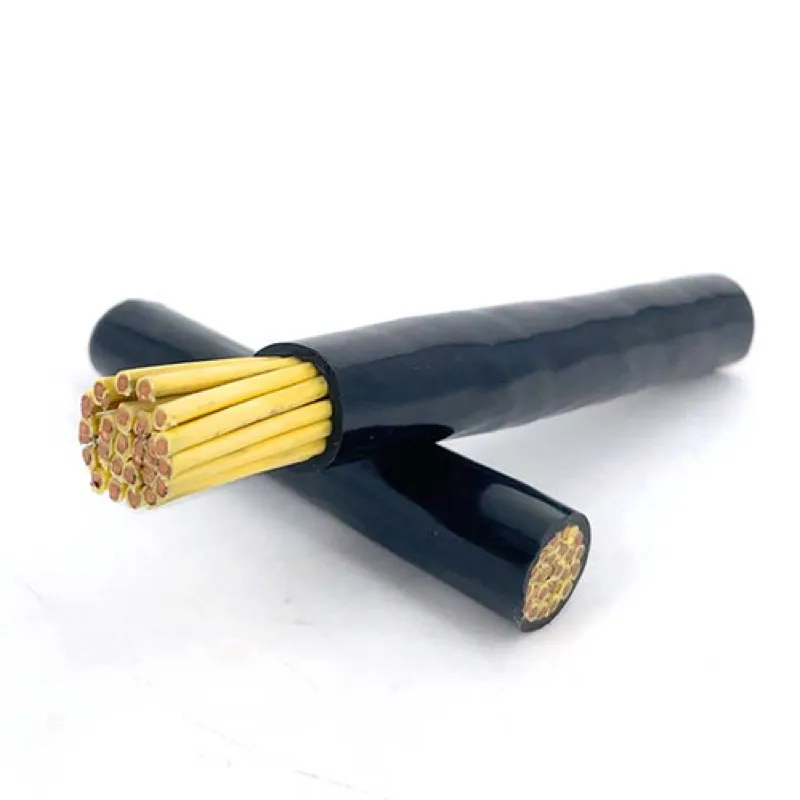
PVC control cable is the backbone of industrial automation, process control, and instrumentation systems worldwide. From a 7-core signal cable connecting PLCs in a packaging plant to a 61-core cable routing sensor data across an oil refinery, these cables carry the low-voltage control signals that keep modern facilities running.
If you're sourcing PVC control cables in bulk — whether for a single large project or ongoing supply — buying factory-direct from China offers significant cost advantages without compromising quality. Chinese manufacturers produce control cables to IEC 60227, BS 6500, and GB/T 9330 standards, supplying markets across Africa, the Middle East, Southeast Asia, and South America.
This guide covers everything a procurement engineer, EPC contractor, or distributor needs to evaluate before placing a bulk order: cable types, specifications, applicable standards, quality verification methods, and what to look for in a reliable Chinese supplier.
We manufacture PVC control cables at our factory in Henan, China — certified to IEC 60227, GB/T 9330, and BS 6500, with production capacity exceeding 500 km per month.
What Is PVC Control Cable?
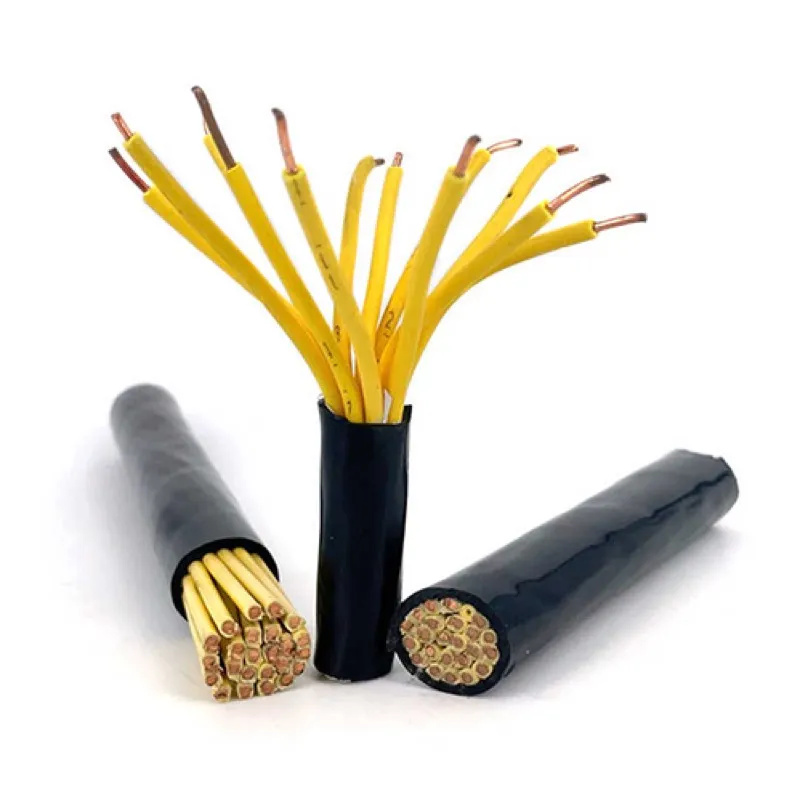
PVC control cable is a multi-conductor cable designed to transmit low-voltage control signals, measurement data, and relay commands between equipment in industrial and commercial installations. Unlike power cables that carry heavy load currents, control cables operate at signal-level voltages (typically 450/750V or 300/500V rated) and prioritize signal integrity, flexibility, and multi-core capacity over current-carrying ability.
Key characteristics that define control cables:
- Rated voltage: 300/500V or 450/750V — designed for control circuits, not power distribution
- Core count: Ranges from 2 cores to 61 cores (and beyond for special applications)
- Conductor size: Typically 0.75mm² to 10mm², with 1.5mm² and 2.5mm² being the most common
- Insulation: PVC (polyvinyl chloride) compound per IEC 60227 or equivalent
- Sheath: PVC outer jacket providing mechanical protection and moisture resistance
- Function: Signal transmission, relay control, instrument connections, and data communication in industrial environments
Control cables are not interchangeable with power cables. They are engineered for different electrical and mechanical requirements — lower voltage stress, higher core count in a compact diameter, and often enhanced screening against electromagnetic interference.
Types of PVC Control Cable
Understanding the different types available is critical for specifying the right cable for your application. Here's a breakdown of the main categories:
Unshielded Control Cable (KVV / CVV)
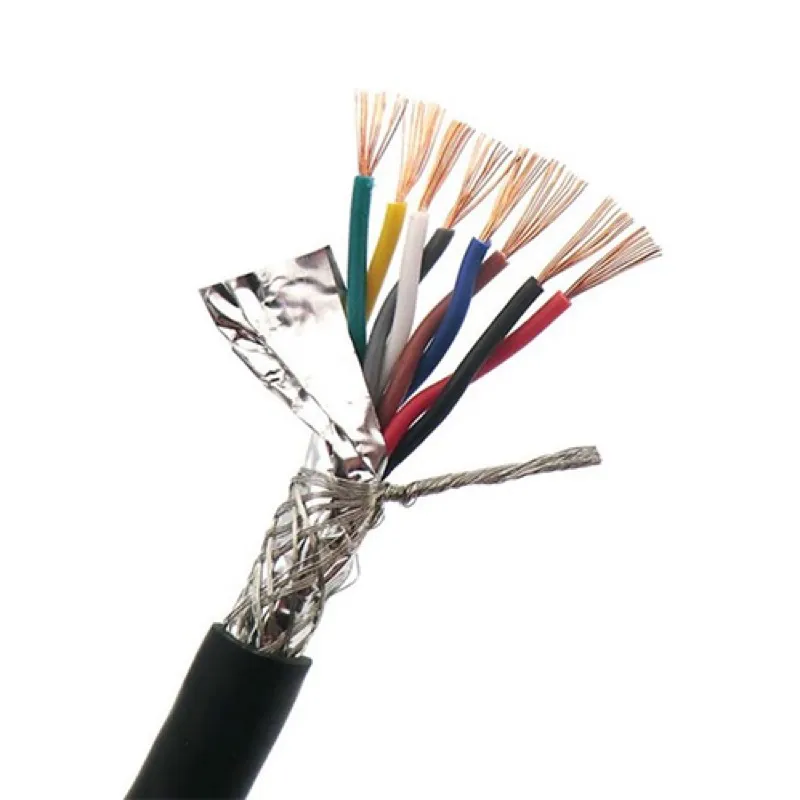
The most basic and widely used type. Multiple PVC-insulated copper conductors bundled together with a PVC outer sheath. Suitable for environments with low electromagnetic interference.
Designation: KVV (Chinese standard) / CVV (IEC designation)
Structure:
- Copper conductor (solid or stranded)
- PVC insulation on each core
- Overall PVC sheath (black or grey)
Best for: General industrial control, building automation, machinery connections in electrically quiet environments.
Shielded Control Cable (KVVP / CVV-S)
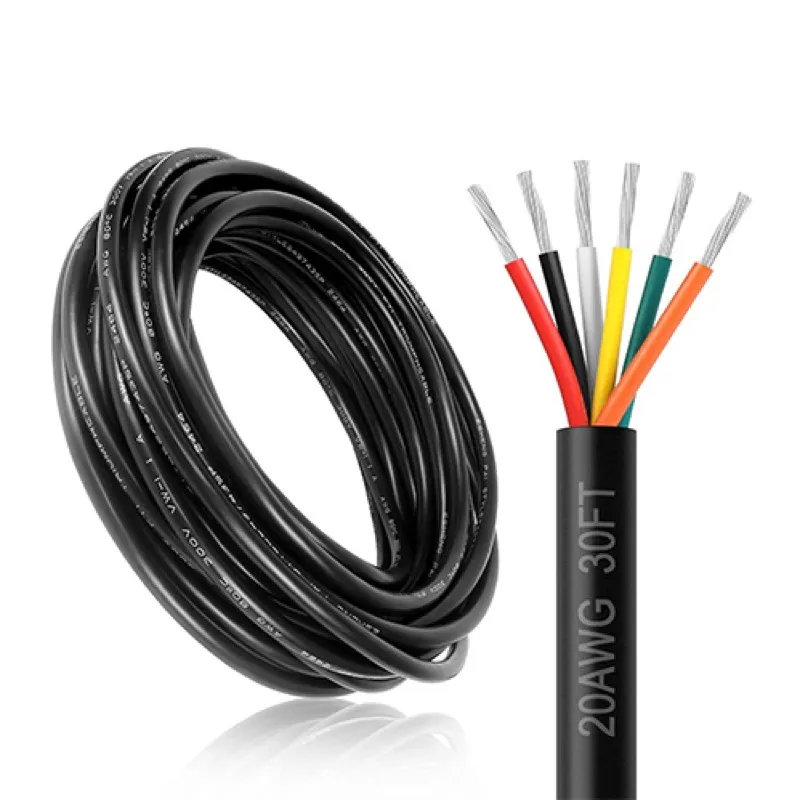
Adds a metallic screen (copper braid, copper tape, or aluminium-plastic composite) between the cable cores and the outer sheath. Essential for environments with variable frequency drives (VFDs), high-voltage switchgear, or other sources of electromagnetic interference.
Designation: KVVP (overall braid screen) / KVVP2 (overall copper tape screen)
Structure:
- Copper conductor
- PVC insulation
- Copper braid or tape screen (≥85% coverage for braid type)
- PVC outer sheath
Best for: Process instrumentation, DCS/PLC connections near VFDs, petrochemical plants, power stations.
Flexible Control Cable (KVVR / RVV)
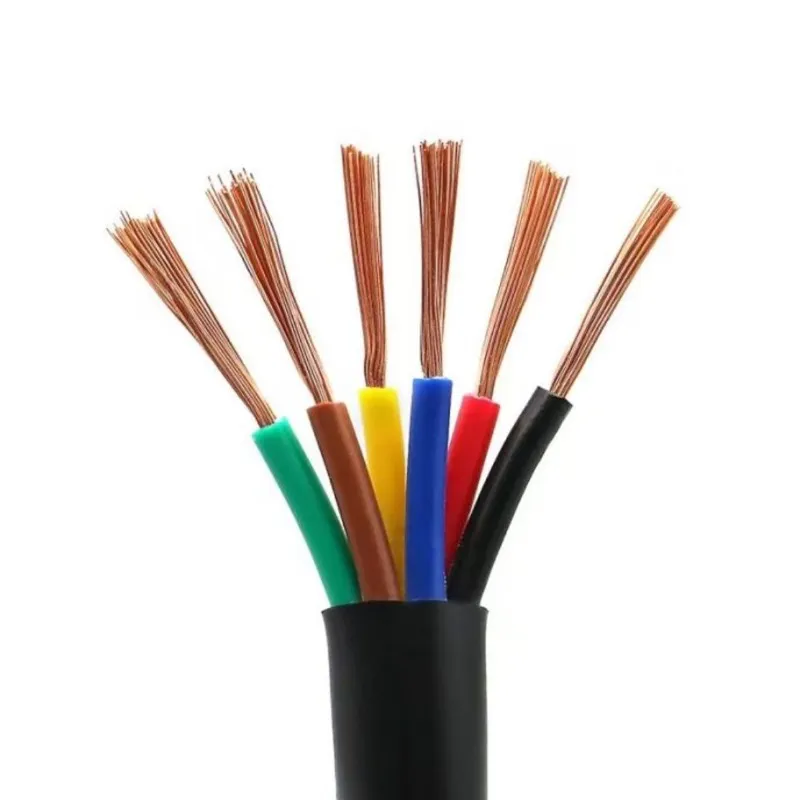
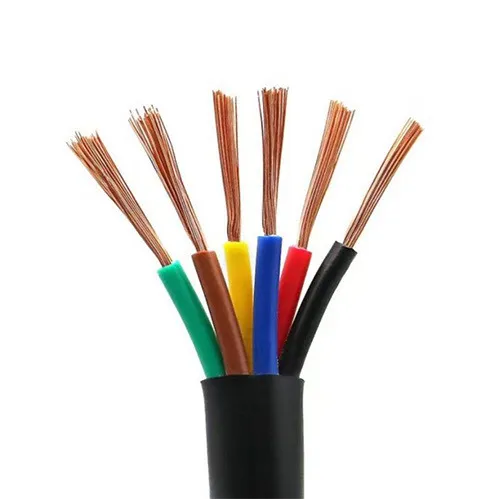
Uses fine-stranded (Class 5) conductors instead of solid or Class 2 stranded, giving the cable much higher flexibility. Required where cables must bend repeatedly or be installed in cable drag chains.
Designation: KVVR (flexible control) / RVV (general flexible)
Structure:
- Fine-stranded copper conductor (Class 5 per IEC 60228)
- PVC insulation
- PVC outer sheath
Best for: CNC machines, robotic cells, cable drag chains, portable equipment, connections requiring frequent re-routing.
Armoured Control Cable (KVV22 / KVVP22)
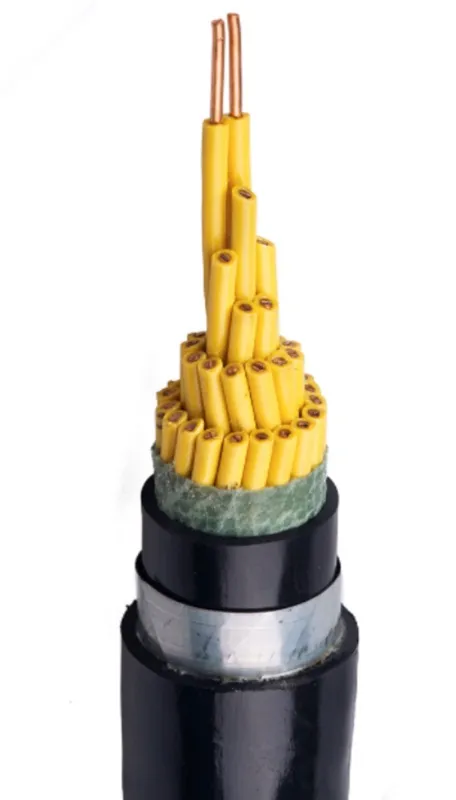
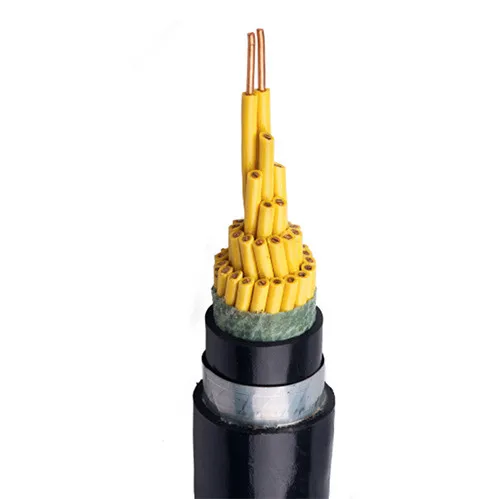
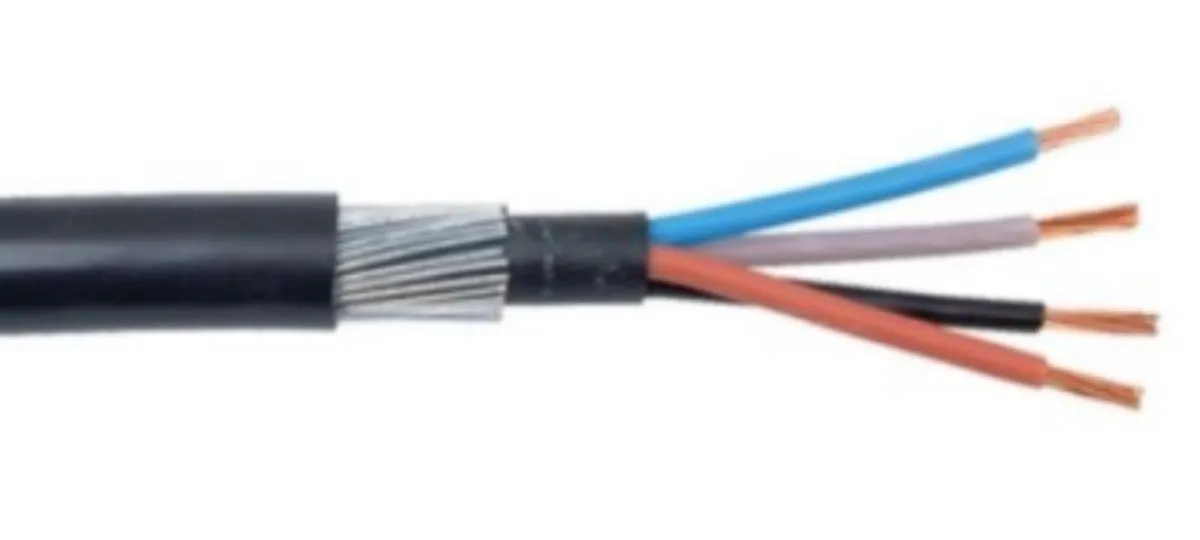
Includes steel tape armour (STA) or steel wire armour (SWA) for mechanical protection. Used for direct burial, outdoor installations, and areas where the cable is exposed to impact or crushing forces.
Designation: KVV22 (steel tape armour) / KVV32 (steel wire armour)
Structure:
- Copper conductor
- PVC insulation
- Inner sheath (PVC bedding)
- Steel tape or steel wire armour
- PVC outer sheath
Best for: Direct burial, cable trenches, outdoor installations, areas with vehicle traffic or construction activity.
Fire-Resistant Control Cable (NH-KVV)
Incorporates a mica tape layer around each conductor or around the cable core assembly, maintaining circuit integrity for 90–180 minutes during fire conditions per IEC 60331.
Designation: NH-KVV (fire-resistant) / ZR-KVV (flame-retardant only)
Best for: Fire alarm systems, emergency shutdown circuits, power plant critical controls, tunnel installations.
Complete Specifications Table
The following table covers standard PVC control cable specifications per GB/T 9330 and IEC 60227. These represent our standard production range — custom specifications are available on request.
Core Count and Conductor Sizes
| Core Count | Available Conductor Sizes (mm²) | Typical Application |
|---|---|---|
| 2 | 0.75, 1.0, 1.5, 2.5, 4.0, 6.0 | Simple on/off control, sensors |
| 3 | 0.75, 1.0, 1.5, 2.5, 4.0, 6.0 | 3-phase control, motor control |
| 4 | 0.75, 1.0, 1.5, 2.5, 4.0, 6.0 | Instrumentation, 4-20mA loops |
| 5 | 0.75, 1.0, 1.5, 2.5, 4.0 | Multi-signal control panels |
| 7 | 0.75, 1.0, 1.5, 2.5 | PLC I/O connections |
| 8 | 0.75, 1.0, 1.5, 2.5 | Building management systems |
| 10 | 0.75, 1.0, 1.5, 2.5 | Industrial automation |
| 12 | 0.75, 1.0, 1.5, 2.5 | Process control |
| 14 | 0.75, 1.0, 1.5, 2.5 | DCS systems |
| 16 | 0.75, 1.0, 1.5, 2.5 | Substation secondary wiring |
| 19 | 0.75, 1.0, 1.5, 2.5 | Complex control panels |
| 24 | 0.75, 1.0, 1.5 | Relay protection circuits |
| 30 | 0.75, 1.0, 1.5 | Large automation projects |
| 37 | 0.75, 1.0, 1.5 | Multi-zone process control |
| 44 | 0.75, 1.0, 1.5 | Refinery/petrochemical |
| 48 | 0.75, 1.0, 1.5 | Large-scale DCS |
| 61 | 0.75, 1.0, 1.5 | Maximum density trunk cables |
Electrical and Physical Properties
| Parameter | Value |
|---|---|
| Rated voltage | 450/750V (standard) / 300/500V (light duty) |
| Test voltage | 2500V AC for 5 minutes (450/750V rated) |
| Insulation resistance | ≥100 MΩ·km at 20°C |
| Conductor resistance (1.5mm²) | ≤12.1 Ω/km at 20°C (Class 1) |
| Conductor resistance (2.5mm²) | ≤7.41 Ω/km at 20°C (Class 1) |
| Operating temperature | -10°C to +70°C |
| Maximum conductor temperature | 70°C (continuous), 160°C (short circuit, 5s) |
| Minimum bending radius | 6× overall diameter (fixed), 10× (flexible type) |
| Flame retardancy | IEC 60332-1 (single cable), IEC 60332-3 Cat C (bundled) |
Approximate Outer Diameters
| Type | 4×1.5mm² | 7×1.5mm² | 12×1.5mm² | 19×1.5mm² | 37×1.5mm² |
|---|---|---|---|---|---|
| KVV (unshielded) | 9.5mm | 12.0mm | 14.5mm | 17.0mm | 22.5mm |
| KVVP (braid shielded) | 11.0mm | 13.5mm | 16.0mm | 18.5mm | 24.5mm |
| KVV22 (armoured) | 13.0mm | 15.5mm | 18.0mm | 21.0mm | 27.0mm |
Note: Dimensions are approximate and vary by manufacturer. Contact us for exact dimensions per your specification.
Applicable Standards
PVC control cables must comply with recognized international or national standards. The most commonly referenced:
IEC 60227 — PVC Insulated Cables of Rated Voltages up to 450/750V
The primary international standard governing PVC-insulated cables. Part 1 covers general requirements; Part 5 covers flexible cables. This is the standard most international buyers specify.
Key requirements:
- Conductor classes per IEC 60228
- PVC compound grades (TI 1–TI 4 for insulation, TM 1–TM 4 for sheath)
- Ageing tests (7 days at 100°C)
- Cold bend and cold impact tests
BS 6500 / BS 7917 — British Standards
BS 6500 covers general PVC cables; BS 7917 specifically addresses multi-core control cables for industrial use. Commonly specified for projects in the UK, Africa, and Middle East markets that follow British engineering practice.
GB/T 9330 — Chinese National Standard
China's standard for PVC insulated control cables, technically equivalent to IEC 60227 with some additional provisions. All cables exported from China are manufactured to this standard as a baseline, with additional compliance to IEC/BS as required by the buyer.
Other Regional Standards
- AS/NZS 5000 — Australia/New Zealand
- UL 2587 / UL 1277 — North America (tray cable)
- SANS 1507 — South Africa
When placing a bulk order, always specify which standard your project requires. A reliable manufacturer can produce to any of the above — but the standard must be clearly stated in your purchase order to ensure correct material selection and testing.
Applications
PVC control cables serve virtually every industry where automation, process control, or instrumentation is involved:
Industrial Automation and Manufacturing
- PLC input/output connections
- Motor control center (MCC) wiring
- Conveyor system controls
- CNC machine tool connections
- Robotic cell signal cables
- Packaging line automation
Power Generation and Distribution
- Substation secondary wiring
- Relay protection circuits
- Generator control panels
- Transformer monitoring systems
- Battery management systems
- SCADA communication cables
Oil, Gas, and Petrochemical
- DCS (Distributed Control System) cabling
- Instrument loops (4-20mA, HART protocol)
- Emergency shutdown (ESD) circuits
- Fire and gas detection systems
- Compressor and pump control
Building and Infrastructure
- BMS (Building Management System) wiring
- HVAC control circuits
- Elevator control cables
- Fire alarm system wiring
- Access control and security systems
- Lighting control circuits
Water Treatment and Mining
- Pump station control
- Valve actuator connections
- Level and flow instrument cables
- Ventilation control in mines
- Crusher and conveyor automation
Why Bulk Order PVC Control Cable from China?
China produces over 50% of the world's wire and cable. For international buyers placing bulk orders, the advantages are substantial:
Factory-Direct Pricing
Chinese cable manufacturers operate with lower overhead than distributors or trading companies. When you buy directly from the factory, you eliminate 2–3 layers of markup. For bulk orders (typically 10+ km per specification), the savings compared to local distributors in your market can be 30–50%.
Production Capacity and Lead Time
Large Chinese cable factories run 24/7 with dedicated production lines for control cables. A typical factory can produce 50–100 km of control cable per day. This means even large project orders (100+ km total) can be fulfilled within 2–4 weeks of confirmed order — faster than many regional manufacturers who need to schedule your job between other products.
Full Customization
Chinese manufacturers are accustomed to producing cables to multiple international standards and custom specifications:
- Custom print marking (your company name, project name, meter marking)
- Non-standard core counts
- Special sheath colors (grey, black, blue, white — or project-specific)
- Mixed conductor sizes within one cable
- Special flame retardancy or fire resistance ratings
- Specific packaging requirements (drum sizes, coil lengths)
Quality Certification
Reputable Chinese cable manufacturers hold:
- ISO 9001 quality management
- ISO 14001 environmental management
- CCC (China Compulsory Certification)
- PCCC (Product Consistency Certification)
- Third-party test reports from internationally recognized labs (SGS, TÜV, BV, Intertek)
Logistics Experience
Established exporters handle all documentation (packing lists, commercial invoices, certificates of conformity, test reports) and have experience shipping cables worldwide via sea freight. Control cables are typically packed on wooden or steel drums, palletized, and loaded into containers — a standard process for any experienced cable exporter.
How to Choose the Right PVC Control Cable for Your Project
Selecting the correct control cable requires matching the cable's properties to your installation environment and electrical requirements:
Step 1: Define the Voltage Rating
Most control circuits operate at 24V DC, 110V AC, or 220V AC — well within the 450/750V rating of standard control cables. However, verify that your system voltage doesn't exceed the cable's rated voltage, including any voltage spikes.
Step 2: Determine Core Count
Count every signal that needs to travel along the same route. Add 10–20% spare cores for future expansion — it's far cheaper to install slightly larger cable now than to pull additional cables later.
Rule of thumb:
- Simple motor control: 4–7 cores
- PLC connections: 7–19 cores
- DCS trunk cables: 24–61 cores
Step 3: Select Conductor Size
For most control and signal applications, 1.5mm² is the standard choice. Use 2.5mm² for longer runs where voltage drop matters, or when the control circuit also carries a small load current (e.g., solenoid valves, small contactors).
| Run Length | Signal Only | Signal + Small Load |
|---|---|---|
| < 50m | 1.0mm² | 1.5mm² |
| 50–100m | 1.5mm² | 2.5mm² |
| 100–200m | 1.5mm² | 4.0mm² |
| > 200m | 2.5mm² | Calculate per load |
Step 4: Shielded or Unshielded?
Choose shielded (KVVP) when:
- Cable runs near VFDs (variable frequency drives)
- Parallel runs with power cables (especially >33kV)
- Analog signals (4-20mA, 0-10V) requiring accuracy
- Environments with radio frequency interference
- Any installation where EMC compliance is required
Unshielded (KVV) is acceptable when:
- Digital on/off signals only
- Short runs within a single control panel
- Isolated from power cables and interference sources
Step 5: Fixed or Flexible?
- Fixed installation (cable trays, conduits, direct burial): Standard KVV with Class 1 or Class 2 conductors
- Moving application (drag chains, robotic arms, hinged doors): Flexible KVVR with Class 5 conductors
Step 6: Environmental Considerations
| Condition | Cable Type |
|---|---|
| Indoor, dry | Standard KVV |
| Outdoor, direct burial | KVV22 (armoured) |
| Fire risk areas | NH-KVV (fire resistant) |
| Bundled cables in trays | ZR-KVV (flame retardant, IEC 60332-3) |
| Chemical exposure | Use LSZH or special PVC compounds |
| Wide temperature range | Verify compound rating |
Quality Inspection and Testing
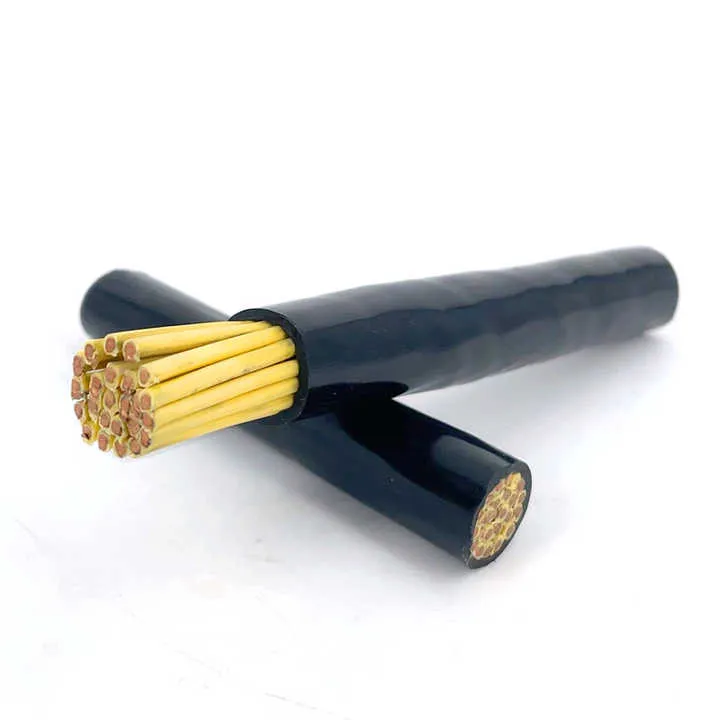
When bulk ordering control cables from any manufacturer — Chinese or otherwise — quality verification is non-negotiable. Here's what to check:
Routine Tests (Every Manufacturing Length)
These tests are performed on every drum produced:
- Conductor resistance test — Verifies conductor material purity and cross-section meets specification
- High voltage test — 2500V AC applied for 5 minutes between each core and between cores and screen/armour
- Insulation resistance — Must exceed 100 MΩ·km at 20°C
- Visual and dimensional check — Outer diameter, print marking, color coding, appearance
Type Tests (Periodic / On Request)
Performed on cable design qualification and periodically during production:
- Ageing test — PVC samples aged at 100°C for 168 hours (7 days); tensile strength and elongation measured before and after
- Cold bend test — Cable wound around mandrel at -15°C (or -25°C for cold-climate grades) without cracking
- Hot deformation — PVC pressed at 80°C to verify compound quality
- Flame retardancy — IEC 60332-1 (single cable) or IEC 60332-3 (bundled) burn test
- Fire resistance (if specified) — IEC 60331, cable maintains circuit integrity during fire
Third-Party Inspection Options
For large bulk orders, consider:
- Pre-shipment inspection (PSI): An independent inspector visits the factory, witnesses final testing, checks marking and packaging. Common agencies: SGS, BV, Intertek, TÜV.
- Production monitoring: Inspector present during key manufacturing stages (conductor drawing, insulation extrusion, final testing).
- Sample testing at independent lab: Pull random samples from production and send to a third-party lab in your country for verification.
What to Request from Your Supplier
Before placing your order, request:
- Factory test report template (so you know what data you'll receive)
- Copies of ISO 9001, CCC, and any relevant product certifications
- Reference projects or client list in your region
- Sample cable (most factories will send free samples for evaluation)
Packaging and Shipping for Bulk Orders
Proper packaging ensures your cables arrive undamaged after weeks of sea transport:
Standard Packaging Options
- Wooden drums: Standard for lengths 100m–2000m per drum. Drum size matched to cable diameter and quantity.
- Steel drums: For heavier cables (armoured types) or where reusable drums are preferred.
- Coils (shrink-wrapped): For smaller quantities or lighter cables (< 10mm OD), typically 100m per coil.
Container Loading
- 20' container: Typically holds 10–18 drums depending on drum size, approximately 8–12 tons of control cable
- 40' container: Typically holds 20–36 drums, approximately 16–25 tons
- Drums are secured with timber wedges and strapping to prevent movement during transit
Documentation Provided
Every shipment includes:
- Commercial invoice
- Packing list (with drum numbers, lengths, weights)
- Factory test report (one per drum or per batch)
- Certificate of conformity
- Material Safety Data Sheet (MSDS) if required
- Certificate of Origin (for customs duty purposes)
How to Place a Bulk Order: Step by Step
For buyers new to sourcing cables from China, here's the typical process:
1. Send Your Inquiry
Provide as much detail as possible:
- Cable type and standard required (e.g., "KVVP 12×1.5mm² per IEC 60227, copper braid shield")
- Quantity per specification (in meters or km)
- Delivery location (port or final destination)
- Required certifications or test reports
- Any special requirements (marking, colors, packaging)
2. Receive Quotation
We'll provide:
- Unit price per meter (FOB, CIF, or other Incoterms as requested)
- Lead time from order confirmation
- Technical specification sheet confirming compliance
- Payment terms
3. Confirm Order and Technical Details
Before production starts, we'll issue a Technical Specification Approval form covering every detail: conductor class, insulation thickness, color code, print marking text, drum size, and testing requirements. You approve this before manufacturing begins.
4. Production and Quality Control
Production begins. For orders over 50 km, we can arrange progress updates with photos at key stages. Pre-shipment inspection available if required.
5. Testing and Shipping
All cables tested per routine test requirements. Test reports issued per drum. Cables packed, loaded, and shipped with full documentation.
Frequently Asked Questions
What is the minimum order quantity for PVC control cables?
Our standard production runs are optimized for bulk orders. Contact us with your specific requirements — we work with projects ranging from a single container to ongoing annual supply agreements.
Can you produce to IEC, BS, and ASTM standards simultaneously?
Yes. Our factory produces to multiple international standards. Each order is manufactured to the specific standard stated in the purchase order. We hold reference copies of all major cable standards and our QC team is trained on the differences between them.
How do I verify the copper content meets specification?
Every production batch is tested for conductor resistance per IEC 60228. Conductor resistance is the definitive test — it confirms both cross-sectional area and copper purity. Values must be at or below the maximum stated in the standard. We provide measured resistance values in our test reports.
What is the difference between KVV and KVVR?
KVV uses solid (Class 1) or standard stranded (Class 2) conductors — suitable for fixed installation. KVVR uses fine-stranded (Class 5) conductors — designed for applications requiring flexibility, such as drag chains, machine tool connections, and portable equipment.
Can you produce custom print marking on the cable?
Yes. We can print your company name, project name, cable type designation, meter marking, year of manufacture, and standard reference directly on the outer sheath. Custom marking is standard for bulk orders at no additional cost.
What shielding coverage do you offer?
- Copper braid shield: 85% minimum coverage (standard), 95%+ available on request
- Copper tape shield: Overlapped copper tape, 100% coverage
- Aluminium-plastic composite tape: Bonded to sheath, 100% coverage
- Individual + overall shield: Each pair/triple individually screened, plus an overall screen for maximum EMI protection
Do you provide cable samples before ordering?
Yes. We provide free cable samples (typically 1–2 meter lengths) for your evaluation. Samples can be shipped via DHL/FedEx within 3–5 days.
What payment terms do you accept?
We work with standard international trade payment terms. Specific arrangements are confirmed during the quotation and order negotiation process.
Can control cables be installed directly in the ground?
Only armoured types (KVV22, KVV32) are suitable for direct burial. Unshielded and shielded types (KVV, KVVP) must be installed in conduit or cable trays when used outdoors or underground.
What is the standard length per drum?
Standard lengths are 100m, 200m, 500m, and 1000m per drum. Custom lengths are available — for bulk orders, we can produce continuous lengths up to 2000m on large drums to minimize joints in your installation.
Why Choose China Cable Factory?
- Dedicated control cable production lines — not a sideline product mixed into power cable production
- Full testing laboratory — high voltage test, insulation resistance, conductor resistance, flame test, ageing oven
- Export experience — shipping cables to 30+ countries across Africa, Middle East, Southeast Asia, and South America
- Technical support — English-speaking engineers who can help you specify the right cable for your application
- Flexible production — from 1 container to annual supply contracts, we scale to your needs
Get a Quote for Your Bulk Order
Ready to source PVC control cables? Send us your cable schedule and we'll provide a competitive quotation within 24 hours:
- Email: sales@chinacablefactory.com
- WhatsApp: Contact us directly
- Online form: Request a Quote
Include your cable specifications, quantities, delivery port, and any special requirements. The more detail you provide, the more accurate our quotation will be.
Related articles: