Key Takeaway
Single-core vs twin-core solar cable (PV1-F / H1Z2Z2-K): construction, current ratings, install speed and when to use each on rooftop and ground-mount PV.
Once you have sized your solar DC cable, one decision remains: run two separate single-core cables, or one twin-core cable that carries the positive and negative in a single flat run. It looks like a small choice, but it changes installation time, cable management, cost, and how the array behaves in the field. Get it right and a rooftop crew wires faster with fewer errors. Get it wrong and you are fighting cable trays, mismatched runs, or unnecessary labour on every string.
This guide compares single-core and twin-core PV1-F / H1Z2Z2-K solar cable head to head — construction, current ratings, installation, and the real-world reasons to pick one over the other on projects across Southeast Asia, Africa, and the Middle East. Every specification below comes from the published data for the cable we manufacture to EN 50618 and IEC 62930; where sizing maths matters, it follows the same method set out in our solar DC cable sizing guide.
We manufacture both configurations at our factory in Henan, China — single-core PV1-F in 2.5–16mm² and twin-core in 2×4mm² and 2×6mm², all TÜV and EN 50618 certified with tinned copper conductors.
Single-Core and Twin-Core Solar Cable: The Short Answer
Both are the same fundamental cable — cross-linked, halogen-free XLPO insulation, tinned copper conductor, 1.5kV DC rated, built for 25 years of UV exposure. The difference is purely how the conductors are packaged:
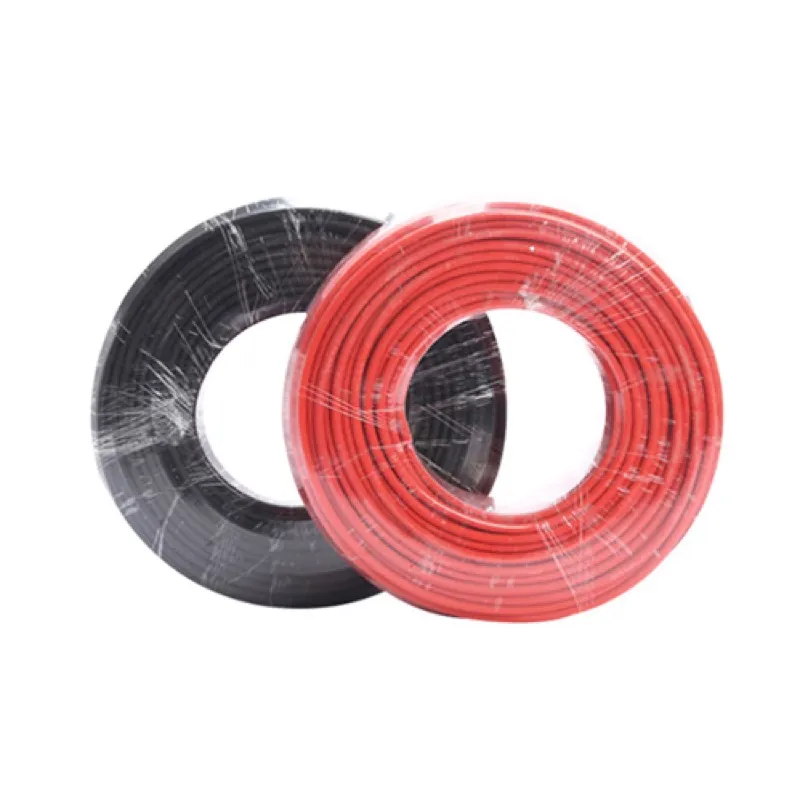
- Single-core is one insulated conductor per cable. You run two of them — one red (positive), one black (negative) — for a DC circuit. This is the default for module-to-module links and most string wiring.
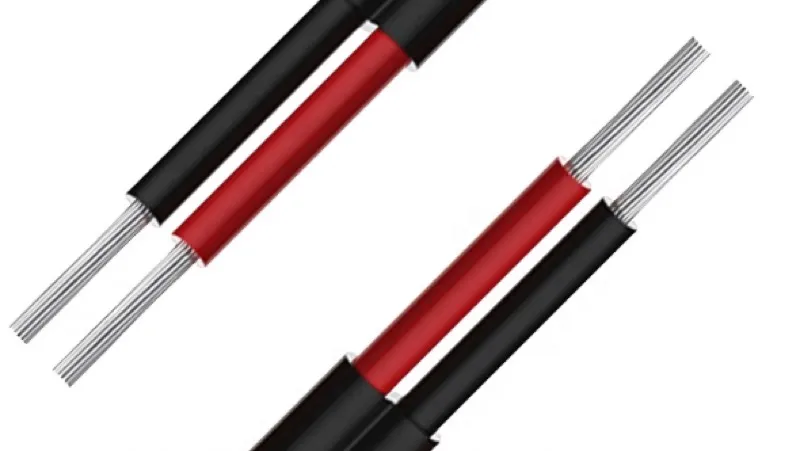
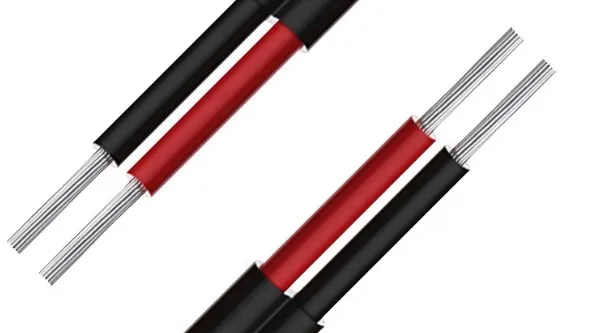
- Twin-core bonds two independently insulated cores, red and black, side by side in one flat cable. You pull one cable and get both polarities, which cuts handling and clipping in half on the runs where it fits.
Neither is "better" in the abstract. The right choice depends on where in the system the cable runs and how the installation is managed, which is what the rest of this guide unpacks.
Side-by-Side Comparison
| Factor | Single-Core PV1-F | Twin-Core Solar Cable |
|---|---|---|
| Construction | One insulated conductor per cable | Two insulated cores (red + black) bonded flat |
| Cables to run per circuit | Two (one red, one black) | One |
| Available sizes | 2.5, 4, 6, 10, 16mm² | 2×4mm², 2×6mm² |
| Insulation | XLPO, double, per core | XLPO, double, per core (identical) |
| Voltage rating | 1.0/1.5kV DC per conductor | 1.0/1.5kV DC per conductor |
| Conductor | Class 5 tinned copper | Class 5 tinned copper |
| Installation speed | Slower — two pulls, twice the clipping | Faster — one pull, half the clips |
| Cable management | Two cables to route and tie | One flat cable, tidy routing |
| Flexibility for tight bends | Higher (independent cores) | Slightly lower (bonded web) |
| Polarity errors | Possible if red/black mixed up | Reduced — colours fixed side by side |
| Best for | Module-to-module, combiner strings, large sizes | String home-runs, rooftop trunk, carports |
The table makes the trade clear: single-core gives you flexibility and the full size range up to 16mm²; twin-core gives you speed and tidiness on the runs where both polarities travel together.
Construction: What Is Actually Inside Each
Both configurations start from the identical PV1-F / H1Z2Z2-K core: a Class 5 stranded tinned copper conductor, wrapped in 0.7mm + 0.7mm double cross-linked polyolefin (XLPO) insulation, rated 1.0/1.5kV DC and formulated for 25-year UV and weather life. The tinning matters in humid and coastal markets — bare copper oxidises at MC4 contacts and resistance climbs over the decades; tinned copper does not.
The single-core cable is that core, finished as a standalone round cable. The twin-core cable takes two of those cores — one with a red sheath, one with black — and bonds them side by side along a thin central web, producing a flat figure-8 profile. Critically, each core in a twin-core cable retains its own full double insulation. The twin construction is not two conductors sharing one jacket; it is two fully compliant PV1-F cables joined for handling convenience. That is why twin-core meets the same EN 50618 requirements as single-core.
When to Use Single-Core Solar Cable
Single-core is the workhorse of PV wiring, and for good reason. Choose it when:
- Module-to-module links. The short jumpers between panels in a string are almost always single-core — the panels ship with single-core leads and MC4 connectors, and you match them.
- You need sizes above 6mm². Twin-core is made in 2×4mm² and 2×6mm² only. Any run that sizes up to 10mm² or 16mm² on voltage-drop grounds — common on long ground-mount trunk runs — must be single-core.
- Positive and negative take different routes. On some layouts the two polarities do not run together the whole way. Single-core lets each conductor take its own path.
- Tight bends and dense combiner boxes. Independent cores flex more freely into tight radii and terminate more easily where space is cramped.
- Ground-mount farms with large cross-sections. The trunk runs that push into 10–16mm² are single-core territory by size alone.
For most utility-scale and larger commercial projects, single-core dominates simply because the sizes needed exceed what twin-core offers.
When to Use Twin-Core Solar Cable
Twin-core earns its place where both polarities travel together and installation speed matters. Choose it when:
- String home-runs on rooftops. The run from the end of a string back to the inverter or combiner carries both polarities the same way — one flat cable instead of two saves clipping and looks tidier.
- Cable tray or conduit space is limited. One flat cable occupies less tray width and fewer cable ties than two rounds. On dense commercial rooftops this adds up.
- Labour cost is the constraint. Pulling one cable instead of two halves the handling on those runs. On large rooftop portfolios where crews repeat the same wiring hundreds of times, the labour saving is real.
- Carports, canopies, and residential systems. Neat, visible cable runs benefit from the tidy flat profile, and the fixed red/black pairing reduces polarity mistakes.
- You want fewer polarity errors. With red and black bonded side by side, a crew cannot accidentally run two blacks or cross a string — the colours are locked in the cable.
The ceiling on twin-core is size: at 2×6mm² maximum, it suits string and shorter trunk runs, not the long high-current trunks that need 10–16mm².
Current Ratings & Specifications
The current ratings below let you compare the two configurations directly, 1.5kV DC, tinned copper. For the full single-core table — with conductor stranding, OD, weight, and resistance values for voltage-drop calculation — plus how to apply temperature and grouping derating, see our solar DC cable sizing guide.
Single-core PV1-F:
| Section (mm²) | Current Rating (A) |
|---|---|
| 2.5 | 36 |
| 4 | 46 |
| 6 | 58 |
| 10 | 79 |
| 16 | 105 |
Twin-core solar cable:
| Configuration | Conductor Stranding | Overall Dimensions (mm) | Weight (kg/km) | Current Rating (A) |
|---|---|---|---|---|
| 2×4mm² | 56×0.31mm | 6.1×12.2 | 120 | 46 |
| 2×6mm² | 84×0.31mm | 6.8×13.6 | 160 | 58 |
Note the current ratings match the single-core equivalents — a 2×4mm² twin-core carries the same 46A per core as a single 4mm², because each core is an identical PV1-F conductor. The choice between them is about installation and layout, not ampacity.
Installation: Labour Time and Cable Management
The strongest case for twin-core is labour, and it is worth quantifying honestly. On a run where both polarities travel together, twin-core replaces two separate pulls with one, and roughly halves the number of clips, cleats, and cable ties. On a single rooftop that is minutes. Across a portfolio of hundreds of rooftops wired by the same crews, it compounds into meaningful labour and material savings — fewer fixings to buy, fewer operations to repeat, fewer chances to mis-route.
Twin-core also tidies cable management. A single flat cable sits neatly in a tray or along a rail, occupies less width, and presents a cleaner finish on visible runs like carports. For DC circuits it also enforces polarity discipline: red and black are fixed side by side, so a crew cannot accidentally pull two negatives or cross a string.
Single-core wins on flexibility. Two independent cores route around obstacles more freely, bend into tighter radii at combiner boxes, and let positive and negative diverge when the layout demands it. And for anything above 6mm², single-core is the only option.
The practical rule most EPC crews settle on: single-core for module interconnection and large trunk runs; twin-core for string home-runs and rooftop wiring where both polarities travel together and speed matters.
Choosing Configuration in Southeast Asia, Africa & the Middle East
The configuration choice interacts with the field realities of these three markets:
- Labour-intensive rooftop rollouts. Fast-growing commercial and residential solar across Southeast Asia and Africa is often wired by large crews under time pressure. Twin-core's faster installation directly cuts labour cost on repetitive rooftop work.
- Utility-scale desert farms. The large ground-mount projects across the Middle East and North Africa run long, high-current trunks that size up to 10–16mm² — single-core territory. Twin-core still has a role in the string wiring feeding those trunks.
- Heat and UV apply to both. Whichever configuration you choose, the 25-year UV-rated XLPO sheath and +90°C conductor rating are non-negotiable in these climates, and both single-core and twin-core carry them identically.
- Humidity and salt on the coast. In coastal Indonesia, the Philippines, Vietnam, and West Africa, tinned copper is what protects terminations from oxidation. Both configurations we supply use tinned copper for exactly this reason.
The sensible pattern for these markets: twin-core to speed up rooftop and string wiring, single-core for the large trunk runs and module links — specified together on the same project.
Common Mistakes When Choosing Configuration
- Specifying twin-core for large trunk runs. Twin-core tops out at 2×6mm². A long trunk that needs 10 or 16mm² on voltage-drop grounds cannot use it — size the run first, then choose configuration.
- Assuming twin-core carries less current. It does not. Each core is a full PV1-F conductor; 2×4mm² carries the same 46A as single 4mm². Ampacity is identical.
- Using twin-core where cores must diverge. If positive and negative take different routes, a bonded twin cable fights the layout. Use single-core.
- Ignoring the labour saving on repetitive rooftop work. On large rooftop portfolios, defaulting to two single-cores everywhere leaves real labour and fixing savings on the table.
- Mixing standards between the two. Whichever you choose, confirm both are EN 50618 / IEC 62930 certified with tinned copper — do not let a cheaper twin-core slip in without the same qualification.
Standards Both Configurations Meet
Single-core and twin-core PV1-F from our factory are manufactured and certified to the same standards:
- EN 50618 — the European harmonised standard for photovoltaic cables, defining the H1Z2Z2-K designation, 1.5kV DC rating, and 25-year life requirement.
- IEC 62930 — the international standard for PV system cables, rated 1.5kV DC.
- TÜV 2 PfG 1169/08.2007 — the TÜV test specification widely referenced in tenders across our target markets.
- GB/T 32129 — the Chinese national standard for photovoltaic cable.
- UL 4703 — PV Wire standard for North American projects, available on request for single-core.
Each core of the twin-core cable meets these standards independently — the twin construction does not dilute compliance. Ask for the TÜV certificate and test report with any order; they should come with every shipment.
How to Specify When You Order
Give your supplier these points and you will get the right configuration and an accurate quote:
- Configuration — single-core, or twin-core flat (state which runs each is for)
- Cross-section — 2.5–16mm² single-core; 2×4mm² or 2×6mm² twin-core (from your voltage-drop calculation)
- Voltage rating — 1.5kV DC for utility strings; confirm your system voltage
- Colour — red (positive) and black (negative); both configurations colour-coded
- Standard/certification — EN 50618 / IEC 62930 / TÜV, plus UL 4703 if shipping to North America
- Total length per type and colour — for accurate drum planning and freight
For pricing, request a quote — solar cable pricing tracks the copper market and moves with order volume, so a current quotation against your bill of materials is more accurate than any published figure. For wholesale and bulk orders — distributors stocking both configurations, or EPC contractors buying for a full project — volume pricing and mixed drums of single-core and twin-core can be quoted together on one order direct from our China factory.
Cost: Cable Price vs Total Installed Cost
Buyers often compare the two configurations on cable price alone, which misses the point. Per metre of conductor, single-core and twin-core are close — twin-core is essentially two single cores plus the bonding web, so the raw material content is similar and both track the copper market the same way. The real difference shows up in total installed cost, which is where twin-core makes its case.
On a run where both polarities travel together, twin-core removes one full cable pull and roughly half the fixings — clips, cleats, and cable ties — plus the labour to install them. On a single string that is marginal. Across a commercial rooftop with dozens of strings, or a portfolio of rooftops wired by the same crews, the labour and fixing savings accumulate into a number that outweighs any small difference in cable price. That is why installers who wire high volumes of rooftop and residential systems lean toward twin-core for home-runs.
The counter-case is size and flexibility. Because twin-core stops at 2×6mm², any project dominated by long high-current trunk runs will buy mostly single-core regardless, and the installed-cost argument for twin-core applies only to the string-level wiring. The honest conclusion: do not choose on cable price per metre. Choose on where the cable runs, then let the installed cost — labour plus fixings plus material — decide. For most projects that means both configurations on the same bill of materials, each used where it is cheapest to install.
Frequently Asked Questions
What is the difference between single-core and twin-core solar cable?
Single-core solar cable is one insulated conductor per cable — you run two (red and black) for a DC circuit. Twin-core bonds two independently insulated cores side by side in one flat cable, so a single pull carries both polarities. Both use identical PV1-F / H1Z2Z2-K construction; the difference is installation convenience and available sizes, not electrical performance.
Does twin-core solar cable carry less current than single-core?
No. Each core of a twin-core cable is a full PV1-F conductor, so a 2×4mm² carries the same 46A per core as a single 4mm², and 2×6mm² matches single 6mm² at 58A. Current rating is identical — apply the same temperature and grouping derating to both.
When should I use twin-core instead of two single-core cables?
Use twin-core on runs where positive and negative travel together — string home-runs, rooftop trunk lines, carports, and residential systems — where one flat cable saves clipping, tidies routing, and reduces polarity errors. Use single-core for module-to-module links, runs where the polarities diverge, and any size above 6mm².
What sizes does twin-core solar cable come in?
Twin-core is manufactured in 2×4mm² and 2×6mm². If your voltage-drop calculation calls for 10mm² or 16mm² — common on long ground-mount trunk runs — you need single-core, which is available up to 16mm².
Can I split twin-core solar cable at the terminations?
Yes. The flat cable splits along the central web at junction and combiner boxes, and each core then terminates independently into MC4 connectors or terminal blocks. Each core is fully double-insulated, so splitting the web does not compromise it.
Is twin-core solar cable code-compliant?
Yes. Each core meets the full PV1-F / EN 50618 requirements independently — double insulation, UV resistance, and 1.5kV DC rating. The twin configuration is simply two compliant cables joined at a central web for installation convenience.
Get a Quote on Single-Core & Twin-Core Solar Cable
We manufacture PV1-F / H1Z2Z2-K solar cable in both configurations — single-core 2.5–16mm² and twin-core 2×4mm² / 2×6mm² — TÜV and EN 50618 certified, with tinned copper conductors and 25-year UV-rated XLPO insulation. We supply solar EPC contractors, distributors, and developers across Southeast Asia, Africa, and the Middle East.
Send us your bill of materials — configuration, cross-section, length per colour, and destination — and we will return a current quotation with certificates. Contact us for a quote or explore the full PV1-F solar cable specifications and twin-core solar cable options. For sizing help, start with our solar DC cable sizing guide, see the wider cables for solar & renewable energy projects guide for system-level selection, and when you are ready to buy, our solar cable manufacturer sourcing guide covers sourcing PV1-F factory direct from China.